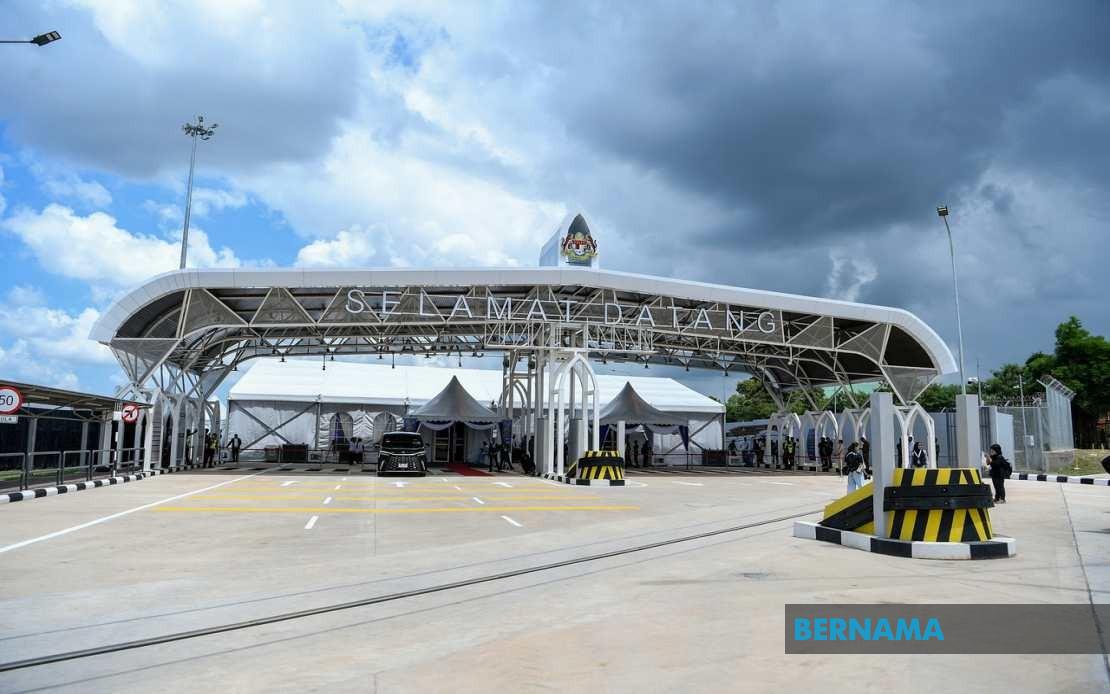
The recently inaugurated Bukit Kayu Hitam-Sadao border complex is demonstrating substantial operational benefits after just one month of service, reshaping the efficiency of trade corridors between Malaysia and Thailand. The 900-metre route, which formally commenced operations on July 11 after being jointly opened by Thai Prime Minister Anutin Charnvirakul and Malaysian Prime Minister Datuk Seri Anwar Ibrahim on July 10, has emerged as a transformative infrastructure project for the region's logistics ecosystem.
The crossing directly links the Bukit Kayu Hitam Immigration, Customs, Quarantine and Security Complex in Kedah with the Sadao Customs, Immigration and Quarantine facility on the Thai side. According to Sadao Customs director Buntoon Oucharoen, the shift towards the new route has been nearly universal, with nearly all commercial vehicles—lorries, buses and vans—now utilising the dedicated pathway. This modal shift represents a dramatic reduction in congestion on the older crossing points, fundamentally altering traffic patterns in this critical trade corridor.
The backbone of this success lies in technological integration. The complex features advanced X-ray scanning equipment branded as "Fast Scan," which has revolutionised container inspection procedures. Previously, the scanning process consumed approximately five minutes per vehicle; the new system compresses this to under one minute. This tenfold acceleration in processing time directly translates into reduced queue lengths and faster clearance cycles. The deployment of digital cargo information systems further streamlines operations by enabling real-time database verification, eliminating the need for extended vehicle queueing while documentation is manually processed. Together, these modernisations create a frictionless inspection environment that maintains security standards while maximising throughput.
The magnitude of traffic flowing through the facility underscores its regional significance. Daily movements now exceed 1,000 logistics vehicles traversing the route, a figure that reflects both the pent-up demand for efficient cross-border solutions and the commercial competitiveness of the new corridor. This volume surge immediately demonstrates that Malaysian and Thai exporters have responded positively to operational improvements, shifting their routing decisions to capture time and cost savings.
Trade statistics from the initial three weeks of operation illustrate the economic multiplier effect. For the period spanning July 11 to 31, import values surged to 19 billion baht (RM2.35 billion), substantially exceeding the 12 billion baht (RM1.48 billion) recorded during the equivalent month-long window in 2023. Export figures similarly expanded, climbing from 13 billion baht (RM1.61 billion) to more than 24 billion baht (RM2.97 billion). These increases—approximately 58 per cent for imports and 85 per cent for exports—suggest that improved border processing efficiency is not merely facilitating existing trade but actively encouraging commerce expansion.
Beyond logistics, the infrastructure expansion carries significant tourism implications. The new route incorporates 11 inbound and 11 outbound vehicular lanes, creating capacity for passenger movement that was previously constrained. The Hatyai-Songkhla Hotel Association has welcomed this enhancement, particularly noting the facilitation of tourist flows during peak travel periods including weekends and public holidays. For Southern Thailand's hospitality sector, improved access from Malaysia represents a competitive advantage in attracting the large and affluent Malaysian visitor base.
The context of Malaysia-Thailand bilateral relations adds strategic dimension to this project. The two nations' trade relationship for the January-to-March 2026 period totalled RM31.33 billion (US$7.90 billion), compared with RM27.35 billion (US$6.15 billion) during the same three-month window in 2025. This growth trajectory reflects structural economic deepening across multiple sectors. Both governments have established an ambitious target of achieving US$30 billion (RM122.6 billion) in bilateral trade by 2027, a figure that hinges upon sustained improvements in logistics infrastructure and cross-border facilitation.
The significance of this infrastructure milestone becomes more pronounced when viewed against the backdrop of Malaysia-Thailand commemorating 70 years of diplomatic relations in the coming year. The border crossing renovation represents a modern embodiment of bilateral commitment, translating diplomatic partnerships into tangible commercial benefits for both economies. The project demonstrates how coordinated infrastructure investment can unlock latent demand in mature trading relationships.
For Malaysian stakeholders, particularly those operating in logistics, automotive components, agricultural products and manufactured goods, the improved access to Thai markets and the broader ASEAN region carries competitive advantages. Reduced border crossing times directly lower supply chain costs, enhance inventory turnover and improve delivery reliability—factors increasingly critical as regional supply chains respond to evolving global economic patterns. The integration of digital systems also creates standardisation benefits that could eventually extend to other regional border crossings as best practices disseminate.
Looking forward, the Bukit Kayu Hitam-Sadao route exemplifies how targeted infrastructure modernisation can address structural constraints limiting regional trade integration. The facility's success in its inaugural month suggests that similar approaches to cross-border infrastructure—emphasising technological sophistication, streamlined procedures and capacity expansion—could yield comparable benefits across other ASEAN land borders. For Malaysia, which pursues enhanced regional economic integration as a development priority, this project validates the returns on strategic infrastructure investment in logistics corridors that serve as arteries for regional commerce.

