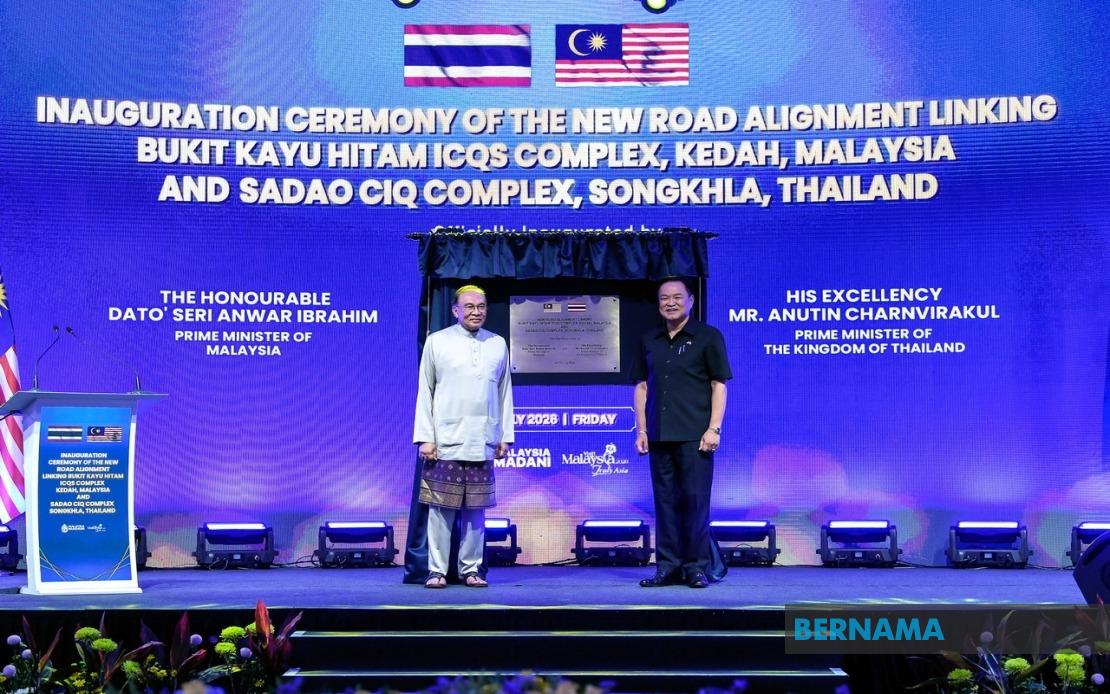
Prime Minister Datuk Seri Anwar Ibrahim has hailed the opening of a new road connection between Malaysia's Bukit Kayu Hitam and Thailand's Sadao as a transformative moment for cross-border commerce, describing it as an essential infrastructure investment to unlock economic potential in both northern Malaysia and southern Thailand. Speaking at the launch ceremony held at the Malaysia-Thailand border in Kedah on July 10, Anwar emphasised that this transport corridor would fundamentally reshape how businesses, goods, and people move between the two neighbouring nations, transcending the conventional limitations of border crossings to create genuine economic dynamism in historically peripheral regions.
The project represents far more than a simple road improvement. By directly connecting the Bukit Kayu Hitam Immigration, Customs, Quarantine and Security (ICQS) Complex in Kedah with the Sadao Customs, Immigration and Quarantine (CIQ) Complex across the border, the alignment addresses long-standing logistical inefficiencies that have constrained bilateral trade and investment flows. For Malaysian business operators and exporters in particular, streamlined border access translates into reduced transportation costs, faster clearance times, and enhanced competitiveness in regional markets—benefits that ripple outward to affect pricing, employment, and consumer choice throughout the supply chain.
Anwar's vision extends considerably beyond infrastructure development alone. He articulated an ambitious framework encompassing the creation of a special economic border zone spanning northern Malaysia and southern Thailand, a concept designed to leverage geographical proximity and complementary economic structures to generate sustained growth. Such zones typically feature preferential trade arrangements, joint investment initiatives, and harmonised regulatory frameworks that encourage companies to locate operations along the border. For Malaysian states including Perlis, Kedah, Kelantan, Perak, and Penang, this represents a potential pathway to diversifying economic bases that have historically relied heavily on agriculture, manufacturing, and tourism.
The initiative was jointly inaugurated by Anwar and Thailand's Prime Minister Anutin Charnvirakul, whose presence underscored the bilateral commitment required to translate such ambitious plans into tangible outcomes. Anutin's attendance at the border ceremony—rather than relegating the event to capital-city politics—signalled recognition on the Thai side that cross-border development demands engagement with local realities and stakeholder concerns. For Malaysian observers, this diplomatic gesture suggests an unusual level of Thai political willingness to prioritise practical economic cooperation over bureaucratic inertia or nationalist posturing that sometimes complicates regional integration efforts.
A critical dimension of the collaboration involves resolving systemic frictions that have impeded efficient trade for years. Malaysia and Thailand have committed to expedited resolution of outstanding issues spanning customs procedures, immigration protocols, fisheries management, and commercial regulations. These obstacles, accumulated through decades of incremental policy divergence and institutional misalignment, have created substantial transaction costs for businesses operating across the border. By addressing them through concerted political effort, both governments aim to transform their relationship from one characterised by periodic diplomatic engagement into a framework of continuous, friction-reduced commercial interaction.
The economic ambitions underpinning this initiative are explicit and quantifiable. Malaysia and Thailand have established a bilateral trade target of USD30 billion by 2027, a threshold that demands sustained growth of roughly 10 to 15 percent annually from current levels. Achieving this objective requires not merely symbolic gestures but comprehensive operational alignment—harmonised standards, simplified documentation, and aligned fiscal incentives. For Malaysian traders, particularly small and medium enterprises (SMEs) concentrated in border states, success would mean genuine market access to Thailand's 70 million-person consumer base, historically accessible only through complex intermediary arrangements or foreign-invested enterprises.
Anwar explicitly acknowledged that constructing a functional special economic border zone represents a long-term undertaking, cautioning against expectations of immediate results. This measured rhetoric reflects realistic understanding that institutional reform, regulatory harmonisation, and infrastructure development proceed incrementally rather than through sudden transformation. The PM's emphasis on political commitment from both leaderships suggests recognition that bureaucratic obstacles and entrenched interests within each nation's government structures pose genuine impediments to rapid change. For Malaysian policymakers and investors, this candour indicates that tangible benefits will accrue gradually, requiring patience while foundations are systematically established.
The broader strategic significance of this initiative extends beyond bilateral Malaysia-Thailand relations into the architecture of Southeast Asian regional integration. As ASEAN continues navigating tensions between national sovereignty and collective economic interests, successful border-zone models become reference cases for other member states contemplating deeper cross-border cooperation. Malaysia's willingness to pioneer such arrangements, particularly in its relationship with Thailand, positions the country as a leader in pragmatic regional economics rather than merely a participant in multilateral forums. For smaller ASEAN nations like Brunei or Cambodia, Malaysian-Thai success offers a template for mobilising dormant border economies without surrendering substantive policy autonomy.
The ceremonial aspects of the launch—including the formal welcomes extended to Anutin and his delegation—reflected diplomatic protocol appropriate to a bilateral relationship that, while generally cooperative, periodically experiences friction over maritime boundaries, refugee flows, and irregular labour migration. That such tensions can coexist with ambitious economic collaboration suggests both governments have successfully compartmentalised disputes, allowing trade and development initiatives to proceed alongside management of disagreements. For Malaysian observers concerned about regional stability and prosperity, this ability to separate contentious security issues from economic cooperation represents a constructive model for managing complex international relationships.
Looking forward, the success of the Bukit Kayu Hitam-Sadao initiative will depend substantially on implementation rigour. Launching infrastructure represents the comparatively straightforward component; the demanding work involves training customs officials to operate under harmonised procedures, establishing dispute resolution mechanisms for commercial disagreements, and building trust among business communities accustomed to viewing cross-border transactions with caution. Malaysian exporters, particularly in agricultural products, processed goods, and light manufactures, will require confidence that regulatory changes represent permanent policy shifts rather than temporary facilitations subject to reversal through bureaucratic whim. This confidence emerges slowly, typically requiring demonstrated consistency through multiple economic cycles.
For Malaysia's northern states and for Thailand's southern provinces, this corridor development carries profound social implications beyond narrow economic metrics. Border regions frequently experience demographic stagnation, as economically ambitious residents migrate toward major urban centres offering superior opportunities. A functioning special economic zone could reverse this outflow by creating employment, investment opportunities, and entrepreneurial prospects within border communities themselves. This dimension matters particularly for Malaysia, where development disparities between peninsula-interior regions and major coastal cities have prompted periodic political tensions and calls for distributive justice. Border prosperity thus connects to broader national cohesion questions, suggesting that the initiative's success or failure carries implications extending well beyond trade statistics.
The Malaysian government's emphasis on consulting border communities and incorporating their welfare considerations into planning represents an evolution in how large infrastructure projects are publicly justified. Rather than framing development primarily in terms of national economic aggregates or international competitiveness, Anwar situated the corridor within an explicit commitment to improving livelihoods for traders, businesses, and residents in peripheral regions. This rhetorical positioning, whether reflecting genuine commitment or sophisticated political communication, signals recognition that infrastructure legitimacy increasingly depends on demonstrable benefits reaching affected populations rather than merely advancing governmental or corporate interests. As Malaysia pursues this initiative alongside other regional connectivity projects, this principle—that development serves people, not abstractions—warrants close monitoring to determine whether rhetoric translates into substantive outcomes benefiting intended communities.

