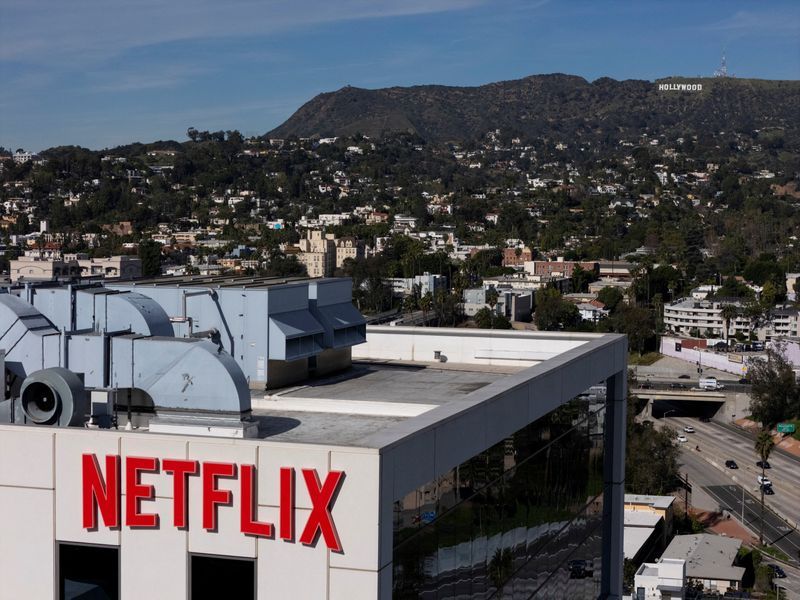
Netflix's forthcoming second-quarter earnings announcement will serve as a critical test of the streaming platform's ability to reignite investor confidence and articulate a credible path toward sustained growth. The company faces mounting scepticism about its strategic direction as it struggles to defend against a diversifying entertainment landscape where traditional media companies, YouTube, and mobile platforms increasingly fragment the viewing audience. This moment arrives after the platform's valuation has contracted substantially during 2024, reflecting deeper market anxieties about whether Netflix can deliver the expansion metrics that once captivated Wall Street.
Analysts tracking the company's financial performance through LSEG expect Netflix to report quarterly revenue of approximately $12.59 billion, representing a 13.6 percent increase from the prior year—a pace that marks the slowest expansion the company has achieved over the preceding four quarters. Such deceleration, even as the platform maintains an enormous subscriber base, underscores the fundamental challenge facing mature streaming operators: extracting growth from a nearly saturated North American market while navigating cost inflation and subscriber acquisition fatigue. Adjusted earnings per share are projected to reach 79 cents, but these headline figures mask the strategic anxieties that have eroded investor sentiment throughout the year.
The advertising arm has emerged as the focal point of Netflix's growth narrative, yet the business remains far from fulfilling the transformative role many Wall Street observers attributed to it. Revenue from advertising is forecast to reach $705.8 million this quarter, yet this performance has disappointed relative to initial forecasts from major research houses. Emarketer analyst Ross Benes acknowledged that his firm substantially reduced its advertising projections for Netflix, noting that the ad division has failed to generate the momentum that most analysts confidently predicted when the company first introduced the lower-priced, ad-supported tier. This gap between expectation and realisation reflects both the difficulty of building advertising operations from scratch and the reluctance of marketers to commit significant budgets to unproven inventory.
The advertising disappointment assumes greater significance because Netflix's previous growth engines have begun to lose propulsive force. The company extracted substantial revenue uplift from cracking down on password-sharing practices and implementing successive price increases, but those one-time benefits have largely exhausted themselves. Without the advertising division expanding at pace, Netflix faces a genuine challenge in demonstrating accelerating profitability or meaningful subscriber growth to shareholders who have grown increasingly accustomed to the company delivering against higher hurdles.
In response, Netflix has initiated a strategic pivot toward live entertainment and premium content experiences intended to deepen viewer attachment and create additional advertising inventory. Reports indicate the company is pursuing acquisition of rights to the FIFA World Cup competitions scheduled for 2030 and 2034 in the United States, recognising that live sporting events command premium advertising rates and generate appointment viewing that transcends traditional episodic consumption patterns. Simultaneously, Netflix has explored acquiring Letterboxd, an online film database and social network, a move that would integrate community engagement directly into its ecosystem and create additional touchpoints for both viewers and advertisers.
These initiatives reflect a recognition within Netflix's leadership that the company must evolve beyond its historical identity as a purveyor of serialised drama and comedy. The competitive environment has shifted fundamentally; traditional broadcasters and cable companies have mobilised formidable streaming operations backed by extensive content libraries, while YouTube has demonstrated unparalleled capacity to capture casual viewing hours across multiple demographic segments. Mobile-first platforms have further fragmented the viewing audience, particularly among younger demographics who increasingly consume entertainment in fractured, short-form intervals rather than traditional episodic binges.
Paolo Pescatore of PP Foresight articulated the underlying structural transformation confronting Netflix with crystalline clarity: the company has progressed from operating as a disruptive outsider challenging incumbent media companies to functioning as the dominant player within the streaming category itself, yet this transition from disruption to dominance presents an entirely different set of challenges. Sustaining momentum from a vastly larger revenue base requires identifying entirely new revenue vectors and expanding into adjacent entertainment categories, a proposition considerably more complex than the growth Netflix achieved through market share capture in its earlier decades.
Contentious data regarding audience retention patterns have further complicated Netflix's investor relations efforts. Bloomberg News reported that viewers exhibit declining propensity to return for subsequent seasons of shows, even those that achieved critical and commercial acclaim in their initial runs. The phenomenon appears particularly acute among Netflix's highest-profile productions; hit series including "The Night Agent" and "Beef" experienced viewer attrition exceeding fifty percent between first and subsequent seasons, suggesting that Netflix's content resonance may be declining relative to the platform's historical performance and that the novelty of individual shows may be exhausting itself more rapidly than anticipated.
Speculation about potential major acquisitions has circulated throughout media and technology circles, particularly following Comcast's announcement that it would spin off NBCUniversal as an independent entity. Some market observers have theorised that Netflix might pursue transformational deals to consolidate content libraries or acquire existing advertising technologies. However, analysts tracking the company suggest that Netflix will likely focus its dealmaking efforts on smaller, strategic acquisitions that buttress specific business initiatives rather than betting on another massive transaction.
The Malaysian and broader Southeast Asian markets represent an important consideration within Netflix's growth calculus, as the region encompasses millions of subscribers with lower average revenue per user than developed markets. Expansion in these territories requires content that reflects regional preferences while maintaining production economics that generate positive unit economics. Netflix's ability to demonstrate that its advertising and live entertainment strategies can translate across diverse cultural contexts and varying advertising market sophistication will materially influence how international investors assess the company's long-term trajectory.
Ultimately, Netflix's second-quarter earnings presentation will likely emphasise the company's strategic initiatives and long-term positioning rather than delivering the blockbuster quarterly metrics that characterised its earlier growth phase. The company must convince investors that its transition toward live events, advertising expansion, and content experimentation constitutes a viable framework for reigniting growth rather than a defensive retrenchment reflecting a maturing business with structurally constrained expansion potential. The narrative Netflix constructs during this earnings cycle will substantially influence investor sentiment and the company's valuation multiple during the months ahead.

