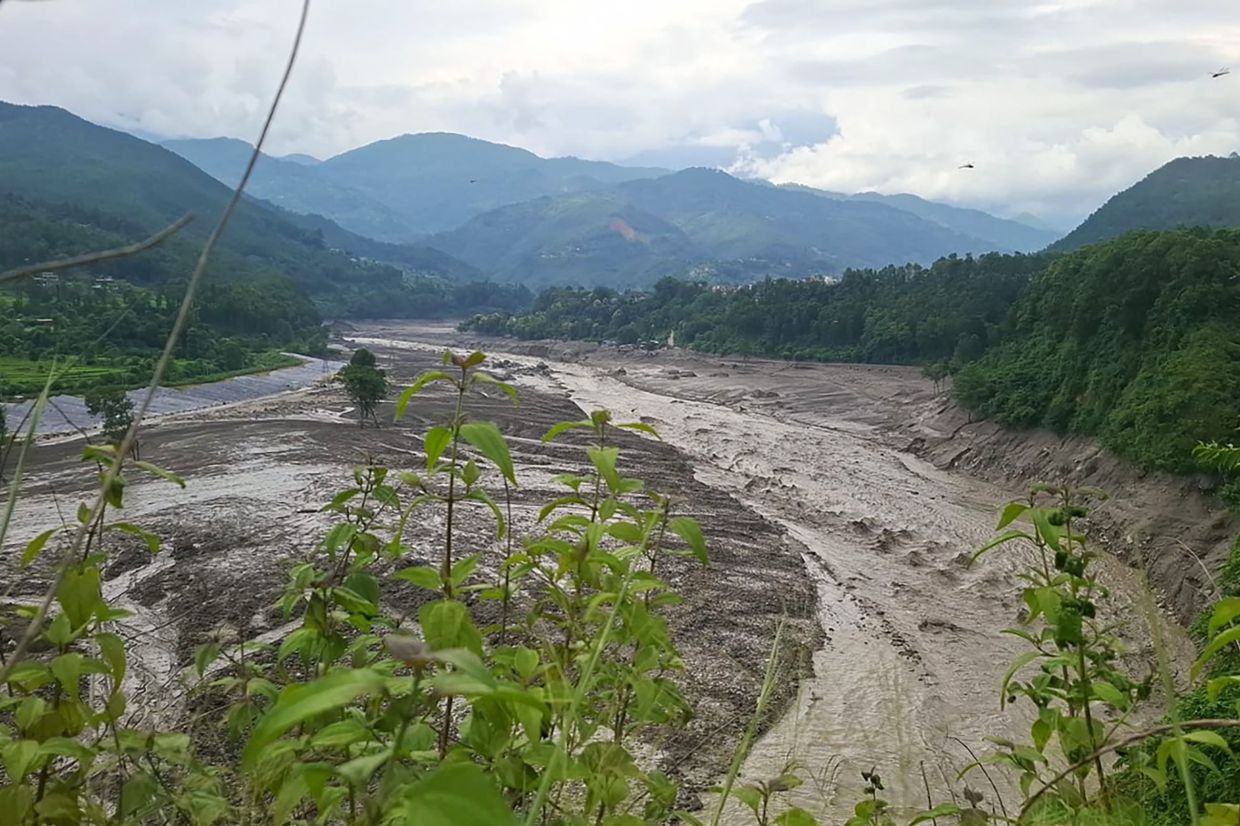
A catastrophic surge of water tore through Nepal on Wednesday morning, transforming the Bhotekoshi River into a destructive torrent that claimed at least 22 lives and left hundreds of people unaccounted for across multiple districts. The flash flood struck around 9am local time on August 26, obliterating villages, severing critical road connections, and destroying hydropower installations across a swath of the Himalayan nation. The scale of the unfolding emergency became clearer as authorities tallied the missing: 384 individuals, including nearly 300 foreign nationals from India, the United States, the United Kingdom, and other countries, had lost contact with family and colleagues in the affected zones.
The disaster carried particular resonance for Malaysian readers. Malaysia's Foreign Ministry confirmed through its embassy in Kathmandu that travel agencies had reported losing communication with 11 Malaysians believed to be in Rasuwa district when the floods struck. The missing Malaysians form part of a larger cohort of Indian and diaspora tourists who were traversing the Himalayan foothills as part of a pilgrimage to Mount Kailash in Tibet, one of Hinduism's holiest sites. South Korean workers constructing a hydropower facility in the region were also among those reported missing, underscoring how the disaster affected a multinational workforce engaged in Nepal's infrastructure development.
The physical devastation concentrated in Nuwakot district presented a grimly apocalyptic scene. Entire multistorey buildings lay entombed beneath vast accumulations of mud and debris, while trucks and vans were buried or swept away by the torrent's force. The Bhotekoshi floodwaters did not respect district boundaries; officials issued urgent warnings to residents across multiple districts, cautioning them to avoid the banks of the Bhotekoshi, Trishuli, and Narayani rivers where secondary flooding remained a threat. The destruction extended beyond human habitation to critical infrastructure, with hydropower projects representing significant economic investments now damaged or destroyed.
Climate scientists at the Kathmandu-based International Centre for Integrated Mountain Development have identified the root cause of the disaster: an avalanche of rock and ice from a Himalayan glacier. This avalanche struck the Lhende Khola River, a tributary feeding into the Bhotekoshi system, effectively damming the waterway. When the temporary ice barrier gave way, the accumulated water surged downstream with catastrophic force. Saswata Sanyal, a disaster risk reduction specialist with the research organisation, emphasised the alarming pattern: the same tributary had flooded once before fourteen months earlier, indicating an accelerating cycle of glacial instability in this region.
The recurring nature of these disasters in the same locations underscores a fundamental shift in Himalayan hydrology. Climate change has begun to fundamentally alter how water moves through the mountain range. The Himalayan region, encompassing Nepal, India, Bhutan, and sections of other South Asian nations, stands as one of Earth's fastest-warming zones, warming at rates significantly exceeding the global average. This accelerated warming has triggered a cascade of consequences: glaciers are retreating at unprecedented speeds, permafrost is thawing, and the region's delicate water balance has grown increasingly unstable. Research published earlier this year by scientists working in Kathmandu revealed that glaciers across the Hindu Kush Himalaya are now melting at rates that have doubled since 2000, driven primarily by rising atmospheric temperatures linked to human-caused climate change.
The pattern of escalating extreme weather in Nepal's mountains reflects broader regional vulnerability. The terrain's steep slopes, heavy monsoon precipitation, and now-destabilised glacial systems create conditions where catastrophic flooding, landslides, and avalanches occur with growing frequency. The August 2023 incident, when a glacial lake in neighbouring Tibet overflowed due to elevated temperatures, foreshadowed Wednesday's disaster. That earlier event killed nine people and damaged crucial infrastructure, including a critical bridge linking Nepal and China. The repeat occurrence of similar calamities within such a brief timeframe suggests the region has entered a new phase of climate-driven instability requiring fundamental shifts in disaster preparedness and early warning systems.
International responses mobilised quickly. Nepal's government appealed directly to India and China for rescue assistance, recognising that transnational cooperation would be essential in accessing remote mountainous areas. Indian Prime Minister Narendra Modi spoke with Nepali counterpart Balendra Shah, pledging comprehensive humanitarian support and confirming that Indian rescue teams were already coordinating with Nepali authorities. Chinese President Xi Jinping issued orders to escalate search and rescue operations in the Gyirong border area on the Tibetan side of the frontier, while directing the evacuation of residents in at-risk zones. CCTV, China's state broadcaster, documented these large-scale rescue efforts, though Chinese authorities initially withheld specific casualty figures from their territory.
The human toll extended across multiple nationalities and professions, illustrating how natural disasters in the Himalayan corridor affect a globalised population. Foreign pilgrims, international construction workers, local residents, and tourism sector employees all fell victim to or went missing in the disaster. For Malaysia specifically, the confirmation of missing citizens added an urgent dimension to a catastrophe initially framed as a distant regional emergency. The loss of communication with 11 Malaysians transformed the event into a matter of direct national concern, prompting diplomatic engagement and consular assistance.
Experts emphasise that conventional infrastructure and reactive response systems prove inadequate in the face of accelerating glacial hazards. Saswata Sanyal highlighted that in an increasingly warming Himalayan environment, early warning systems represent the primary adaptive measure available to vulnerable communities. However, effective early warning requires investment in monitoring networks, real-time data transmission to remote areas, and community education about evacuation procedures—resources that Nepal and its neighbours have struggled to deploy comprehensively. The recurrence of near-identical disasters in the same locations within fourteen months indicates that despite warnings from climate scientists, the region remains dangerously underprepared for the new hydrological reality created by climate change.
The Wednesday floods represent more than a singular tragedy; they signal the emergence of a structural climate challenge for the entire Himalayan region and downstream communities across South Asia. As global temperatures continue to rise, glacial systems that have remained relatively stable for millennia are now entering a phase of rapid transformation. For Malaysia and other nations with citizens in Nepal, whether as tourists, workers, or businesspeople, the disaster underscores the expanding geographic footprint of climate impacts. The Himalayan region's instability no longer affects only local mountain communities but increasingly threatens the safety of international visitors and workers across an expanding array of economic activities in the high mountains.

