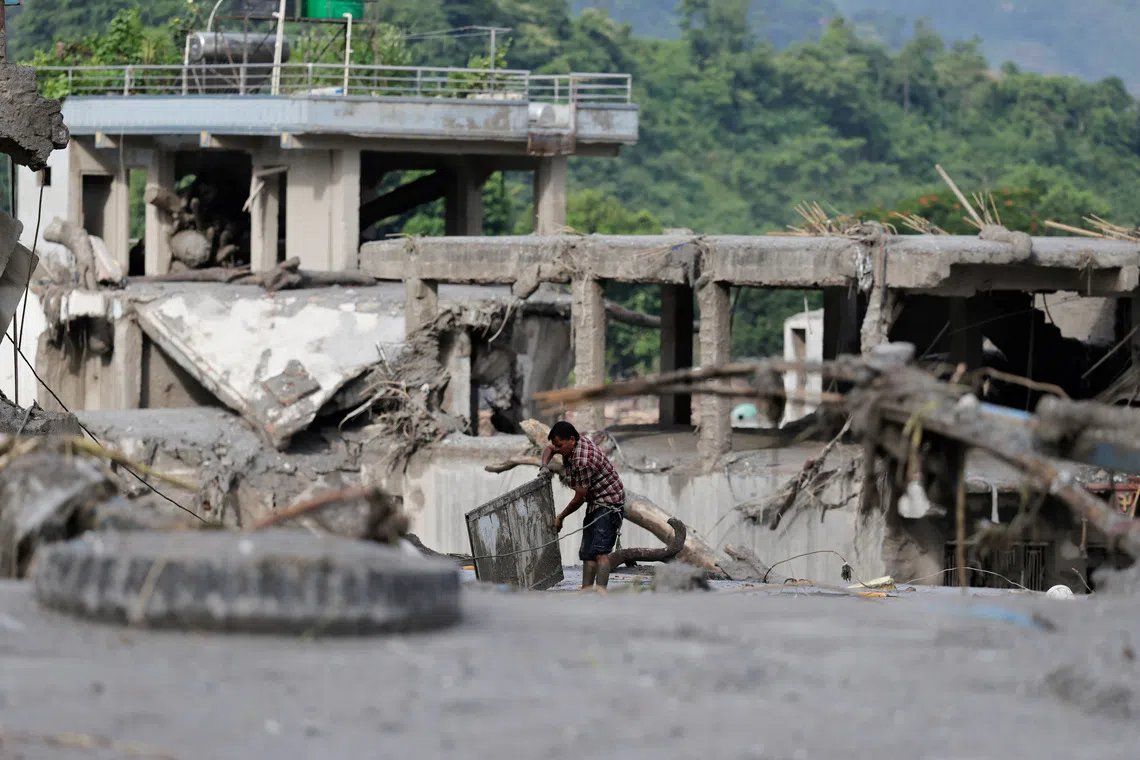
The Himalayan border region shared by Nepal and China faces a mounting humanitarian crisis as authorities on both sides of the frontier grapple with a cascading disaster unfolding in real time. Having already endured a catastrophic flood event on Wednesday sparked by a massive glacier collapse, communities in the affected valleys now face the terrifying prospect of secondary flooding as water accumulates behind natural and artificial barriers formed by debris. The dual threat reveals how environmental hazards in high-altitude terrain can compound exponentially, with each phase of the disaster presenting distinct dangers that overwhelm rescue and recovery operations still actively searching for more than 1,000 missing persons.
The initial calamity struck when a glacier destabilised in the remote mountains, sending vast quantities of rock, ice, mud and other debris cascading into river systems that drain toward populated lowlands. At least 362 people have been confirmed dead across the border regions, while rescue teams continue navigating treacherous terrain in search of survivors and bodies. The sheer scale of material mobilised by the glacier collapse fundamentally altered the hydrology of the affected valleys, blocking natural watercourses and creating entirely new water bodies that did not exist before the disaster.
Nepal's disaster management authorities have sounded an immediate alarm regarding conditions on their territory. A substantial lake has formed where the glacier debris now acts as an impromptu dam, impeding the normal flow of river water through the valley. As precipitation continues and meltwater accumulates, the water level behind this debris barrier rises steadily, increasing pressure on the natural dam structure. The Nepali authorities have issued public notices urging all persons in downstream communities, including rescue personnel actively engaged in search operations, to relocate to higher elevations and move away from riverbanks and other vulnerable zones.
China faces an analogous but quantifiably more severe situation on its side of the border. Across the frontier in Tibet, authorities have calculated that approximately three million cubic metres of water will flow into an already-constructed reservoir over the forthcoming seventy-two-hour period. To contextualise this volume, Chinese officials have compared the inflowing water to roughly 1,200 Olympic-sized swimming pools worth of liquid. The already-dammed reservoir on the Chinese side now confronts the prospect of exceeding its containment capacity, with structural failure posing catastrophic consequences for downstream communities in Tibet and potentially beyond.
Meteorology compounds the hazard substantially. Chinese state media outlets, drawing on analysis from the country's water resources ministry, have warned that rainfall anticipated over the coming week will intensify water accumulation rates, further elevating the risk profile. Hydrology specialists monitoring the situation have expressed grave concern about the trajectory. Zhu Jinfeng, a researcher positioned within the water resources ministry's hydrology division, conveyed the severity of conditions to state television, emphasising that water volumes continue climbing while simultaneously the probability of catastrophic failure escalates in lockstep.
The temporal dimension adds urgency to the warnings. Chinese officials have projected that the period around September 1st represents the window of maximum peril, when water flow into the dammed reservoir is expected to reach its highest intensity. This timeline creates a narrow window for evacuation, reinforcement operations, and risk mitigation measures. Both governments are working against the calendar as well as against hydraulic forces, attempting to implement protective measures before water levels overwhelm containment infrastructure.
The warnings have prompted immediate operational adjustments among rescue teams active in the region. Personnel engaged in search and recovery missions face an agonising dilemma: the imperative to locate missing persons conflicts with the necessity of self-preservation as the secondary flood hazard materialises. In Nepal, rescue workers including Pawan Koirala and his team of thirteen have begun deliberately withdrawing from riverbeds and low-lying areas, relocating to elevated ground despite the ongoing need to locate missing individuals. This retreat represents a tacit acknowledgment that continued operations in vulnerable zones have become untenable, and that the risk to rescuers themselves now outweighs the incremental probability of locating additional survivors.
The geological and hydrological dynamics at play reflect the extreme vulnerability of Himalayan mountain communities to environmental hazards. The region's complex topography, with high-altitude water sources feeding into confined valleys, creates inherent instability. When large-scale events such as glacier collapse occur, the debris often has nowhere to disperse except through existing river channels, creating bottleneck effects that generate dangerous lakes. These secondary hazards can prove as lethal as the initial triggering event, yet occur with less warning and sometimes less predictability.
For Malaysia and Southeast Asian observers, the Nepal-China situation underscores the transnational nature of mountain-originated disasters. The Himalayan range supplies water to billions of people across Asia, and environmental degradation or catastrophic events in these heights can trigger cascading impacts far downstream. Climate change is intensifying glacier instability across the region, suggesting that events of this magnitude may become increasingly frequent rather than remaining anomalies. The coordination challenges visible between Nepali and Chinese authorities also highlight governance complications when disasters cross international borders, requiring simultaneous action by multiple sovereignties operating under different administrative frameworks.
The unfolding secondary flood threat represents a grim reminder that major disasters rarely conclude with a single triggering event. Rather, they unfold across multiple phases, each presenting distinct hazards requiring adaptive response strategies. The rescue and recovery operation that began Wednesday continues to evolve, but now must accommodate warnings of impending danger that could claim additional victims among the very communities and rescue personnel already traumatised by the initial catastrophe.

