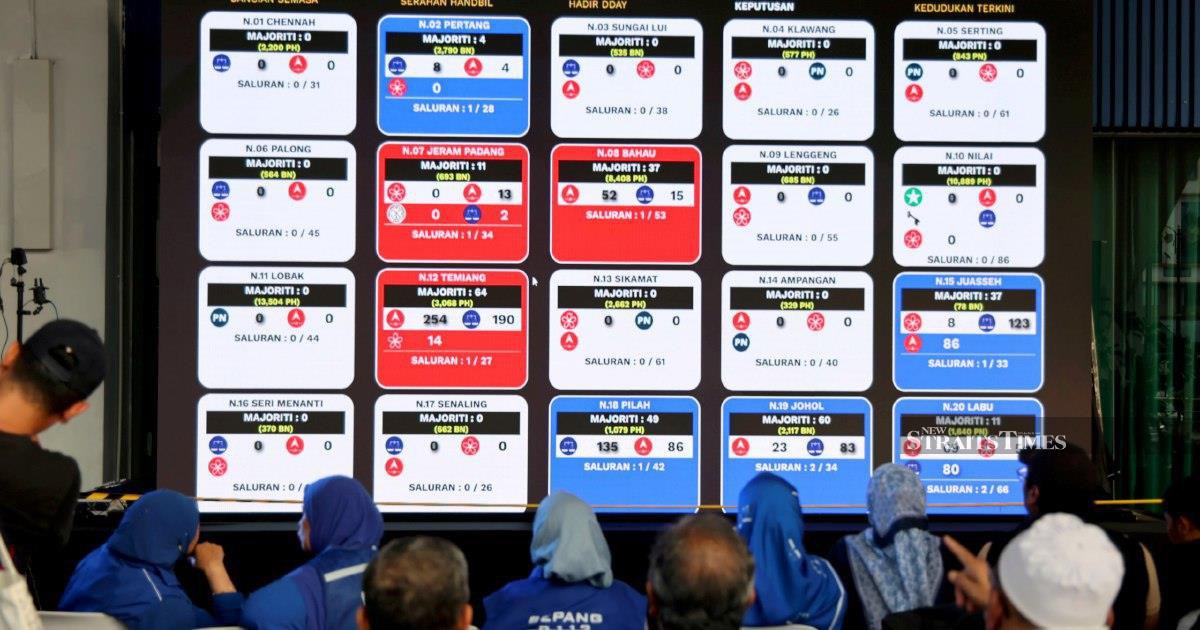
The Negri Sembilan state election has become a barometer for Pakatan Harapan's political health among Malaysia's Malay-speaking heartland, with results indicating the coalition faces mounting headwinds in a demographic sector it needs to win broader national support. The performance revealed that despite holding office at federal level, the coalition has not successfully consolidated voter loyalty in one of the nation's key swing states, where Malay voters form the electoral majority and traditional support patterns have long favoured Barisan Nasional.
Packatan Harapan's competitive difficulties in Negri Sembilan cannot be dismissed as a localised anomaly but rather reflect systemic challenges the coalition has grappled with since returning to government in 2018. The state, strategically positioned in the central region and economically integrated with the Klang Valley, serves as a critical testing ground for coalition strategies aimed at diverse voter bases. When a coalition cannot maintain its position in such territories, it signals vulnerability across comparable demographics elsewhere in Peninsular Malaysia.
The Malay voter base represents the largest single demographic constituency in Malaysia, and controlling their support determines which coalition can achieve the parliamentary majorities needed to form government at federal level. Pakatan Harapan's inability to translate its 2018 federal victory into sustained ground-level dominance in Malay-plurality areas suggests the coalition's appeal may have relied heavily on anti-establishment sentiment rather than deeper ideological or programmatic alignment with this crucial voting bloc. As that protest energy dissipates, the coalition faces the harder task of building enduring support rooted in concrete governance outcomes and policy resonance.
The electoral landscape in Negri Sembilan also reflects broader shifts in how Malay Muslim voters evaluate political options. Concerns about economic management, religious policy, and communal representation have created openings for alternative parties to make inroads, particularly among younger voters and those in urban centres. Pakatan Harapan's internally diverse membership—spanning secular-leaning and Islamist-oriented parties—has sometimes created confusion about the coalition's authentic positions on identity-centred issues that matter deeply to Malay communities. This ambiguity, whether real or perceived, erodes the coalition's natural advantage when competing for votes in these constituencies.
Economic pressures affecting ordinary Malay families have intensified since 2020, including cost-of-living challenges, employment precarity, and reduced opportunities in traditional sectors. Voters in this demographic have grown increasingly sceptical whether the ruling coalition's policies effectively address their circumstances. Opposition parties have exploited this discontent by offering simpler narratives and, in some cases, promising more direct support mechanisms. Pakatan Harapan's more technocratic governance approach has struggled to communicate its achievements or future plans in ways that resonate with constituencies experiencing genuine hardship.
The regional implications of Pakatan Harapan's Malay voter challenge extend beyond Negri Sembilan itself. Other states with comparable demographics—including several along the west coast and in the northern region—may experience similar shifts if the coalition cannot arrest this erosion of support. A sustained pattern of weakness among Malay voters across multiple state elections would substantially complicate any federal-level strategy the coalition might pursue in advance of the next general election, potentially shifting the parliamentary arithmetic in directions unfavourable to the current government.
Within Pakatan Harapan's internal structure, the Negri Sembilan results will likely intensify debates about coalition strategy and party positioning. The Democratic Action Party, rooted primarily in non-Malay urban communities, and Amanah, which positions itself as the Islamically-conscious alternative to PAS, face different challenges in reaching Malay voters. Smaller coalition partners contribute limited electoral machinery in these contexts. The tension between maintaining ideological clarity and achieving electoral competitiveness has never been sharper for coalition architects.
The traditional ruling party, Barisan Nasional, retains institutional advantages, particularly among Malay-Muslim voters and in rural constituencies where community networks and patronage systems remain influential. As Pakatan Harapan's lustre has dimmed through the wear of governing, Barisan Nasional has benefited from a kind of default return to familiarity. This is not necessarily a ringing endorsement but rather reflects the electoral reality that established networks prove durable when alternative coalitions fail to deliver compelling reasons to sustain voter loyalty.
Pakatan Harapan's path forward requires addressing root causes rather than merely adjusting messaging. The coalition must demonstrate concrete improvements in living standards, articulate coherent positions on religious and communal issues that different voter segments can support, and rebuild trust through transparent governance. The Negri Sembilan election serves as an urgent reminder that controlling Malaysia's political future depends fundamentally on regaining the confidence of Malay voters, a challenge that neither slogans nor organisational restructuring alone can resolve. Without substantial progress on this front in the coming months, subsequent electoral tests promise even more difficult terrain for the coalition.

