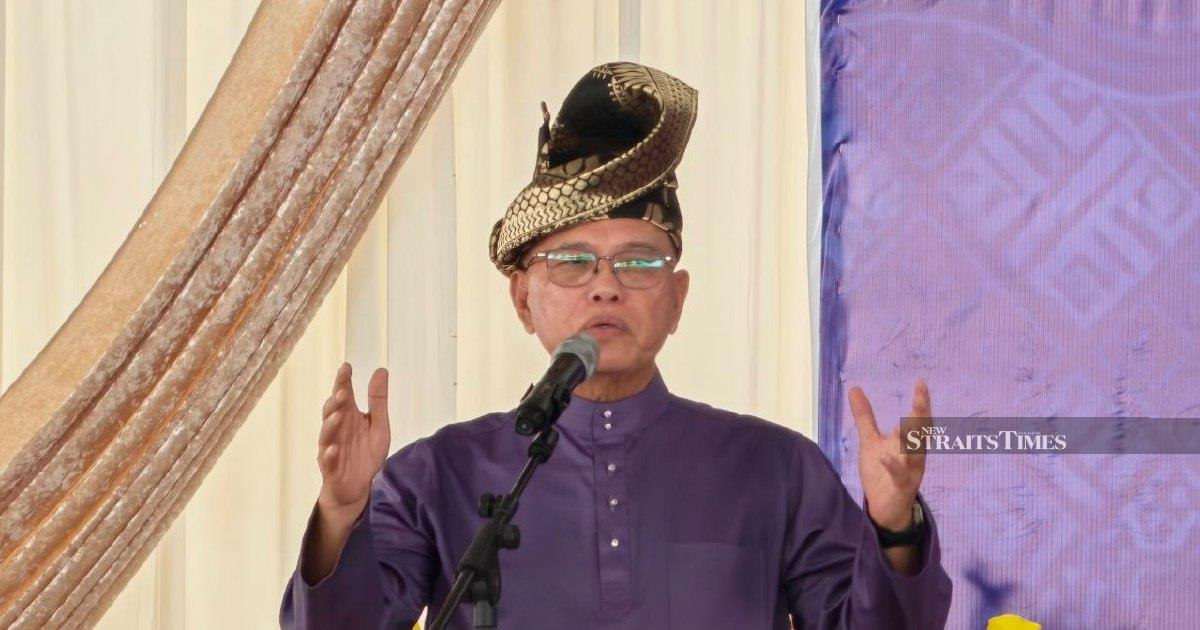
The recent Negri Sembilan state election has become the subject of competing interpretations among Malaysian political leaders, with Umno's second-ranking official arguing that the outcome validates a governance-centred rather than identity-driven approach to politics. Speaking in Temerloh, Datuk Seri Wan Rosdy Wan Ismail contended that voters in the central state had consciously rejected appeals based on communal grievances, instead casting their ballots in favour of parties and coalitions demonstrating administrative competence and stability.
This assertion carries particular weight in Malaysia's contemporary political landscape, where successive elections have been marked by competing claims regarding the electorate's priorities. Wan Rosdy's interpretation suggests that regardless of demographic composition or historical voting patterns, Malaysian voters increasingly evaluate performance metrics—infrastructure delivery, economic management, and institutional effectiveness—over the traditional fault lines that have defined post-independence politics. The statement implicitly positions Barisan Nasional as the beneficiary of this shift, claiming that the coalition's emphasis on administrative credentials rather than communal appeals proved decisive.
Negri Sembilan, with its mixed demographic profile and relatively balanced representation across ethnic communities, provides a particularly instructive testing ground for such assertions. The state's political history reflects Malaysia's broader patterns of alternating government, yet its electoral behaviour often anticipates national trends. A result that genuinely reflects voter preference for governance over identity politics would have significant implications for how both established and emerging political forces calibrate their campaign strategies moving forward. If confirmed across multiple electoral contests, such a shift would constitute a fundamental reorientation in Malaysian politics.
The Umno vice-president's framing also serves a tactical purpose within Malaysia's ongoing political realignment. By claiming that voters consciously rejected racial or communal messaging, Wan Rosdy effectively characterises opposition parties or alternative coalitions as engaging in divisive politics by contrast. This rhetorical manoeuvre positions Barisan Nasional as the moderate, stability-oriented choice—a narrative that has gained currency following the post-2018 period of political turbulence and competing power struggles. Such positioning matters considerably for Umno, which has worked to rehabilitate its image following the 1MDB scandal and subsequent electoral reverses.
However, the relationship between electoral outcomes and voter motivations remains notoriously difficult to establish with precision. Exit polls and public statements by candidates provide limited insight into the complex calculus that determines individual voting decisions. Voters rarely operate from a single consideration; instead, they balance multiple factors including local issues, national economic conditions, family traditions, and candidate appeal. Attributing a particular election result to a single overriding factor requires substantial evidence beyond mere outcome observation. The same Negri Sembilan result could be interpreted through multiple lenses: as validation of Barisan governance, as rejection of a weakened opposition, as endorsement of local figures, or indeed as a reflection of community-specific concerns entirely distinct from broader racial or administrative considerations.
The emphasis on administrative stability rather than racial appeals also reflects evolving public discourse in Malaysia regarding the nature of effective governance. Younger voters, in particular, have demonstrated increasing focus on tangible service delivery—reliable infrastructure, responsive public administration, environmental management—rather than abstract appeals to communal identity. Urban centres across Malaysia have consistently shown greater receptivity to candidates and parties emphasising concrete policy platforms. Whether this represents a generational shift with staying power or a temporary tactical adjustment in voter preferences remains an open question that cannot be definitively resolved from a single state election.
Sean-Asian observers of Malaysian politics note that electoral behaviour in the country continues to display complexity and nuance that defies easy categorisation. Voters simultaneously demonstrate strong attachment to community representation—insisting on leaders from their own demographic communities—while increasingly scrutinising those leaders' practical performance in office. This apparent paradox shapes contemporary electoral dynamics across the region, where identity politics and pragmatic governance concerns coexist rather than existing as mutually exclusive alternatives. The Negri Sembilan result may reflect this ambivalence rather than a clear rejection of any single factor.
Umno's invocation of the Negri Sembilan outcome also occurs within the context of broader coalition positioning ahead of potential federal elections. By establishing the narrative that voters reward administrative competence and penalise divisive messaging, the party attempts to set expectations and frameworks for interpreting subsequent electoral contests. This prospective dimension of political rhetoric often proves as significant as the ostensible analysis of past events. If this interpretation gains traction within media and political commentary, it could influence how subsequent electoral results are understood and presented to the Malaysian public.
The sustainability of such narratives depends partly on consistent validation through ongoing electoral contests. Should forthcoming elections in other states or at federal level produce results incongruent with the stability-over-identity interpretation, the framing will lose credibility. Conversely, if multiple elections reinforce this pattern, it could genuinely signal enduring shifts in electoral motivation. Malaysian political analysts will be closely monitoring campaign messaging and voter behaviour in coming contests to determine whether Wan Rosdy's interpretation reflects genuine realignment or represents partisan interpretation of ambiguous results.

