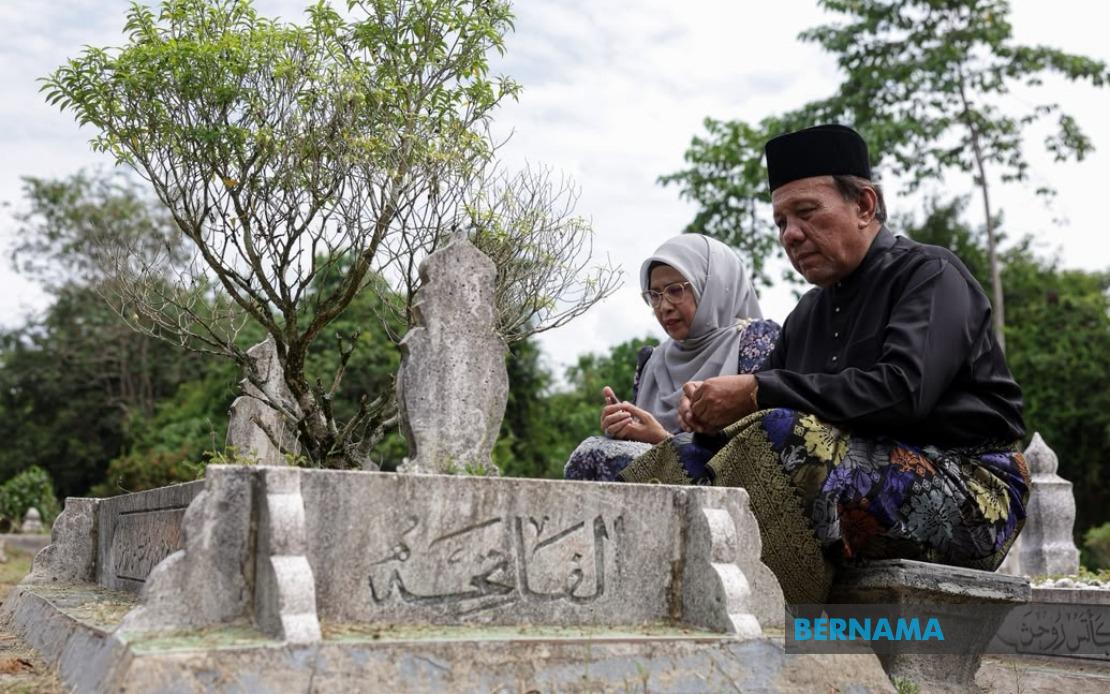
Datuk Ismail Lasim observed a moment of filial piety moments after assuming office as Menteri Besar of Negeri Sembilan, travelling to Tebing Tinggi Muslim cemetery in Kuala Pilah to pay respects at his parents' graves. Accompanied by his wife Datin Noraishah Othman and dressed in formal traditional Malay attire, the newly installed leader carried out the solemn visit on the same day he was sworn in before the Yang di-Pertuan Besar of Negeri Sembilan, Tuanku Muhriz Tuanku Munawir, at Istana Besar Seri Menanti.
The gesture reflected a personal connection to his family's legacy at a significant juncture in his political career. Ismail's father, the late Lasim Yaman, passed away on March 5, 2020, having reached the age of 97, while his mother, the late Bedah Othman, died on September 16, 2014. The cemetery visit underscored the emotional weight of milestone moments in public life, with Ismail acknowledging those who shaped his values before stepping into his new responsibilities.
Ismail's pathway to the Menteri Besar's office came through victory in the Juasseh state seat during yesterday's 16th Negeri Sembilan state election. His election success formed part of a broader political outcome that fundamentally reshaped the state's legislative landscape and created the conditions for his appointment to the top executive position. The electoral mandate he secured at the constituent level translated into broader coalition support at the state government level.
The election results delivered a decisive outcome for two major political coalitions competing for control of Negeri Sembilan. Barisan Nasional emerged as the dominant force, capturing 18 of the state assembly seats, while Perikatan Nasional secured seven seats. This distribution of seats provided both coalitions with the combined strength to govern with a two-thirds majority, a supermajority that carries significant legislative advantages. The comfortable margin indicates stable governance prospects for the incoming administration, enabling the new Menteri Besar to pursue policy initiatives with reasonable confidence of legislative support.
The formation of the state government through a coalition arrangement between Barisan Nasional and Perikatan Nasional represents a distinctive political configuration for Negeri Sembilan. Such collaborative structures have become increasingly common across Malaysian states as electoral outcomes produce more fragmented results, requiring larger groupings to form viable administrations. The partnership signals willingness among these two major coalitions to cooperate on state-level governance despite their different national political orientations and competition in other jurisdictions.
Ismail's appointment carries significance for Negeri Sembilan's development trajectory and political representation. As Menteri Besar, he assumes responsibility for steering state policies across critical areas including economic development, infrastructure, education, and social services. His background and electoral victory in Juasseh position him as a representative of voter preferences in that constituency, though his duties now extend to the entire state population. The transition from constituency representative to state chief executive marks a substantial elevation in administrative scope and political authority.
For Malaysian and broader Southeast Asian observers, the Negeri Sembilan result demonstrates patterns of political realignment that have characterised recent electoral cycles in Malaysia. The strengthening of coalition-based governance models reflects voter behaviour and institutional pressures that reward larger groupings capable of assembling legislative majorities. Understanding these electoral dynamics provides insight into how Malaysian politics continues to evolve, with implications for future state-level contests and the balance of power between competing national political blocs.
The two-thirds majority secured by the governing coalitions in Negeri Sembilan grants them considerable legislative flexibility. This supermajority allows for amendments to state legislation, approval of substantial budgets, and passage of contentious measures without requiring opposition support or negotiating with smaller political parties. Such commanding majorities shape the character of state administration, typically enabling more decisive policy implementation compared to situations requiring narrower legislative coalitions. The political stability this provides serves administrative efficiency, though it also reduces parliamentary scrutiny and debate on government decisions.
Ismail's personal priorities and policy agenda will likely emerge in coming weeks as the new administration settles into office and begins articulating its governing programme. His immediate post-inauguration visit to his parents' graves may signal an intention to govern with values-based decision-making and conscious connection to his community roots. Whether this translates into specific policy directions or administrative approaches will become apparent as the government develops its legislative agenda and budgetary priorities for the term ahead.

