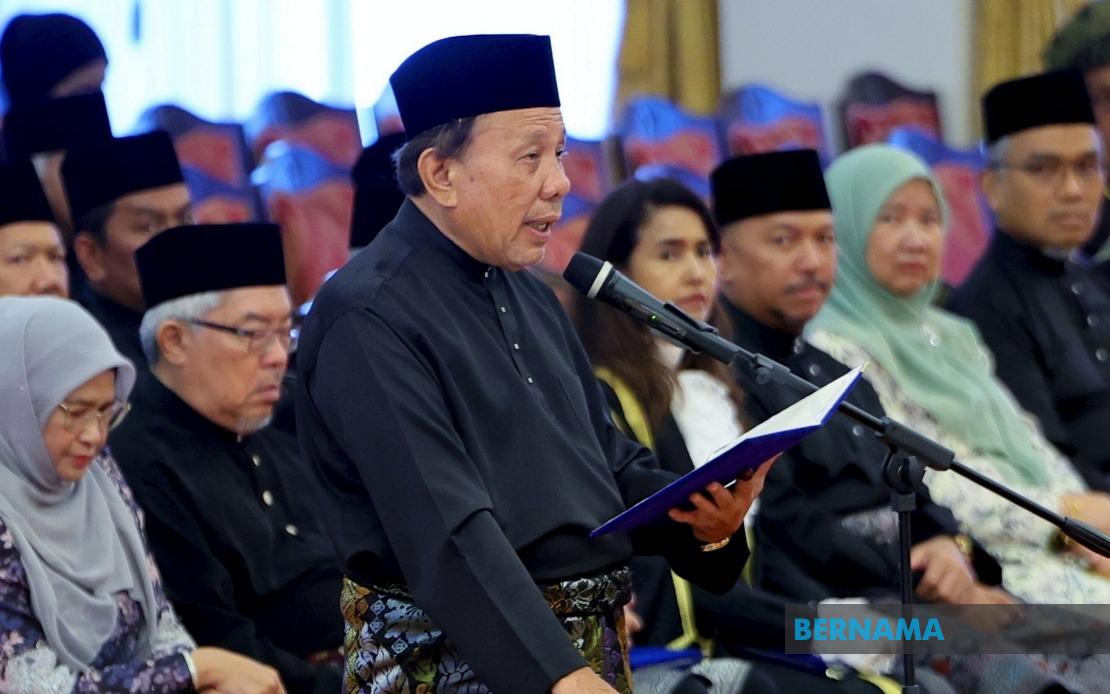
Datuk Ismail Lasim took his oath of allegiance as Negeri Sembilan's Menteri Besar at Istana Besar Seri Menanti on August 2, pledging to govern with fairness, transparency and effectiveness in service of the state's people. Administered before Yang Dipertuan Besar Tuanku Muhriz Tuanku Munawir, the ceremony formalized the transition that followed the 16th state election, with the incoming leader framing his appointment as both honour and weighty responsibility.
The mandate secured in the recent electoral contest represents a significant test of political confidence, and Ismail acknowledged this directly in his speech. Rather than treating the electoral victory as mere institutional power, he characterized it as a solemn public trust requiring demonstrable dedication to improving citizens' lives. His remarks suggest an administration conscious of accountability, positioning listening to constituent concerns and fulfilling promises as central to governance rather than secondary considerations.
Ismail's emphasis on upholding royal institutions and constitutional frameworks reflects Malaysia's broader commitment to constitutional monarchy and parliamentary democracy. By publicly pledging allegiance to Tuanku Muhriz's guidance and counsel, the new Menteri Besar situated himself within established protocols of consultative governance. This positioning carries practical implications for state-level policymaking, as decisions will theoretically benefit from royal perspective while remaining accountable to democratic processes and public scrutiny.
A distinctive element of Ismail's vision involves safeguarding Negeri Sembilan's unique customary heritage, specifically Adat Perpatih. The state's matrilineal inheritance customs and consensus-based decision-making traditions distinguish it significantly from other Malaysian states. By committing to preserve and transmit these cultural foundations to future generations, Ismail acknowledged that modern governance must balance contemporary development priorities with institutional continuity and cultural identity—a tension particularly acute in rapidly urbanizing territories.
Economic development remains central to the new administration's agenda. Ismail identified strengthening the state economy, attracting quality investments, and generating employment as key priorities, alongside improving living standards through enhanced education, healthcare, housing support, and agricultural initiatives. For Negeri Sembilan—a state positioned between Kuala Lumpur and Melaka but often overshadowed by these economic powerhouses—targeted investment attraction and sectoral development could reshape regional competitiveness and opportunity distribution.
The Menteri Besar's definition of progress extended beyond conventional metrics. Rather than measuring success solely through infrastructure spending and GDP growth, Ismail advocated for welfare-focused indicators encompassing social cohesion, institutional strength, and public trust in governance. This framing resonates with growing regional recognition that sustainable development requires attention to quality-of-life factors, environmental stewardship, and equitable opportunity access—concerns increasingly prioritized by Southeast Asian voters and investors alike.
Ismail's commitment to consensus-building and receptiveness to constructive criticism addresses persistent challenges in Malaysian state governance. By explicitly welcoming diverse perspectives and acknowledging the value of critical feedback, the new leader signalled willingness to operate beyond narrow partisan circles. This approach could foster more inclusive policymaking and reduce the adversarial polarization that has complicated implementation of development initiatives across several Malaysian states in recent years.
The administration's proposed strengthening of relationships between royal institutions, state government, federal authorities, civil service, private sector, and community leadership reflects recognition that effective governance depends on institutional alignment and multi-stakeholder coordination. For Negeri Sembilan specifically, this multi-level engagement framework could facilitate better integration with federal development schemes while preserving state autonomy over customary and local matters.
Ismail's explicit tribute to predecessor Datuk Seri Aminuddin Harun acknowledged continuity concerns common during leadership transitions. By recognizing Aminuddin's contributions and development foundations, Ismail positioned his administration as evolutionary rather than revolutionary, emphasizing that progress builds on established platforms rather than discarding previous work. This rhetorical strategy supports smoother institutional transition and prevents unnecessary disruption to ongoing projects and administrative systems.
For Malaysian observers and the broader Southeast Asian region, Negeri Sembilan's leadership transition exemplifies how state-level elections influence governance approaches. As Malaysia navigates demographic shifts, urbanization pressures, and economic competition from neighbouring economies, the quality of leadership at state level becomes increasingly consequential. Ismail's stated commitment to transparent administration, public-centric policymaking, and institutional integrity will face practical testing through budget allocation decisions, civil service reforms, investment outcomes, and social policy implementation.
The swearing-in ceremony itself underscored the formal structures constraining Malaysian executive power. By emphasizing constitutional limits, royal guidance, and democratic accountability, Ismail acknowledged that state governance operates within defined institutional boundaries. This recognition, combined with pledges to uphold federal-state relations and strengthen inter-institutional coordination, suggests awareness that Negeri Sembilan's development trajectory depends partly on harmonious engagement with national authorities and neighboring state governments.
The coming months will determine whether Ismail's administration translates rhetorical commitments into tangible outcomes. Governance effectiveness ultimately reflects decisions regarding resource allocation, civil service management, transparency mechanisms, and responsiveness to constituent demands. Negeri Sembilan's citizens, business community, and federal counterparts will assess whether stated principles translate into measurable improvements in service delivery, economic performance, and institutional trust—benchmarks by which any Malaysian state administration's success should ultimately be evaluated.

