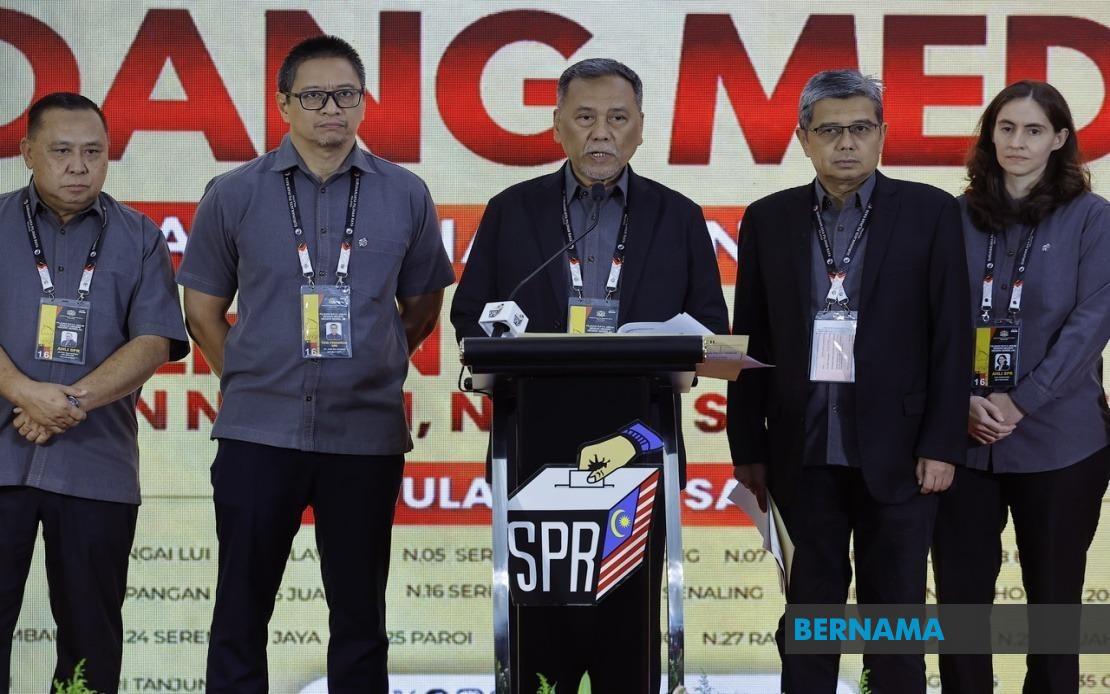
The Negeri Sembilan state election is shaping up to be a competitive contest, with the Election Commission confirming that 103 candidates have been cleared to contest across the state's 36 legislative seats. The validation process concluded on July 18 after nomination submissions officially closed at 10 am at eight centres throughout the state, with EC chairman Datuk Seri Ramlan Harun overseeing the verification of all candidacies at a subsequent press conference.
Pakatan Harapan has established itself as the frontrunner in candidate numbers, fielding 36 nominees across the electoral landscape. The opposition coalition's significantly larger slate reflects its strategic ambitions in the state, where it will seek to consolidate existing support and expand its footprint. Barisan Nasional, the traditional governing force in Malaysian politics, has submitted 25 candidates, positioning itself as a formidable challenger despite fielding fewer contenders than its primary rival.
The field extends beyond these two major coalitions. Bersatu has entered the contest with 24 candidates, reflecting its continued role as a significant player in Malaysian electoral politics despite its fractious relationship with other political formations. Perikatan Nasional, another coalition framework, has fielded 11 candidates, signalling its determination to capture seats in this east-coast state. These numbers underscore the fragmentation of Malaysia's political landscape at the state level, where multiple coalitions and parties compete simultaneously rather than presenting a binary choice to voters.
Smaller political entities have also registered their presence in the election. Berjasa, ASLI, and the Socialist Party of Malaysia each put forward a single candidate, ensuring representation across the ideological spectrum. Additionally, four independent candidates are contesting, reflecting a tradition of individuals running without party affiliation. This diverse candidate pool demonstrates the breadth of democratic participation available to Negeri Sembilan voters, though it also complicates the electoral calculation and potentially fragments the vote in decisive fashion.
The competitive nature of this election is particularly evident in the prevalence of three-cornered contests, which account for 21 of the 36 seats. Three-way races introduce considerable unpredictability compared to direct two-candidate battles, as vote splitting becomes a critical factor in determining outcomes. Eleven seats will see straight contests between two candidates, offering voters a more straightforward choice. Two seats—Nilai and Sri Tanjung—will feature five-cornered battles, whilst Jeram Padang and Rahang will host four-candidate races, further amplifying the complexity of the electoral mathematics.
Demographic analysis of the candidate pool reveals the gender composition of this election's contenders. A total of 94 male candidates significantly outnumber the nine female candidates across all parties and independent candidacies. This disparity, whilst reflecting broader patterns in Malaysian politics, highlights ongoing underrepresentation of women in electoral candidacies at the state level. The age range of candidates spans from 23 years old to 70 years old, with Bersatu fielding the youngest nominee in Sri Tanjung and Pakatan Harapan putting forward a septuagenarian in Gemencheh, demonstrating the diversity of generational representation amongst those seeking office.
The Negeri Sembilan state assembly, which comprises 36 seats, was formally dissolved on June 5, triggering the pathway to this election. The Election Commission has scheduled early voting for July 28, allowing designated groups including military personnel, police officers, and their spouses to cast ballots ahead of the general polling day. The main election will take place on August 1, providing voters across the state with the opportunity to determine the composition of their legislative assembly and, consequently, the formation of the next state government.
The electoral franchise for this contest encompasses 889,490 eligible voters, a substantial constituency reflecting Negeri Sembilan's population base. This figure comprises 867,151 ordinary registered voters, alongside 16,884 military personnel and their spouses, and 5,455 police officers. The inclusion of these latter groups through the early voting mechanism acknowledges the electoral participation rights of uniformed personnel while managing logistical considerations associated with their service duties.
For Malaysian observers and political analysts, the Negeri Sembilan election serves as a significant barometer of electoral sentiment in one of the country's smaller but politically important states. The prevalence of three-cornered contests reflects the broader fragmentation visible in Malaysian politics following the 2022 general election, where no coalition achieved an outright parliamentary majority. How voters in Negeri Sembilan navigate this complex ballot—whether consolidating around major coalitions or distributing support amongst smaller players—will provide insights into the trajectory of Malaysian electoral politics and the viability of coalition frameworks at the state level.

