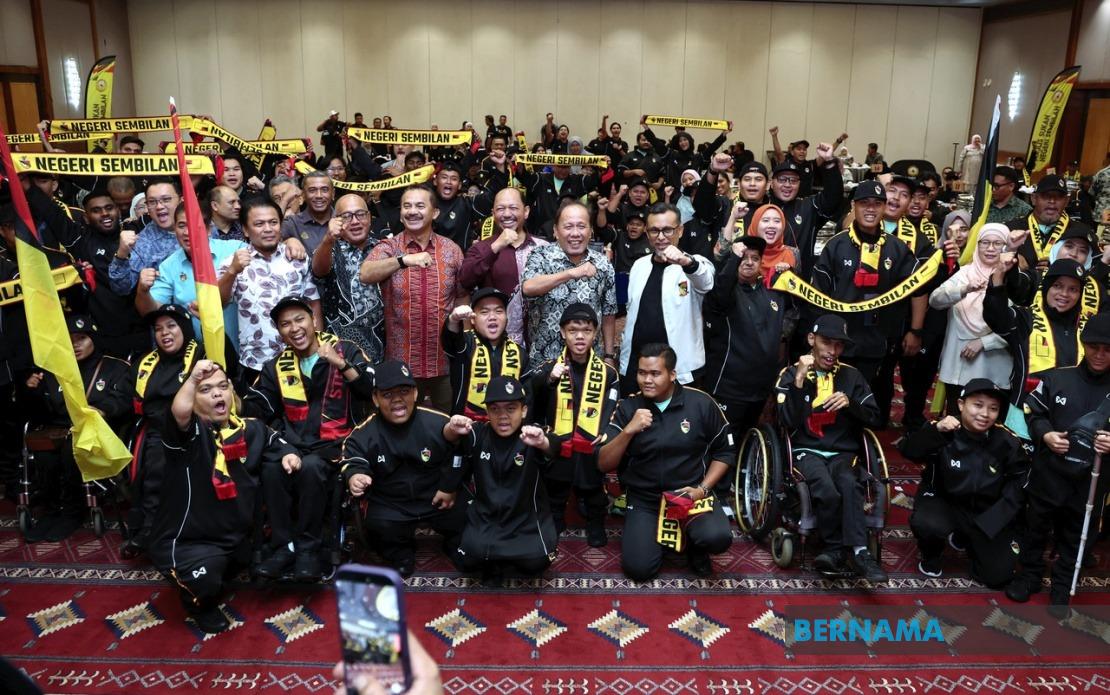
Negeri Sembilan is banking on a determined effort from its contingent of 80 para athletes to capture 12 gold medals at the upcoming 2026 Para Malaysia Games (Para SUKMA) in Selangor, which opens on September 5. The ambitious target reflects the state's determination to bounce back following what Menteri Besar Datuk Ismail Lasim described as a disappointing showing at the recent SUKMA 2026 held in the same year, which concluded on Monday with underwhelming results for the Negeri Sembilan delegation.
The medal objective carries symbolic weight beyond mere numerical aspiration, according to Lasim, who characterised it as a comprehensive reflection of the preparation, discipline and sustained commitment demonstrated by athletes throughout their rigorous training regimen. Speaking at a flag handover ceremony for Para SUKMA officials and team management, the Menteri Besar expressed confidence that the target represents an achievable benchmark grounded in realistic assessment of team capabilities rather than unfounded optimism.
Context surrounding Negeri Sembilan's performance at SUKMA 2026 underscores the urgency of redemption at the para Games. The state contingent managed only seven gold medals from a total haul of 48 medals at the recent traditional Games—a marked deterioration from the 19 gold medals captured from 56 total medals achieved at the same competition two years earlier. This statistical decline prompted state leadership to recalibrate expectations and intensify preparations for the Para SUKMA platform, where athletes compete across disability classifications.
Historical performance at Para SUKMA provides a reference point for evaluating the feasibility of the 12-gold-medal target. At the 2024 Para SUKMA Games held in Sarawak, Negeri Sembilan's para athletes demonstrated considerable strength, capturing 14 gold medals alongside 19 silver and 20 bronze medals for a respectable overall medal tally. The marginal reduction in the gold-medal target from 14 to 12 reflects a conservative recalibration rather than a dramatic downward revision, suggesting confidence remains tempered by realistic assessment of competitive dynamics.
Lasim's rhetoric emphasised the exceptional character and resolute determination inherent to para athletes as a cohort. He portrayed them as possessing an extraordinary fighting spirit capable of restoring institutional pride and reputation through outstanding competitive performance. This framing positions Para SUKMA not merely as an athletic competition but as an opportunity for redemptive narrative-building for Negeri Sembilan following the state's underwhelming conventional Games performance.
The state government is reinforcing competitive motivation through financial incentive structures. Medal-winning athletes will receive tangible rewards, a recognition that monetary recognition can complement intrinsic motivation and acknowledge the sacrifices demanded of high-performance para athletes. Such incentive schemes have become standard practice among Malaysian state contingents competing in national Games, reflecting broader evolution in sports administration toward performer reward structures.
For Malaysian and Southeast Asian observers, Negeri Sembilan's Para SUKMA trajectory illustrates broader dynamics within national para-sport development. The distinction between conventional and para athlete performance—with Negeri Sembilan underperforming at SUKMA 2026 whilst maintaining stronger showings at Para SUKMA—suggests that para sport infrastructure, talent identification, and coaching systems may have evolved differentially across Malaysia's states. This disparity warrants attention from sports administrators evaluating resource allocation and capacity-building priorities.
The September 5 commencement of Para SUKMA 2026 in Selangor represents a significant fixture within Malaysia's sporting calendar. Hosting arrangements in Selangor, the nation's most economically developed state, signify effort to showcase para sport at scale and visibility. Negeri Sembilan's participation within this context positions the state's contingent to compete against other Malaysian state delegations whilst demonstrating para sport capabilities to national audiences.
Lasim's remarks, conveyed through official flag handover protocols involving Chef de Mission and Team Managers, underscore the institutional importance accorded to Para SUKMA preparation. Attendance by Negeri Sembilan Sports Council director Marhizah Abdul Razak and State Youth and Sports Development Action Committee chairman Datuk Mustapha Nagoor confirmed multi-level administrative engagement in contingent preparation, suggesting comprehensive coordination spanning sporting, youth development, and state administrative structures.
The 12-gold-medal target must be contextualised within competitive landscape dynamics at Para SUKMA. Success depends not only on individual athlete performance but on whether competing state contingents maintain, improve, or decline from previous Games. Selangor, the host state, typically deploys substantial resources and exhibits advanced para-sport infrastructure, potentially establishing formidable competition. Other developed states similarly maintain competitive para-sport programmes, meaning Negeri Sembilan's target, whilst achievable relative to historical precedent, faces intensive competitive pressure.
Beyond medal accumulation, Negeri Sembilan's engagement with Para SUKMA reflects evolving recognition within Malaysian sport that para athletes merit institutional investment, public attention, and state pride equivalent to conventional athletes. The transition from reactive apology regarding SUKMA 2026 performance toward proactive confidence-building regarding Para SUKMA suggests strategic repositioning where para sport becomes a platform for state reputation enhancement rather than ancillary consideration.
The path toward the 12-gold-medal objective will unfold across multiple sports and disability classifications throughout September's Para SUKMA 2026 competition. Negeri Sembilan's 80-athlete contingent will encounter competitors similarly motivated across diverse events, with outcomes dependent upon technical preparation, mental resilience, and competitive match-ups determined through draw mechanics. Ultimately, the target represents both quantifiable aspiration and qualitative commitment to demonstrating para athlete excellence representing Malaysian state pride.

