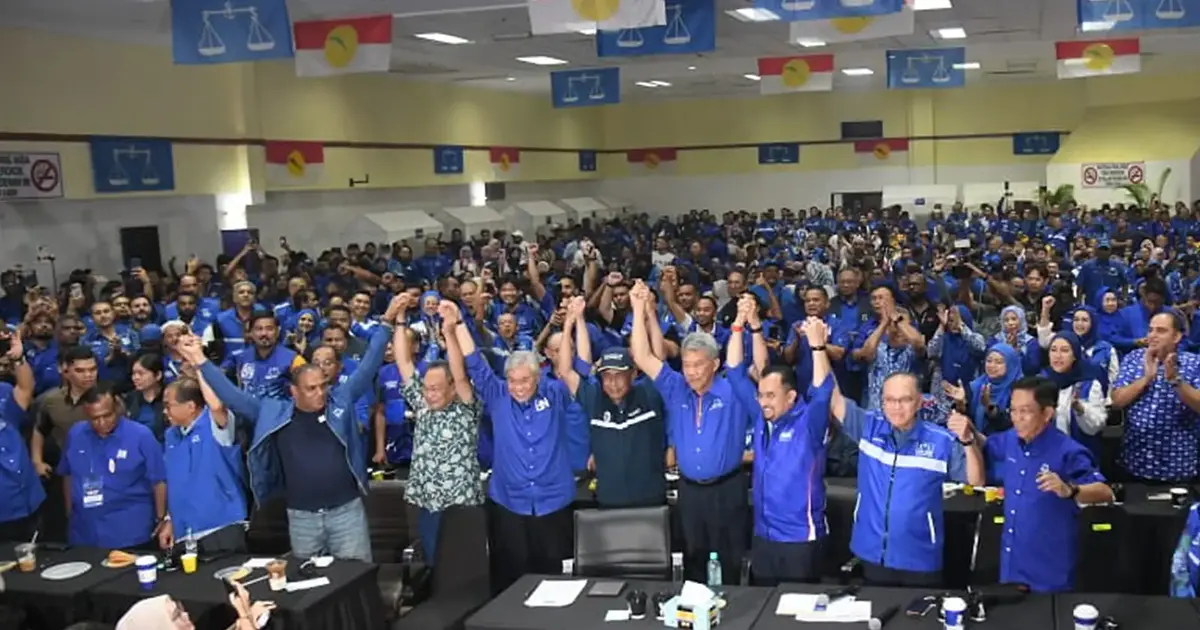
The recent Negeri Sembilan state election has delivered a decisive mandate to Barisan Nasional, reinforcing the coalition's resurgence across Malaysian politics and providing momentum as the federal government navigates an increasingly fragmented political environment. The results represent more than a routine state-level contest—they expose deepening vulnerabilities within the opposition Pakatan Harapan bloc and hint at emerging structural problems within the Perikatan Nasional coalition that supports the current national administration.
Barisan Nasional's commanding performance in Negeri Sembilan reflects a broader recovery trajectory for the traditional ruling coalition, which faced near-extinction following the 2018 general election. The coalition's ability to consolidate voter support across multiple state constituencies demonstrates that the organization and party machinery rebuilt over the past five years remains potent at the state level. This success carries particular significance because Negeri Sembilan sits geographically between the federal capital and Selangor, a key strategic location for testing messaging and on-the-ground operations ahead of national contests.
The implications for Pakatan Harapan stretch beyond disappointed expectations in a single state election. The opposition coalition, which governed Malaysia from 2018 to 2020, has struggled to maintain electoral momentum despite controlling several large states including Selangor and Penang. The Negeri Sembilan results suggest that the reform agenda and anti-corruption narrative that mobilized voters five years ago has lost potency, particularly among traditional supporters who may view the opposition as divided and administratively inconsistent across different state governments. For Malaysian voters accustomed to seeing Pakatan Harapan as a unified alternative to Barisan Nasional, recent infighting and internal defections have created an impression of political immaturity.
The performance also exposes significant fissures within Perikatan Nasional, the coalition nominally supporting Prime Minister Anwar Ibrahim's administration. Bersatu, the party led by former Premier Mahathir Mohamad that provides crucial support to the federal government, faces serious questions about its electoral viability and organizational sustainability. In state contests, Bersatu's participation often complicates rather than strengthens government-aligned campaigns, particularly where the party lacks deep grassroots networks. The tension between Bersatu's ministerial representation at federal level and its marginal electoral performance creates an unstable dynamic that could reshape national coalitions.
For Negeri Sembilan specifically, Barisan Nasional's victory allows the coalition to govern without the complications of managing coalition partners with competing agendas. The state can proceed with unified decision-making on economic policy, land development, and service delivery—areas where multi-party administrations often experience gridlock. However, the coalition must demonstrate tangible improvements in state welfare and infrastructure to consolidate support, particularly given the high expectations that accompany decisive electoral victories.
The regional implications extend across Southeast Asia's wider political context. Malaysia's electoral system increasingly resembles those of Thailand and Singapore, where a single dominant coalition maintains institutional advantages that smaller parties struggle to overcome. Barisan Nasional's recovery suggests that traditional establishments can resurrect political fortunes through careful institutional management and messaging adjustment, even after catastrophic electoral defeats. This pattern may offer lessons—both cautionary and strategic—for other regional political formations navigating comparable transitions.
Pakatan Harapan's pathway forward requires fundamental strategic reassessment. The coalition must either unify its component parties around a coherent platform or acknowledge that the broad church model of opposition politics cannot sustain electoral momentum indefinitely. Anwar Ibrahim's administrations in Selangor, Penang, and other states offer concrete records to defend or critique, but the opposition has not yet articulated how these records translate into a compelling national vision distinguishable from Barisan Nasional's renewed brand.
Bersatu's position within Perikatan Nasional remains particularly fragile. The party entered federal coalition politics as the kingmaker that could neither govern alone nor disappear from the national stage. Negeri Sembilan's results underscore that Bersatu cannot deliver consistent electoral support in state contests, raising questions about its long-term utility to coalition partners. If federal coalition partners increasingly view Bersatu as a liability rather than an asset, incentives exist for realigning the national government without Bersatu's participation—a development that would fundamentally reshape Malaysian governance structures.
The election also reflects evolving voter preferences across social and economic divides. Urban voters, particularly younger and educated demographics, appear to have fragmented their support less cohesively than during 2018 or 2022, suggesting that Malaysia's political realignment remains incomplete. Rural voters, traditionally Barisan Nasional strongholds, have consolidated support, indicating that the coalition's institutional advantages in non-urban areas remain robust. These geographic and demographic patterns will prove crucial as attention turns toward the next federal election, when national stakes will force clearer voter polarization than state contests typically generate.
Moving forward, Malaysian political observers should monitor whether Barisan Nasional can translate state-level victories into sustained federal dominance, whether Pakatan Harapan can rebuild coherence and momentum, and whether Bersatu can justify its continued existence as an independent political force. Negeri Sembilan provided early answers suggesting that the post-2020 era of unstable coalitions and fluid alignments may be stabilizing into a more conventional pattern where one coalition holds decisive advantage. This consolidation could reduce political volatility, but it may also constrain the competitive democracy that Malaysian voters have grown accustomed to experiencing over the past two decades.

