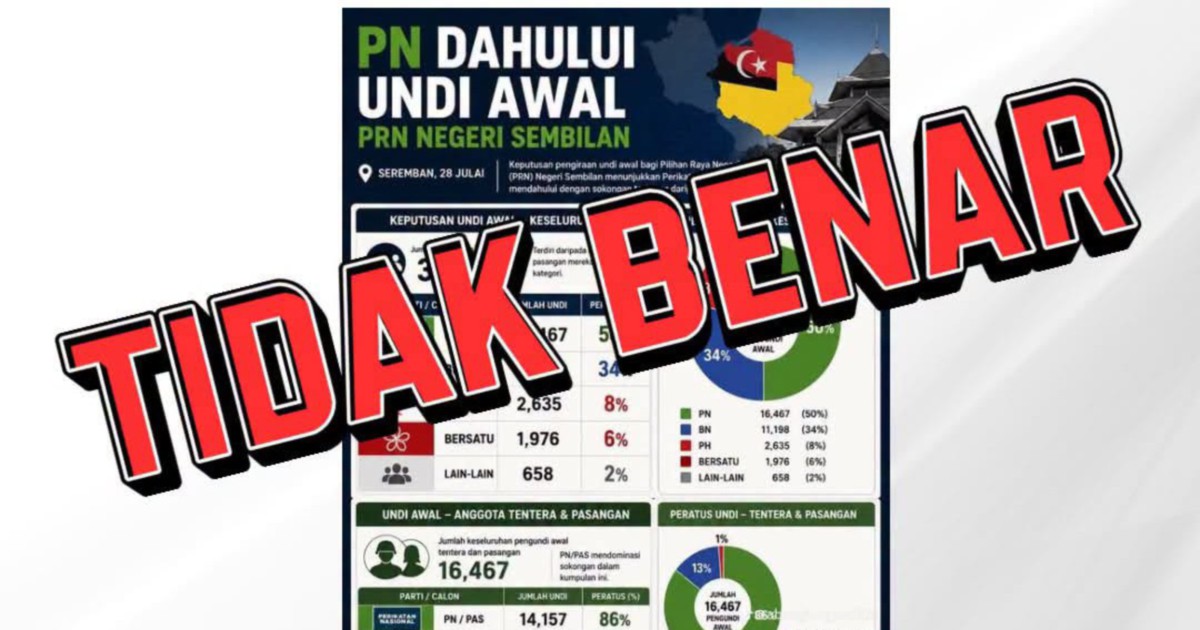
The Election Commission officially confirmed Friday that the tallying of early votes for the 16th Negeri Sembilan state election will commence at 5pm this Saturday, establishing a clear timeline for the crucial first phase of the voting process that has drawn considerable public attention. The announcement from the electoral body came as part of efforts to maintain transparency and manage expectations around one of the state's most closely watched political contests in recent years.
The early voting mechanism represents a significant portion of total ballots cast in Malaysian state elections, comprising votes from election officials, security personnel, and other designated groups permitted to cast ballots ahead of general polling day. In previous elections, these early votes have sometimes provided early indicators of electoral momentum, leading to intense public scrutiny of the counting process and results announcement timing. The EC's decision to set a specific commencement hour aims to prevent confusion and ensure proper coordination of polling and counting operations.
Saturday's 5pm timeline allows adequate preparation time following the conclusion of early voting sessions, which typically occur on Friday. The staggered approach to vote tabulation—processing early votes separately before the main election count—has become standard practice in Malaysian electoral procedures, enabling officials to verify procedures and ensure accuracy before managing the substantially larger volume of general election day ballots. This methodical approach reflects the EC's commitment to electoral integrity despite mounting public pressure for rapid result announcements.
Beyond the procedural clarity, the EC also felt compelled to address misleading claims circulating on social media platforms alleging that Perikatan Nasional had already established a commanding lead in the race. These viral assertions, which emerged despite voting not yet concluding and results remaining entirely unavailable, represented the kind of false information that can influence voter behaviour and undermine confidence in electoral processes. The EC's direct rebuttal of these claims underscores growing challenges electoral authorities face in managing information ecosystems during campaigns.
The Negeri Sembilan election has generated unusually high engagement across digital platforms, with various political coalitions and their supporters actively promoting narratives to shape public perception. The emergence of unfounded claims about opposition performance suggests either deliberate disinformation efforts or the natural tendency for supporters to speculate about likely outcomes based on preliminary polling data or sentiment analysis. Regardless of origin, such claims can distort the authentic electoral process and warrant official clarification.
The 16th Negeri Sembilan state election represents a competitive contest where control of the state assembly remains genuinely contested between major political coalitions. The Barisan Nasional administration, which has governed the state for decades, faces challenges from both Pakatan Harapan and Perikatan Nasional, creating a triangular competition that could produce unexpected results. Early vote patterns may genuinely indicate momentum, but premature declarations of victory lack any factual foundation and serve only to spread confusion.
For Malaysian voters observing the contest, the EC's clarification about the Saturday timing provides essential information for those planning to follow the count or access official results announcements. The 5pm commencement gives media organisations, political parties, and the general public a defined moment to focus attention, reducing ambiguity about when credible information will emerge. This contrasts sharply with the uncertainty created when false claims proliferate unchecked across social platforms.
The broader context reveals how Southeast Asian democracies increasingly struggle with election-related misinformation as digital communication becomes central to political campaigns. Malaysia's experience across recent federal and state elections demonstrates that institutional measures—such as clear procedural announcements—must work alongside media literacy initiatives and platform accountability to combat false narratives. The EC's proactive debunking of specific claims represents an increasingly necessary function for electoral bodies in the digital age.
Regional observers note that similar challenges with false election claims have emerged across Southeast Asia, from Thailand to the Philippines, suggesting shared vulnerabilities in how information spreads during politically sensitive periods. Malaysia's approach to addressing these issues through direct EC statements may offer insights for neighbouring countries developing their own election-related misinformation strategies. The interplay between traditional electoral procedures and digital information management will likely define election integrity across the region for years to come.
As Negeri Sembilan residents prepare for their state election, the combination of procedural clarity and factual correction from the EC aims to restore focus to the substantive political choices before voters. Saturday's early vote count promises to deliver the first genuine insight into electoral sentiment, providing voters and analysts alike with reliable data on which to base subsequent assessments. Until then, the EC's message remains clear: only officially announced results from properly conducted counting procedures merit public acceptance and political significance.

