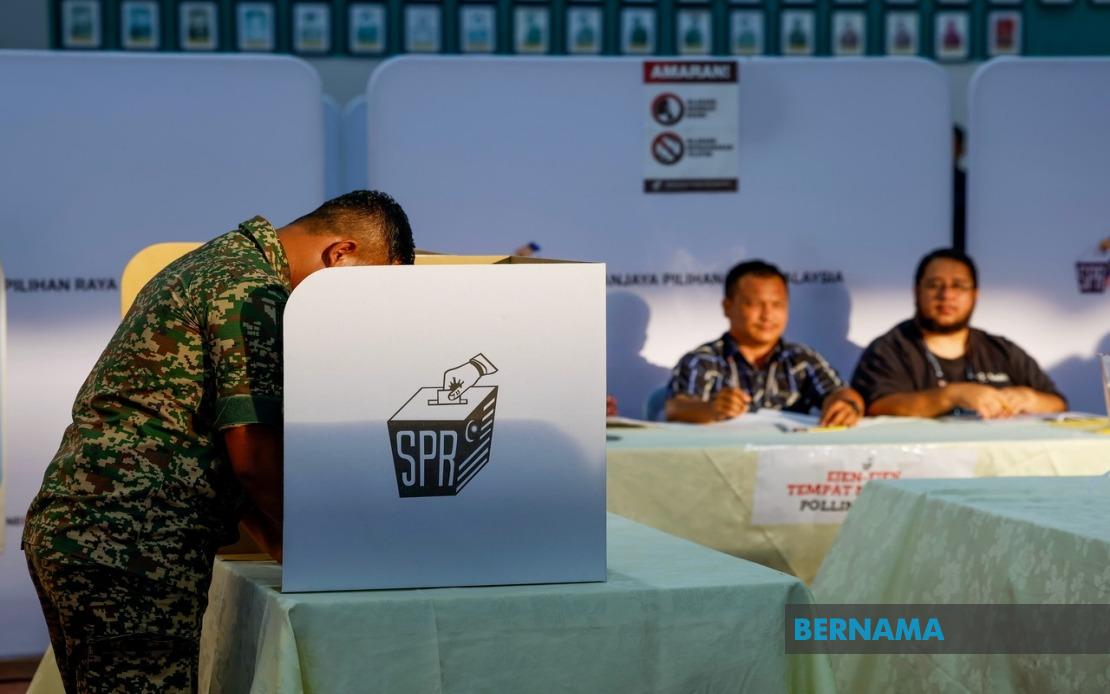
The 16th Negeri Sembilan state election witnessed a respectable early voting turnout during the morning phase, with 14.31 per cent of registered early voters having submitted their ballots by 9 am. This participation rate, while representing a preliminary snapshot of engagement levels among designated voter categories, reflected the administrative efficiency of the Election Commission in managing simultaneous polling operations across multiple locations. The voting bloc comprised uniformed service personnel and their spouses, a demographic traditionally afforded advance voting privileges to accommodate their operational commitments and service obligations.
Amongst the 3,356 votes tallied during the early morning window were contributions from 1,431 military personnel and 925 police officers, alongside their spouses. This composition underscores the deliberate inclusion of security and defence sector employees in Malaysia's democratic process, recognising the practical constraints these professionals face in securing leave during general polling periods. The participation of these groups, drawn from across the state, demonstrated their commitment to exercising franchise rights despite operational demands that typically restrict their availability on standard election days.
The Election Commission's logistical framework for early voting proved comprehensive, with 38 polling centres operating simultaneously from 8 am. These facilities had been established to serve the total pool of 22,389 registered early voters eligible to participate in this preliminary phase. The staggered establishment of multiple centres across Negeri Sembilan's geography reflected careful planning to minimise queuing and accommodate the dispersed locations where eligible voters were stationed or residing. This infrastructure represented a significant administrative undertaking, requiring coordination of election officials, security personnel, and support staff across diverse venues.
Operational flexibility characterised the closing arrangements for these early polling locations, with centres scheduled to shut down in phased intervals between noon and 5 pm. Rather than imposing a uniform closure time across all venues, the Election Commission adopted a differentiated approach that accounted for local voter numbers and geographic particularities. This staggered model aimed to prevent bottlenecks while ensuring orderly procedures and maintaining the integrity of ballot handling processes as voting concluded. Such operational nuance reflected lessons learned from previous electoral exercises and contemporary best practices in election management.
The broader electoral context for Negeri Sembilan involves competitive positioning across 36 state constituencies, with 103 candidates fielded across these seats. This candidate-to-seat ratio of approximately 2.9:1 indicates a moderately contested election environment, with multiple contenders vying for representation in several constituencies while others faced less competitive races. The distribution of candidacies across the 36 seats would likely reflect patterns of incumbent consolidation, opposition challenges, and multi-cornered contests that characterise contemporary Malaysian state politics. The overall candidate pool suggested genuine electoral competition, though geographical variations would determine the intensity of contests in individual divisions.
General polling for Negeri Sembilan's broader electorate was scheduled for 28 July, the same day as early voting operations. This simultaneous arrangement aimed to streamline the overall election calendar while managing electoral administration efficiently. The main voting day would determine outcomes for the 889,490 registered voters comprising Negeri Sembilan's general electoral population. This substantially larger voter base dwarfed the early voting component, positioning the general polling phase as the determinative phase of the electoral exercise. The compression of voting into a single day for the general electorate, supported by advance polling for designated groups, represented a recognised approach to managing Malaysia's state-level electoral cycles.
For Malaysian readers and regional observers, the Negeri Sembilan election carried significance beyond the immediate question of state representation. As a barometer of electoral sentiment in a crucial component of Malaysia's federal structure, the state contest would provide insights into voter preferences and political dynamics in a region that maintains considerable economic and political importance. State elections frequently signal shifts in public opinion that subsequently influence calculations at federal level, making Negeri Sembilan's outcome potentially indicative of broader trends in electoral behaviour and coalition preferences. The state's positioning within the broader peninsular political landscape gave the exercise additional weight beyond its immediate constituency implications.
The early voting process, while confined to a subset of the eligible population, offered preliminary indications of administrative capability and public engagement with electoral procedures. The relatively steady participation rate during morning hours suggested that logistical arrangements were functioning appropriately and that designated voters were accessing their entitlements. As voting continued throughout the day and into the afternoon, patterns of turnout would accumulate to provide a fuller picture of participation levels amongst early voters. These preliminary figures would subsequently be contextualised against final tallies from general polling to assess overall electoral engagement across Negeri Sembilan's population.
The management of security sector participation in Malaysia's electoral process reflects broader democratic commitments to ensuring that state employees, despite their service obligations, maintain rights to political participation. By facilitating advance voting, the Election Commission acknowledges the reality that certain professional groups require accommodation to exercise franchise effectively. This institutional recognition of practical challenges to universal suffrage embodies a pragmatic approach to democratic administration, ensuring that vocational commitment does not result in effective disenfranchisement. The early voting framework thus represents a mechanism for reconciling professional service requirements with democratic participation principles that underpin Malaysia's electoral system.

