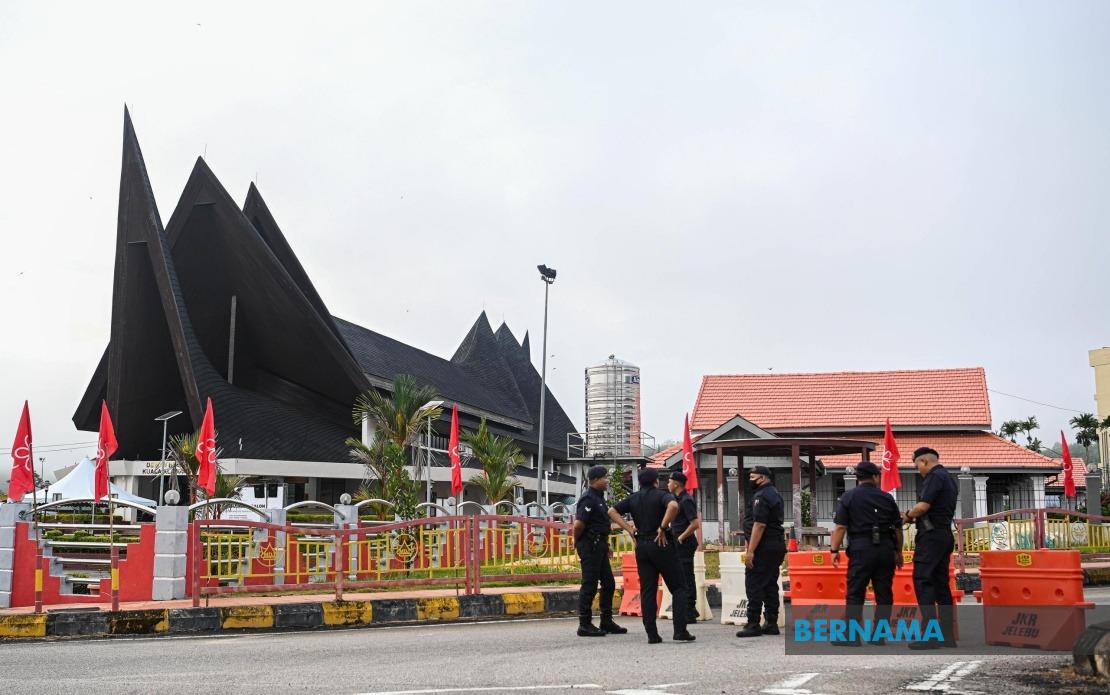
Clear skies and settled weather greeted Negeri Sembilan as the state embarked on a critical political milestone on July 18, with the nomination process for the 16th State Election formally opening at eight designated centres statewide. The conditions provided an auspicious backdrop for what promises to be a competitive and complex electoral contest, with Election Commission personnel deployed across all venues to manage the orderly registration of candidates beginning at 9 am and concluding within a single hour.
The machinery of the electoral process was methodically assembled in the hours before nominations opened. Election Commission officials undertook systematic preparations to ensure procedural integrity and operational efficiency, while media contingents began positioning themselves from early morning to capture the unfolding political drama. The arrival of party supporters, gradual but steady throughout the morning, underscored the significance that political organisations and their grassroots bases attached to the nomination day, recognising it as a symbolic threshold in the campaign period.
Negeri Sembilan's 36-seat State Assembly had been dissolved on June 5, setting the electoral machinery in motion. The Election Commission subsequently calendared July 28 for early voting, allowing civil servants, essential workers, and others unable to vote on polling day to participate. The actual general election is scheduled for August 1, providing a concentrated campaign window of less than two weeks for parties to mobilise voters and articulate their manifestos.
The electorate participating in this contest comprises nearly 890,000 registered voters across the state. Breaking down the composition, 867,151 are ordinary civilian voters who form the core of the electoral base. An additional 16,884 military personnel and their spouses are eligible to cast ballots, reflecting the significant armed forces presence in Negeri Sembilan. Police officers and their families add another 5,455 voters to the rolls. This diverse voter pool spanning civilian, military, and law enforcement communities presents distinct challenges and opportunities for political strategists seeking to construct winning coalitions.
The competitive landscape reveals a fragmented political arena where multiple coalitions and independent actors are vying for representation. Pakatan Harapan has committed to contesting all 36 seats, signalling an aggressive strategy to dominate the state legislature. This represents the strongest position among the major coalitions and reflects confidence in the opposition bloc's ground organisation and voter appeal. Barisan Nasional, the traditional governing force in Malaysian politics, is adopting a more selective approach, fielding candidates in 25 of the 36 constituencies, suggesting either resource constraints or calculated decisions to concentrate efforts in stronghold and winnable seats.
Perikatan Nasional, the newer political alliance that has gained significant traction in recent Malaysian elections, is contesting 11 seats, maintaining a meaningful presence without attempting a comprehensive challenge. The landscape is further diversified by smaller parties and movements. Parti Orang Asli Malaysia, representing indigenous communities, Parti Sosialis Malaysia representing left-wing interests, and Parti Barisan Jemaah Islamiah Se-Malaysia representing Islamist constituencies each plan to contest a single seat, adding ideological and communal dimensions to the election beyond mainstream coalition competition.
The most recent entrant to this contest is Parti Pribumi Bersatu Malaysia, which finalised its participation strategy during the nomination period itself. Bersatu is contesting 24 of the 36 seats as a solo political force, a decision that reflects the party's evolving position within Malaysia's fractured political landscape. The party has incorporated Parti Bersepakat Hak Rakyat Malaysia (Urimai) into its campaign structure, with Urimai candidates contesting two seats under the Bersatu logo, effectively creating a technical alliance while maintaining nominal independence.
The current political configuration differs markedly from outcomes in the immediately preceding state election. When Negeri Sembilan voters went to the polls in 2023, Pakatan Harapan secured 17 of 36 seats, establishing the largest single bloc but falling short of the 19-seat majority required for outright control. Barisan Nasional captured 14 seats, maintaining substantial parliamentary representation despite declining electoral fortunes compared to its historical dominance. Perikatan Nasional won five seats, establishing itself as a meaningful force in state politics. No other parties or independent candidates succeeded in winning representation. The 2023 outcome therefore reflected a three-way split in which coalition management and cross-coalition agreements would be necessary to form a functional government.
For Malaysian observers and Southeast Asian analysts tracking political developments, the Negeri Sembilan election carries wider significance. The state serves as a testing ground for political strategies and electoral appeals that may reverberate nationally. The performance of established coalitions against newer political actors, the resilience or fragility of support bases, and the effectiveness of campaign messaging will provide insights into voter sentiment across Peninsular Malaysia. The willingness of political actors to compete selectively rather than comprehensively, as demonstrated by Barisan Nasional and Perikatan Nasional, may indicate strategic recalibrations occurring within Malaysian politics as traditional hierarchies continue to shift.
The nomination process itself, proceeding smoothly under favorable climatic conditions, established the formal parameters for electoral competition. Once all candidates have been registered and nomination lists finalised, the next critical juncture arrives with the August 1 polling day. Between now and that date, political parties will seek to mobilise supporters, persuade undecided voters, and consolidate their respective bases. The concentrated campaign period, spanning less than two weeks, will test the organisational capabilities and popular resonance of competing political forces as they contend for the mandate to govern this central Malaysian state.

