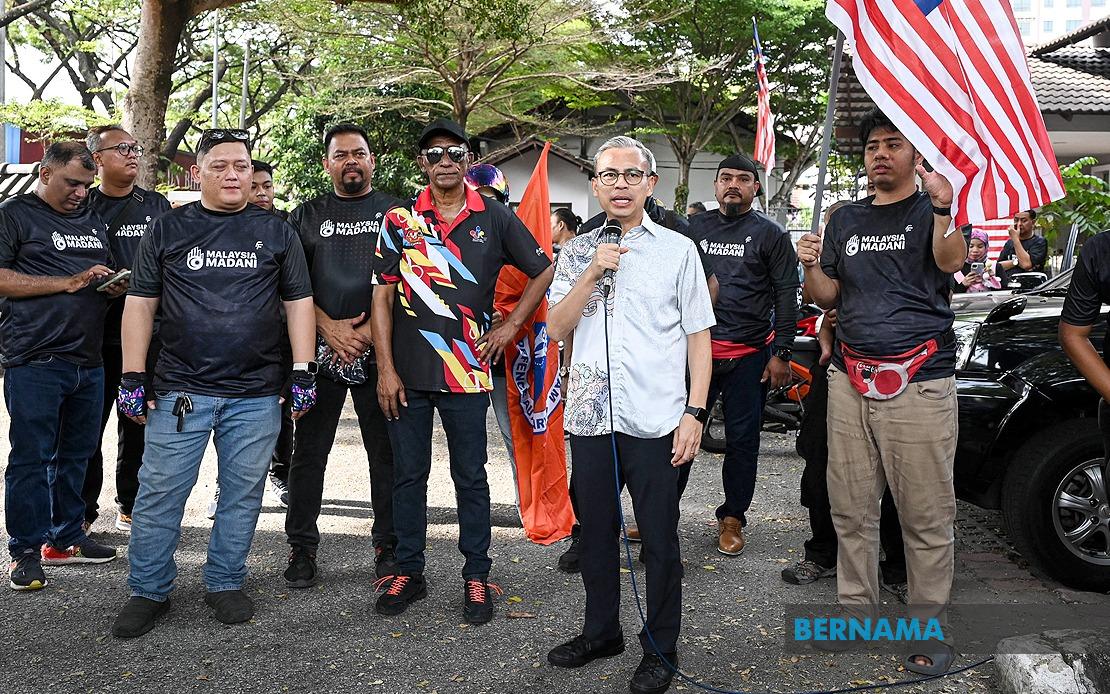
Nearly 300 motorcyclists converged on Kuala Lumpur's Lembah Pantai constituency to participate in the Kembara Merdeka Convoy, a community-driven initiative designed to amplify the nation's pre-independence celebrations. The event, held on the eve of Malaysia's National Day, brought together residents from across the diverse neighbourhood in a display of collective spirit and shared belonging. Communications Minister Datuk Seri Fahmi Fadzil, who represents the Lembah Pantai constituency, championed the convoy as a platform to showcase the strength of Malaysia's pluralistic society.
Fahmi's message at the programme centred on leveraging the area's ethnic and cultural diversity as a unifying force rather than a point of division. In his remarks, he stressed that Lembah Pantai residents exemplify the broader Malaysian experience—a tapestry woven from multiple backgrounds and traditions. The minister's emphasis on unity resonates particularly in an urban constituency where communities of different faiths, languages, and ancestries live in close proximity, often setting the tone for how neighbourhoods across Malaysia navigate their collective identity. By framing the convoy as an expression of Malaysian-ness that transcends individual ethnic lines, Fahmi positioned the event within a larger narrative about the nation's foundational values.
The motorcade itself traced a purposeful route through several key locations within Lembah Pantai, beginning its journey at Taman Seri Sentosa before proceeding through five designated stops. The path took participants through Kampung Pasir, IWK Eco Park, and the Vista Angkasa area in Kampung Kerinchi, ultimately concluding at Bangsar LRT station. This deliberate routing served multiple functions: it brought Merdeka festivities to different pockets of the constituency, ensured visibility across multiple neighbourhoods, and created waypoints for community interaction and engagement throughout the convoy's progression.
A symbolic element underscored the convoy's patriotic dimension. At each of the five pit stops, participating motorcyclists transferred Jalur Gemilang flags to local representatives, including members of the Resident Representative Council and community leaders. This flag-handover ritual transformed what could have been a purely recreational motorcade into a ceremonial expression of national pride and shared stewardship. By distributing the nation's flag through multiple community touchpoints rather than concentrating them in a single location, organisers ensured that the symbol of Malaysian identity reached diverse groups and neighbourhoods simultaneously.
Fahmi articulated an explicit hope that the communal spirit demonstrated during the convoy would not remain confined to a single event. His call for sustained engagement reflects a broader understanding that national unity requires continuous reinforcement through regular community activities and shared initiatives. The minister envisioned the convoy as a catalyst for deeper, ongoing relationships rather than an isolated celebration, suggesting follow-up programmes encompassing charitable assistance, community contributions, and subsequent Merdeka-related activities. This forward-looking perspective acknowledges that patriotism and inter-ethnic harmony are not static achievements but dynamic practices requiring regular renewal.
The choice of motorcycles as the vehicle for this unity message carries particular significance in Malaysian urban culture. Motorcyclists represent a cross-section of society spanning socioeconomic backgrounds, professions, and age groups. Unlike initiatives that might appeal to a narrower demographic, a motorcycle convoy inherently attracts participants from diverse walks of life, making it an inclusive framework for community participation. The scale of participation—nearly 300 riders—demonstrates genuine grassroots interest in both national celebrations and local community building, suggesting that Merdeka observance remains a motivating force for collective action.
Timing the convoy for Merdeka eve rather than National Day itself carries strategic implications for community engagement. By launching the celebrations a day early, organisers extended the festive period and created an opportunity for residents to build momentum heading into the official holiday. This sequencing also reflects a recognition that civic enthusiasm requires activation and that traditions deepen when communities engage in deliberate, ceremonial preparations rather than merely observing designated dates passively. The convoy effectively transformed the eve into an active celebration rather than a quieter prelude.
For Lembah Pantai specifically, the convoy represents a visible assertion of the constituency's multicultural character at a moment of heightened national focus. As an urban district encompassing various communities, income levels, and backgrounds, Lembah Pantai embodies both the opportunities and challenges of Malaysia's plural society. Events such as this convoy provide opportunities for local leaders to model and reinforce how diversity strengthens rather than threatens social cohesion. By prominently featuring multi-ethnicity as the convoy's central theme, Fahmi positioned the constituency as a exemplar of Malaysian identity at its most inclusive.
The involvement of resident associations and community councils in receiving the Jalur Gemilang flags also distributed ownership of Merdeka celebrations beyond government structures into neighbourhood-level institutions. This decentralisation of participation recognises that national patriotism finds its most authentic expression through local communities rather than top-down mobilisation alone. By empowering resident councils to become custodians of the flag at their respective pit stops, the event validated the role of grassroots organising in shaping how Malaysians express national identity.
Beyond the immediate spectacle, the Lembah Pantai Kembara Merdeka Convoy illustrates how Malaysian constituencies are experimenting with different formats for celebrating independence and fostering civic engagement. Rather than confining National Day observances to official ceremonies or passive flag displays, this initiative combined patriotic symbolism with community participation in a manner accessible to ordinary residents. The motorcycle convoy format, in particular, offers a replicable model that other constituencies might adopt to activate their own communities during festive periods.

