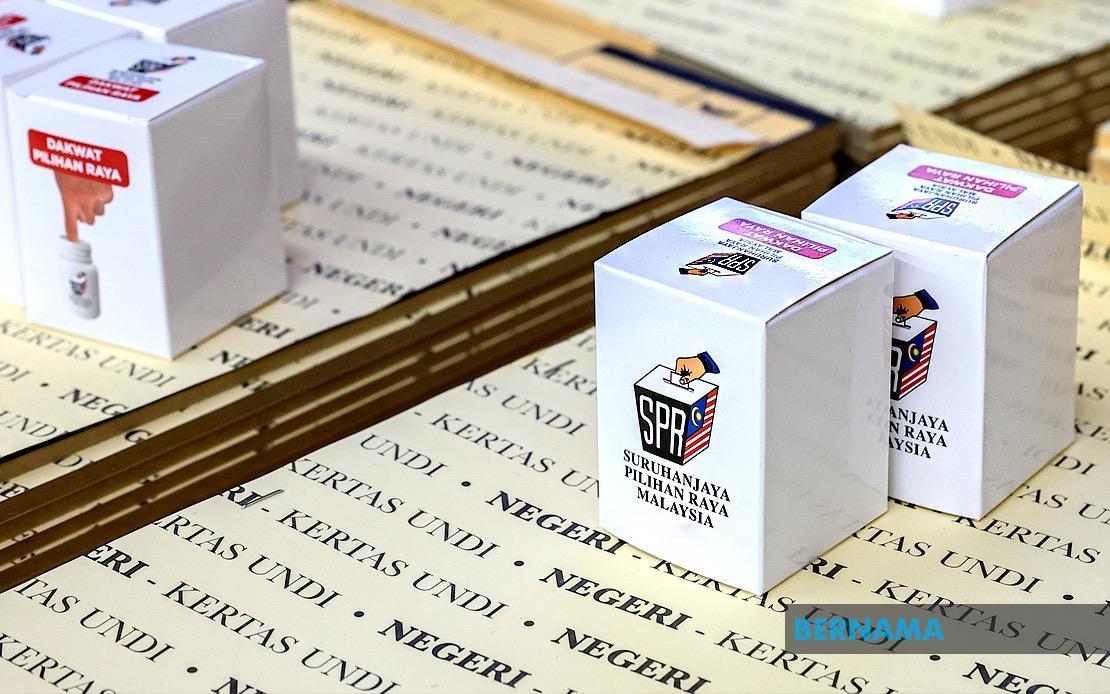
The 16th Johor State Election enters a critical phase tomorrow as close to 25,000 early voters prepare to cast their ballots across the state, part of established electoral procedures that allow serving military and police personnel to fulfil their democratic duty before the main polling day on Saturday, July 11. These 24,751 early voters comprise two distinct groups: 12,041 military personnel along with their spouses, and 12,710 police officers accompanied by their families, reflecting the security sector's traditionally high participation rate in Malaysian elections.
Across Johor, 64 dedicated early voting centres have been established to accommodate this significant cohort. The infrastructure divides neatly between the two forces, with 53 centres designated for police personnel and their relatives, while 11 centres will serve military personnel and their families. All polling stations will commence operations simultaneously at 8 am tomorrow, creating a coordinated electoral exercise that ensures efficiency and reduces logistical complications. The staggered closing times, ranging from noon through to 6 pm depending on each centre's voter load and geographic location, reflect thoughtful planning to accommodate varying turn-out levels across the state.
Within the police sector's early voting arrangements, the breakdown shows that 12,067 personnel and their spouses intend to vote in person at their designated centres tomorrow. However, an additional 643 police-affiliated voters have opted for postal voting, exercising an alternative arrangement that recognises the operational demands placed on security personnel. This flexibility in voting methods demonstrates how Malaysia's electoral commission accommodates the particular constraints of uniformed services, ensuring that no eligible voter is disenfranchised due to duty commitments.
Maintaining order and security throughout these early polling operations demands substantial personnel deployment. The police force has mobilised 3,565 dedicated officers and civilian staff to oversee the process, a deployment that underscores the electoral commission's commitment to ensuring smooth, protected voting. This workforce breaks down into 647 commissioned officers, 2,806 rank-and-file personnel, and 112 civilian administrative staff, each fulfilling specific operational responsibilities. Their duties encompass a comprehensive range of activities: establishing security perimeters at each voting centre, escorting ballot boxes through transport routes, managing traffic flow in surrounding areas, maintaining crime-prevention patrols to deter disorder, staffing operations command centres, supervising strategic locations, and enforcing regulations across all affected districts.
The geographic distribution of voting centres across Johor reveals interesting patterns in voter concentration within the security sector. Several small outposts—including the Buloh Kasap Police Station in Segamat, Tenang Police Station in Labis, and Bandar Penawar Police Station—will serve only six to twenty-eight voters each, justifying their closure at noon once these voters have completed their democratic exercise. Conversely, the Federal Reserve Unit Hall Number 2 at Johor Police Headquarters stands as the largest single early polling centre, drawing 1,338 personnel affiliated with the Stulang state constituency alone. Equally significant is the KEMAS Preschool facility at the 6th General Operations Force Battalion in Bakri, which anticipates 927 voters from the Bukit Naning constituency. These concentration points highlight how security sector distribution reflects population settlement patterns and administrative jurisdictions across the state.
Weather conditions pose a secondary consideration in the electoral planning for tomorrow. Malaysia's Meteorological Department has issued forecasts indicating morning rainfall across four specific districts: Batu Pahat, Muar, Pontian, and Tangkak. The remainder of Johor is expected to experience fair weather conditions, suggesting that inclement weather will not significantly impede voting operations across most of the state. Nevertheless, organisers will likely monitor conditions in the affected districts, as rain can occasionally slow traffic and foot traffic to polling centres, potentially affecting the timing of closures.
The Johor state election context frames these early voting operations within a broader electoral competition. Saturday's poll will determine control of the state legislature through voting in 56 constituencies, with 172 candidates standing across these seats. This represents a substantial electoral exercise for Malaysia's southernmost mainland peninsula state, reflecting both the competitive nature of Johor politics and the diversity of candidates and parties vying for representation. The early voting phase tomorrow thus serves as a preliminary indicator of voter engagement levels, though the security force's demographic characteristics make direct extrapolation to general voting patterns difficult.
These early voting arrangements reflect international best practices in electoral administration, acknowledging that uniformed services require special accommodation to balance their civic obligations against professional duties. Most democracies implement comparable systems, recognising that the military and police deserve equal opportunity to participate in electoral processes despite operational demands. Malaysia's implementation through a two-tier centre structure (police and military) with comprehensive security oversight demonstrates institutional maturity in election management, even while handling the logistical complexity of processing tens of thousands of voters across dispersed geographic areas within compressed timeframes.
For Malaysian and Southeast Asian observers, Johor's electoral processes merit attention as a case study in managing security force participation within democratic systems. The detailed deployment of personnel, the geographic distribution of polling centres, and the coordination between civil and security administrations illustrate how a developing democracy manages the technical and administrative dimensions of elections. As Johor voters exercise their franchise tomorrow and on Saturday, the state contributes to Malaysia's ongoing democratic experience, particularly in demonstrating how electoral integrity and operational security can coexist within professional standards.

