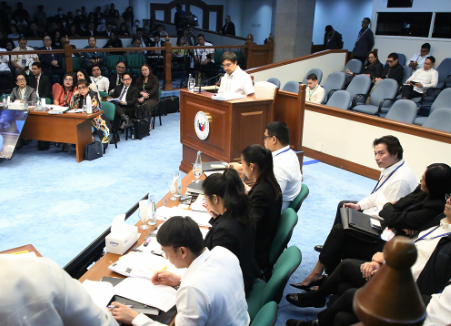
During the fifth day of Vice President Sara Duterte's impeachment trial before the Senate on Tuesday, a senior National Bureau of Investigation official provided testimony asserting that the Vice President possessed the wherewithal to act on assassination threats she made publicly against President Ferdinand Marcos and his immediate family. Jeremy Lotoc, the NBI's regional director and former chief of the Cybercrime Division, told Senate President Sherwin Gatchalian that Duterte's capacity to execute her stated intentions was beyond question, lending weight to prosecutors' argument that her remarks constituted grave threats and an impeachable betrayal of public trust.
The NBI's investigative conclusions, according to Lotoc's testimony, rested on establishing that Duterte's statements were neither casual nor empty bluster but rather "serious, real and active." Prosecutors building their case sought to demonstrate that her office as Vice President, combined with her influential political pedigree—her father Rodrigo Duterte having served as Philippine president—furnished her with genuine capacity to inflict harm. When Gatchalian pushed back on the notion that the Vice Presidency alone provided such capability, Lotoc invoked her broader background and family connections as evidence of her reach and potential to command resources necessary for violence.
A particularly contentious aspect of the prosecution's case concerned whether Duterte had actually engaged someone to carry out killings as revenge should she face assassination herself. Lotoc maintained that the NBI's position rested on Duterte's own public utterances, particularly statements made during a November 23 online press conference and again on November 26, in which she explicitly stated she had spoken with an unidentified person about exacting vengeance. The witness argued the Vice President's reiteration of these claims across multiple platforms indicated seriousness rather than rhetorical posturing. However, under questioning about the foundation for concluding she had contracted a specific assassin, Lotoc acknowledged the NBI possessed no independent corroborating evidence identifying any would-be hit man or even confirming such a person existed.
This evidentiary limitation proved significant for understanding the investigative case's apparent weaknesses. Lotoc conceded that the NBI's determination that Duterte had spoken to someone relied entirely on her own admissions and public statements, without any circumstantial or direct evidence validating the existence of an actual intermediary or murder plot. The bureau had sought to interview Duterte directly to probe whether she had genuinely contracted with anyone, but she declined to appear, instead submitting written denials. Lotoc characterized her failure to cooperate as problematic, suggesting that personal questioning might have elicited answers clarifying whether she had actually recruited an assassin or merely engaged in hyperbolic political rhetoric.
The distinction between what Duterte actually did—making threatening public statements—and what she allegedly planned to do—contracting for assassinations—became central to the defense strategy during cross-examination. Prosecutors, however, argued that Duterte's written denial carried minimal weight because it addressed only the hiring allegation while failing to contradict her prior statements about threatening the President's life. Private prosecutor Amado Virgil Ligutan highlighted that Duterte never retracted her original threatening remarks, instead reiterating them in subsequent interviews. This pattern of repetition, Lotoc testified, indicated the Vice President did not regard her statements as jokes or casual remarks but as genuine expressions of hostile intent.
A secondary claim by Duterte—that she herself faced mortal danger through "Operation Romanov"—received scrutiny from Senator-judges seeking to understand whether the Vice President had rational grounds for her aggressive posturing. Lotoc testified that NBI investigations traced the term "Romanov" to Davao City Mayor Sebastian Duterte (the Vice President's brother) during a January 2024 rally, where it referenced threats supposedly directed at President Marcos and his household rather than at Sara Duterte herself. Critically, the NBI found no validated threats against the Vice President, contradicting her assertion that Operation Romanov constituted a genuine conspiracy against her life. Information about this supposed plot came from social media personality Princess Maui, whose claims the NBI deemed unreliable after she failed to substantiate allegations in person.
The lack of cooperation from the Duterte camp emerged as a recurring theme undermining the Vice President's defense narrative. Neither the Vice President nor her representatives furnished investigators with specific, actionable intelligence about alleged threats against her, effectively stalling the NBI's inquiry into whether she genuinely believed her life was in jeopardy. This absence of corroboration complicated any argument that her threats against Marcos constituted proportionate responses to credible assassination plots. Instead, the evidentiary picture suggested a one-directional pattern: clearly documented threats emanating from Duterte against state officials, but unsubstantiated counterclaims of plots targeting her.
When the defense sought to undermine Lotoc's credibility by highlighting typographical and clerical errors in NBI documents, the witness dismissed such inconsistencies as immaterial to the substantive findings. He maintained that administrative mistakes did not alter the bureau's core conclusion that Duterte had committed grave threats and incitement to sedition. Prosecution adviser Robert Ace Barbers characterized the defense cross-examination strategy as fundamentally weak, arguing it focused narrowly on formatting problems rather than engaging with the actual investigative substance or contradicting Lotoc's key testimonial points.
For Malaysian observers and broader Southeast Asian analysts, Duterte's impeachment proceedings illustrate the legal and political complexities surrounding high-ranking officials' incendiary rhetoric. The case demonstrates tension between the extensive latitude given political figures for inflammatory speech in many democracies and the specific threshold at which such speech becomes criminally prosecutable as grave threats. Philippine constitutional law treats betrayal of public trust as an impeachable offense distinct from ordinary criminal conduct, potentially imposing accountability standards on the nation's second-highest official that exceed those applied through regular courts.
The testimony also underscores how intelligence and investigative agencies navigate politically sensitive matters involving national leadership. The NBI's decision to recommend charges—and by extension the prosecution's pursuit of impeachment—reflected institutional judgment that the Vice President's statements crossed meaningful thresholds of seriousness and potential harm. Yet the complete absence of evidence regarding a specific assassin or concrete murder conspiracy meant prosecutors relied fundamentally on the statements themselves, their context, and inferences about Duterte's intent and capability rather than on direct proof of criminal planning.
The impeachment trial structure provided the Senate with an alternative to ordinary criminal proceedings, allowing lawmakers to weigh Duterte's fitness for continued high office through a political rather than purely judicial lens. Senators faced questions about whether a Vice President who publicly threatens the sitting President, his spouse, and a legislative leader can be trusted to exercise constitutional powers or serve as successor should presidential incapacity arise. Lotoc's testimony directly addressed this concern by emphasizing that Duterte's position and background furnished her genuine means to harm those she threatened, thus converting her statements from mere rhetoric into potent political danger.
Looking forward, the trial's outcome will reverberate across Philippine governance and potentially influence how other Southeast Asian democracies treat similar provocations by high officials. Should the Senate find Duterte guilty of betrayal of public trust and remove her from office, it would establish powerful precedent that even Vice Presidents cannot with impunity publicly call for the assassination of sitting presidents. Conversely, acquittal would suggest that such rhetoric, however shocking, enjoys sufficient protection as political speech to shield even the nation's second-highest official from removal, a conclusion with profound implications for executive accountability and institutional stability in a region where democratic norms remain contested.
The evidentiary foundation of the impeachment case—Duterte's own documented statements rather than external proof of conspiracy—makes the trial ultimately a referendum on whether those statements alone satisfy the constitutional threshold for removing an elected official from high office. Lotoc's testimony that serious, real, and active threats had been made proved central to this constitutional calculation, articulating the prosecution's central argument that betrayal of public trust derives from the threatening utterances themselves, regardless of whether an actual assassin was contracted.

