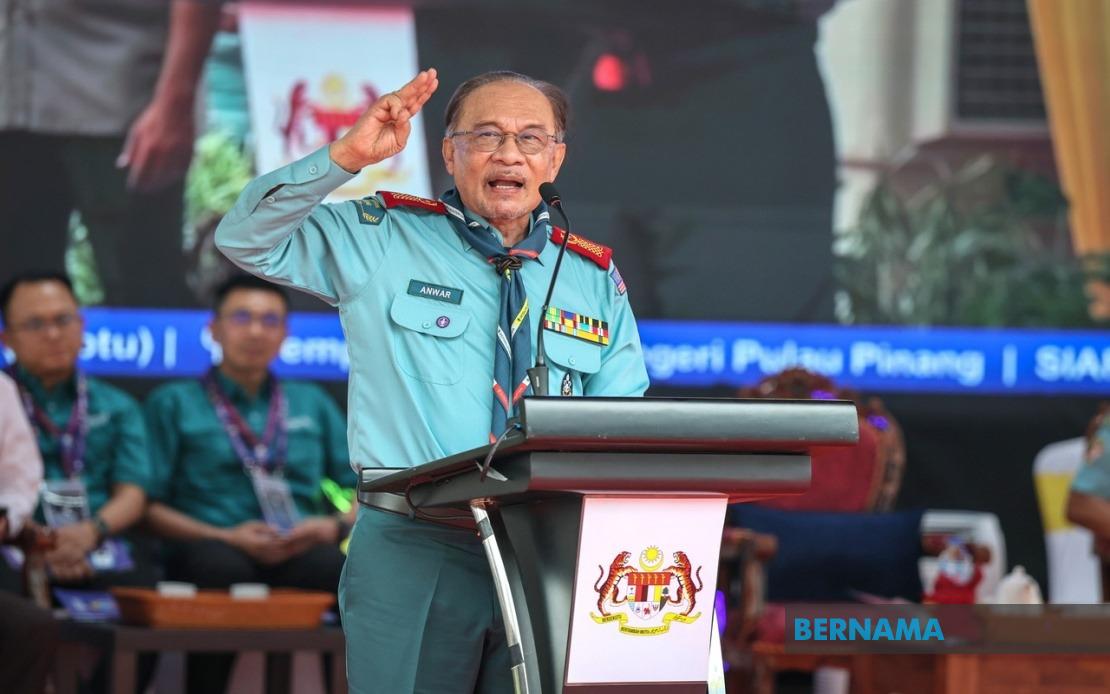
Prime Minister Datuk Seri Anwar Ibrahim has challenged Malaysia to broaden its definition of national success beyond economic and technological advancement, arguing instead that true progress depends fundamentally on nurturing a generation of young people who embody knowledge, discipline, and moral integrity. Speaking at the 15th Malaysian Scouts Jamboree (MYJAM15) in Batu Kawan on August 29, Anwar articulated a vision of development that places human character at the centre of nation-building, a perspective that resonates with growing concerns across Southeast Asia about the quality of civic engagement among youth.
Anwar's remarks underscore a philosophical tension increasingly evident in Malaysian policymaking: the pursuit of technological modernity without losing sight of values-based education. The Prime Minister specifically called for educational systems that transcend the transmission of academic knowledge, instead embedding within curricula a spirit of service, personal responsibility, and familial obligation. This framing suggests recognition that Malaysia's competitive advantages in the region—its technological infrastructure and economic capacity—require complementary social cohesion to prove sustainable over the longer term.
The timing of these comments at MYJAM15 was particularly deliberate. With more than 5,450 scouts attending the event from 11 countries including South Korea, Indonesia, Singapore, and Sri Lanka, Anwar deployed the jamboree as a platform to project Malaysia's commitment to character development alongside institutional strength. The gathering carries symbolic weight in the regional context, demonstrating Malaysia's capacity to host substantial international youth programming while reinforcing values-centred messaging to participants.
A critical element of Anwar's address concerned the relationship between technological progress and cultural preservation. He cautioned the younger generation against allowing rapid advancements in information technology and artificial intelligence to erode the cultural roots and heritage that provide foundational identity within Malaysian society. This concern is hardly unique to Malaysia; across the region, governments grapple with how to harness digital transformation while maintaining traditional values that underpin social cohesion. Anwar's framing suggests that technological adoption and cultural continuity need not be mutually exclusive pursuits, but rather require deliberate policy integration.
The Prime Minister further emphasised that educational institutions—schools, universities, and other learning centres—should be conceived as engines for producing individuals capable of balancing multiple obligations: service to parents, contribution to communities, and loyalty to the nation. This tripartite responsibility reflects a communitarian ethos that distinguishes Malaysian governance philosophy from purely individualistic Western models, positioning youth development as fundamentally linked to social interdependence rather than personal autonomy alone.
Anwar's references to unity in diversity hold particular relevance given Malaysia's multicultural composition and the pivotal role younger generations will play in maintaining intercommunal harmony. As these youth ascend to leadership positions in the coming decades, their capacity to navigate difference without sectarian tension becomes crucial to Malaysia's political stability. The Scout movement, historically a vehicle for fostering such unity, provides a practical institutional context in which Anwar's values can be instantiated and modelled.
The Malaysian Scouts Jamboree's return to Penang marked a significant milestone, with the state hosting the event for the first time since 1966—a 60-year interval that itself reflects shifting patterns in regional youth engagement and international scouting networks. The presence of delegations from multiple nations transformed the gathering into a microcosm of regional cooperation, allowing Malaysian scouts to benchmark their own development against international peers while contributing to cross-border networks that increasingly shape youthful consciousness.
Anwar's emphasis on preparing the younger generation for future tests and challenges acquired particular urgency given Malaysia's approaching 2026 National Day celebrations. By linking his message to this symbolic milestone, he framed youthful moral development not as an abstract aspiration but as a concrete national imperative. The invocation of patriotism and resilience suggested that Malaysia faces unspecified but anticipated difficulties requiring a generationally coherent response rooted in shared values rather than institutional coercion alone.
Chief Minister Chow Kon Yeow and Chief Scout Datuk Prof Dr Mohd Zin Bidin's presence at the event reflected institutional alignment around the values Anwar articulated, suggesting cross-party and cross-sectoral consensus on the importance of character-focused youth development. This coalition-building around educational philosophy indicates that debates over Malaysia's developmental trajectory, while politically contested, share common ground regarding the primacy of moral formation in creating stable, productive citizenship.
For Malaysian policymakers and educators, Anwar's remarks offer a framework for reconceptualising youth development beyond conventional metrics of academic achievement or employment preparation. The emphasis on integrating knowledge acquisition with values inculcation presents both philosophical clarity and practical challenges for implementation within increasingly technocratic institutional environments. Schools and universities operating under pressure to compete internationally in rankings and research output must simultaneously cultivate the contemplative, character-forming dimensions Anwar advocated.
Regionally, these statements position Malaysia within a broader conversation about post-development governance in Southeast Asia, where nations have achieved sufficient economic advancement to reflect on whether growth alone constitutes meaningful progress. Anwar's vision aligns with emerging thought across the region questioning whether rapid modernisation without corresponding social coherence produces societies equipped to manage the alienation and fragmentation that often accompany technological change.
The challenge for Malaysian institutions lies in translating Anwar's aspirational rhetoric into curricular and institutional reform that genuinely embeds values alongside technical instruction. This requires sustained commitment beyond speeches and ceremonial occasions, involving teacher training, resource allocation, and structural incentives that reward moral development as rigorously as academic achievement. Whether Malaysian educational and civic institutions can deliver on this vision remains an open question, but Anwar's articulation of the need provides a touchstone against which future policy implementation can be measured.

