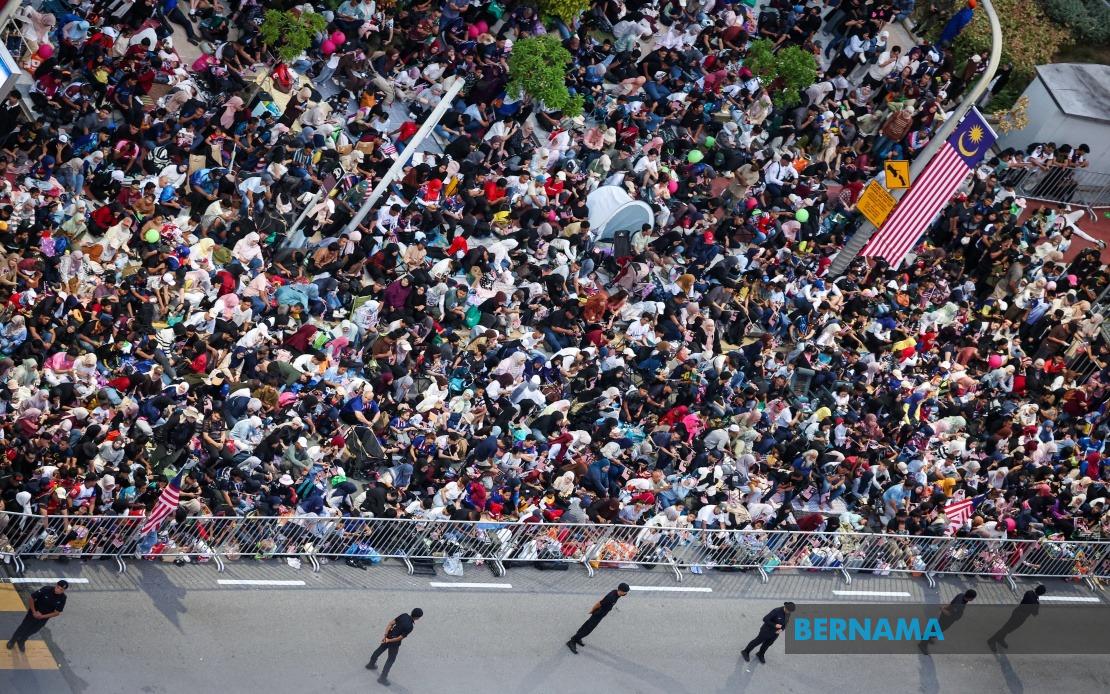
Thousands of Malaysians descended on Dataran Putrajaya starting from late evening on August 30, determined to claim prime viewing positions along the parade route for the nation's 69th National Day celebration. The groundswell of public enthusiasm reflected deep-rooted patriotic sentiment, as families, friends, and independent photographers staked out territory hours in advance, transforming the sprawling venue into a bustling encampment of eager observers and creative content creators.
For Mock Wei Qi, a 23-year-old freelance photographer, the early arrival represented an investment in capturing compelling visual storytelling. Arriving at 11 pm on August 30 alongside fellow photography enthusiasts, Mock sought cinematically rich angles that could authentically convey Malaysia's distinctive character and cultural vibrancy to international audiences. His deliberate approach underscored how the National Day spectacle functions as more than ceremonial display—it serves as a canvas for creative professionals to document national identity through their artistic lens.
Mock's perspective illuminates a growing trend among younger Malaysians who view patriotic occasions through the dual prism of civic participation and professional opportunity. The freelancer explicitly framed his presence not merely as spectating a parade, but as a curated chance to hone technical skills while simultaneously celebrating national attributes. This generation's engagement with state occasions often intertwines personal advancement with collective pride, reflecting evolving attitudes toward how Malaysians express and consume nationalism in the social media age.
Family participation emerged as equally prominent among early arrivals. A couple identified as As and Adib brought their children to Dataran Putrajaya by 5 pm, motivated by previous disappointment. Their experience the prior year—arriving too late and watching from a distant vantage point—prompted strategic recalibration. This year's deliberate early appearance represented a family commitment to securing proximity and unobstructed sightlines, transforming the National Day celebration into a shared familial memory worth planning around.
The couple's rationale reflects broader patterns in how Malaysians prioritize experiential participation during major national events. Rather than passively consuming coverage through media channels, families increasingly invest time and effort to attend in person, particularly during school holiday periods when logistical coordination becomes feasible. The competitive scramble for physical space simultaneously captures the premium placed on direct, embodied engagement with national ceremonies.
Ahmad Azri Onn, 55, attended with his wife and three children aged between 10 and 15, arriving at approximately 5:30 pm. Rather than viewing the overnight stay as arduous, Ahmad Azri reframed the extended wait as an improvised camping adventure, transforming the venue preparation period into entertainment. His approach proved shrewd, as the family secured desirable positioning while the children experienced National Day festivities during scheduled school holidays, maximizing the educational and recreational value of their presence.
The meteorological conditions—characterized by drizzle during late evening hours—might have deterred less committed spectators. However, Ahmad Azri noted that precipitation actually provided relief from typical daytime heat, creating surprisingly comfortable conditions for the family's overnight vigil. This observation captures how Malaysian audiences demonstrate remarkable resilience and adaptability when attending important national occasions, viewing environmental challenges as minor obstacles rather than prohibitive barriers.
By morning on August 31, Dataran Putrajaya had transformed into a densely populated amphitheater of anticipation. The accumulated presence of tens of thousands created a palpable atmosphere charged with collective excitement. The venue's filling capacity throughout the morning hours suggested a crescendo building toward the 8 am official commencement of the 69th National Day parade.
The 2024 celebration operated under the thematic banner "Malaysia MADANI: Kesejahteraan Dinikmati," a national branding framework emphasizing societal wellbeing and shared prosperity. This conceptual framing provided ideological scaffolding for the day's spectacles and ceremonial components. For attendees, however, such thematic abstractions translated into concrete visual narratives rendered through military displays, cultural performances, technological showcases, and symbolic pageantry designed to affirm national unity and accomplishment.
The early bird phenomenon at Dataran Putrajaya carries significance beyond mere logistical observation. It reveals how National Day celebrations continue commanding genuine public enthusiasm among diverse demographic segments—young creative professionals documenting contemporary Malaysia, middle-aged families engineering memorable experiences for children, and retired citizens maintaining lifelong engagement with patriotic observances. The willingness to arrive overnight, endure uncertain weather, and sacrifice sleep demonstrates that state occasions retain substantive cultural resonance within Malaysian society, functioning as rare moments when divergent communities converge around shared civic identity.
Moreover, the crowd dynamics highlight evolving tensions between spontaneous grassroots patriotism and carefully orchestrated state spectacle. While authorities arrange ceremonial programs and security parameters, Malaysians simultaneously assert agency through their own curation of experience—selecting vantage points, coordinating group attendance, and narrativizing the day through personal photography and family storytelling. The interplay between official pageantry and public participation creates a multivalent National Day experience that transcends simple passive consumption.

