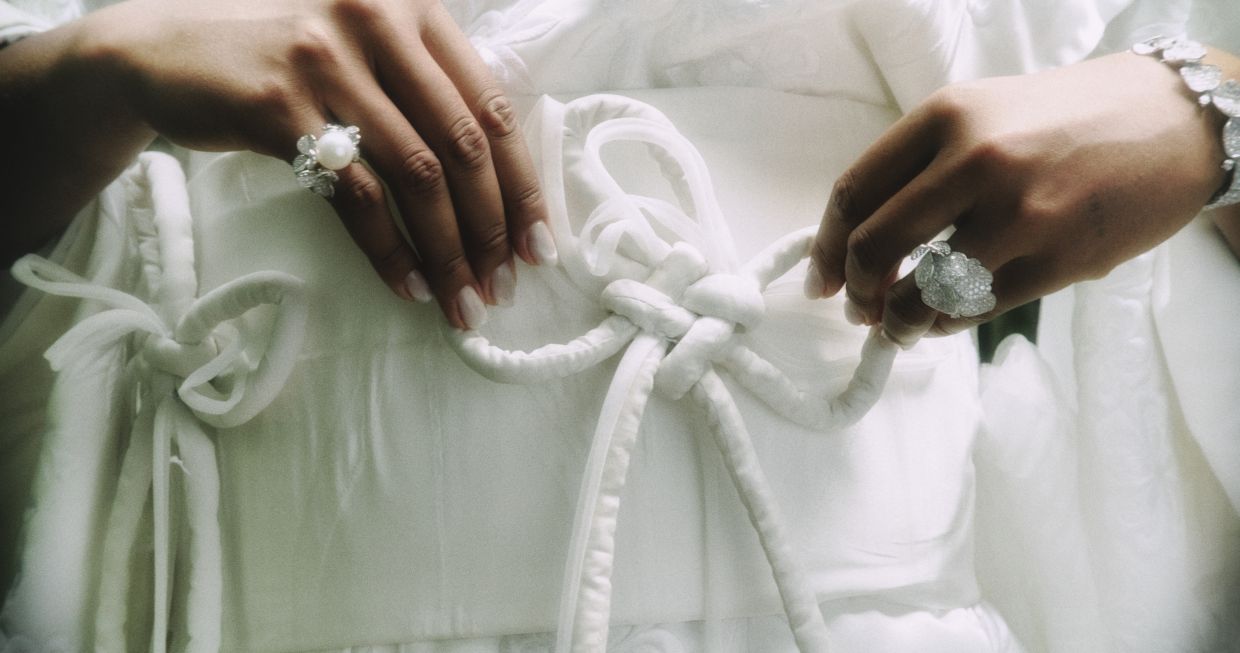
When Naomi Osaka stepped onto Wimbledon's centre court on Monday, June 29, the 14th-seeded former world number one arrived not merely to compete but to orchestrate what amounts to a theatrical fashion statement. Despite battling a foot injury that nearly kept her from the tournament altogether, Osaka emerged wearing an all-white creation by Hana Yagi, an independent Japanese designer, titled "Evolving Ceremony." The entrance marked the culmination of a deliberate strategic shift in how the Japanese tennis star weaponizes fashion as a tool for brand building, cultural expression, and industry influence—a shift that extends far beyond the conventional role of competition attire in professional sports.
The Wimbledon gown itself represented a masterwork of conceptual design and technical innovation. Drawing inspiration from traditional Japanese dress codes including the kimono and the junihitoe—the elaborate 12-layer garment worn by noblewomen during the Heian period from 794 to 1185—Yagi constructed the dress from seven distinct textiles sourced from upcycled vintage kimonos, a traditional shiromuku wedding dress, and a deconstructed modern wedding gown. This commitment to repurposing existing materials telegraphed a broader environmental consciousness that increasingly defines Osaka's approach to her public presentation. Accompanying the Yagi creation was a Nike performance dress beneath, featuring Japanese kirigami-inspired floral appliques and micro-pleated detailing that itself sold out before the tournament commenced, demonstrating the commercial potency of Osaka's sartorial choices.
What distinguishes Osaka's fashion strategy from the conventional designer partnerships common in tennis is her explicit prioritization of heritage and craftsmanship. The jewelry selected for the Wimbledon appearance came from Mikimoto, the legendary Japanese pearl house, extending the visual narrative of cultural pride throughout every layer of her presentation. In a statement, Osaka articulated the intentionality behind these choices: "Working with Hana allowed us to celebrate Japanese history and craftsmanship while creating something that feels entirely modern. I love that it feels both powerful and delicate at the same time." This language reveals sophisticated thinking about how fashion communicates contradictions—strength alongside refinement, tradition alongside innovation—that mirror the pressures and expectations placed on contemporary female athletes, particularly those navigating multiple cultural identities.
The Wimbledon entrance represents act three in a narrative arc that commenced at the Australian Open in January. During that Melbourne appearance, Osaka descended the tunnel in a Robert Wun creation designed to evoke a jellyfish, complete with a butterfly hat signaling her status as a young mother and symbolizing personal transformation. The formal outer layer was shed moments before competition began. Her French Open appearance followed with a black corset and ballgown skirt by Kevin Germanier, explicitly referencing the Eiffel Tower while utilizing upcycled materials from her previous Nike collections. Together, these three appearances establish thematic consistency around sustainability, emerging talent development, and cultural storytelling that transcends typical athlete endorsement dynamics.
The environmental dimension of Osaka's approach deserves particular attention within the context of fashion industry practices. By consistently prioritizing upcycled and repurposed materials, Osaka signals that high-level athletic competition need not depend on wasteful fast-fashion production. This positioning carries subtle but significant weight in an era when corporations compete for athlete partnerships partly on the basis of demonstrated sustainability commitments. For a player with Osaka's commercial visibility, the choice to feature emerging and independent designers rather than established luxury houses represents a calculated but genuine effort to amplify underrepresented voices. Hana Yagi, now in her twenties and based in Tokyo, gained international recognition after becoming a finalist in the International Talent Support competition in Italy in 2019. By platforming designers at similar career stages, Osaka transforms her tournament appearances into career-launching opportunities.
Yagi's technical execution of the Wimbledon dress reveals the complex engineering required to translate artistic vision into functional tournament attire. The designer intentionally created nine detachable segments that could be systematically removed in less than one minute—the window available before Osaka's matches commenced—while simultaneously remaining reconfigurable throughout the tournament's progression. The ingenious solution involved Velcro fasteners that enable rapid transformation without compromising the aesthetic presentation. Additionally, the dress featured an adjustable train measuring nearly ten feet, a feature acknowledging the practical realities of Wimbledon's layout: outer courts sit sufficiently distant from the players' lounge that an extended train risks material damage during the walk to competition areas. This attention to logistical constraints represents a level of sophistication that most casual observers never witness but that directly enables the spectacle they do.
Oaska's stylist Marty Harper articulated the broader mission underlying this approach: providing visibility and opportunity to "new kids on the block" rather than exclusively featuring established luxury houses. This framing recontextualizes the entrance walk from a moment of personal vanity into something closer to institutional leverage. Because Osaka commands the attention of millions of viewers globally, her choice of designer becomes an industry signal that can meaningfully impact that creator's career trajectory. The stakes differ fundamentally from scenarios where wealthy private clients commission bespoke work; Osaka's platform transforms each tournament entrance into an implicit endorsement that carries genuine professional consequences.
For Malaysian and Southeast Asian audiences, Osaka's approach carries particular significance within a regional context increasingly conscious of cultural authenticity and representation in global media. Her explicit centering of Japanese heritage through these designs provides a counternarrative to the erasure or superficialization of Asian cultural elements that frequently occurs within international fashion and sports narratives. Rather than treating Japanese design traditions as aesthetic references to be borrowed and repurposed by Western designers, Osaka works directly with Japanese creators and places Japanese cultural knowledge at the conceptual center of her public presentation. This positioning becomes especially relevant given how regional athletes often navigate pressure to conform to Western-defined standards of athletic presentation and personal branding.
The competitive implications of Osaka's strategy deserve consideration beyond the realm of fashion criticism. In professional tennis, where a player's mental and emotional state significantly impacts performance, the controlled environment of the entrance walk provides opportunity to establish psychological momentum before the match begins. By investing substantial creative energy into a presentation that positions her as commanding, sophisticated, and culturally grounded, Osaka may be engineering an affective state that translates into competitive advantage. The spectacle also reshapes audience attention: before a single serve, she has already dominated the narrative space and captured viewer imagination. This phenomenon extends across the global sports industry, where tunnel walks, entrance music, and costume have become increasingly important components of athletic performance itself.
The practical logistics of executing these designs underscores the resources required to maintain this strategic approach. Each tournament necessitates the creation of not one but multiple custom couture-level garments that satisfy conflicting demands: they must be visually spectacular when viewed from stadium heights, rapidly removable, potentially reconfigurable across multiple competition days, and physically manageable during the transition from walk to court. The fact that Osaka manages this repeatedly demonstrates the organizational infrastructure supporting her brand identity—teams of designers, stylists, and coordinators working months in advance to ensure that every public appearance reinforces her cultivated image.
Looking forward, Osaka's approach suggests a potential future where athlete fashion becomes genuinely inseparable from competitive identity rather than an ancillary concern. Whether this trajectory enhances or distracts from her on-court performance remains an open question, but the calculation itself reveals sophisticated understanding of how celebrity operates in contemporary sports. By winning what she might term the "attention championship" before the first serve, Osaka ensures that her presence registers across multiple registers simultaneously—as a returning player managing injury, as a Japanese cultural ambassador, as an environmental consciousness advocate, and as a tastemaker capable of elevating emerging designers into global visibility. Few athletes have demonstrated such multifaceted strategic thinking about their public presentation.

