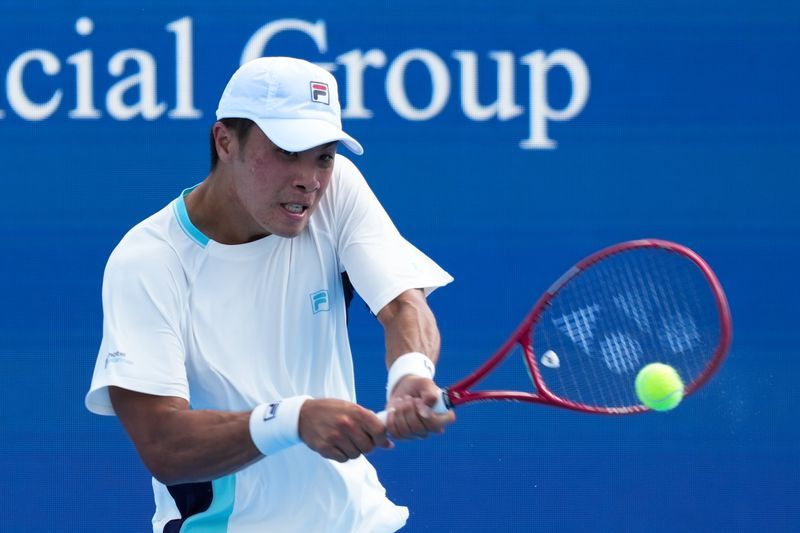
Brandon Nakashima's impressive run through North American hard courts continued Friday in Cincinnati, where the 25-year-old American mounted a dramatic comeback in the deciding set to overcome fellow countryman Taylor Fritz and secure a place in the Masters 1000 semi-finals. Nakashima's 7-6(9) 4-6 6-3 victory adds significant momentum to his campaign as the tennis calendar approaches the U.S. Open, one of the sport's most prestigious tournaments, with the competition set to commence later this month.
The win represents a remarkable turning point in the head-to-head record between the two Americans. Nakashima entered the match with a concerning 1-4 record against Fritz, suggesting considerable struggles against his opponent in previous encounters. However, Friday's performance demonstrated a stark contrast to that historical pattern, with the 27th-seeded Nakashima delivering when it mattered most against the sixth-seeded Fritz. This reversal underscores the volatility of professional tennis and how momentum and form can dramatically shift the dynamics between competitors.
The opening set proved to be a tightly contested affair that showcased the calibre of both players' serving games. Neither competitor managed to generate significant break-point opportunities in regular play, as both maintained commanding service holds throughout the set. The intensity and competence on serve forced the match into a tiebreak, a format that often determines the fate of evenly matched contests. In the tiebreak itself, the players exchanged minibreaks and leads in a see-saw battle that could have gone either direction. Ultimately, Nakashima seized control when Fritz's concentration lapsed, sending a ball beyond the baseline on Nakashima's fifth set point to hand the American the opening frame.
Fritz responded with considerable authority in the second set, employing an aggressive return-of-serve strategy that immediately paid dividends. The sixth seed secured an early break, capitalising on his opponent's vulnerability on serve to take control of the set. Fritz consolidated his advantage by closing out the set with an ace, forcing the contest into a decisive third set where both players knew another strong performance would determine the match.
The decider unfolded with dramatic momentum swings that illustrated the mental and physical demands of professional tennis at the highest level. Fritz initially capitalized on Nakashima's unforced errors to establish a 3-2 lead, suggesting he was positioned to secure victory and extend his record over his rival. However, the dynamics shifted almost immediately. Nakashima demonstrated remarkable resilience when facing a seemingly hopeless situation at 30-0 down on break point. Rather than surrender, he recovered to convert his second break opportunity of the match, levelling the set at 3-3 and sending a powerful psychological signal that he remained firmly in contention.
From that crucial juncture, Nakashima's game elevated noticeably while Fritz's precision deteriorated. The American then seized the momentum by winning the final three consecutive games, a run that was facilitated by mounting errors from his opponent as confidence visibly drained from Fritz's play. Nakashima served out the match with authority, securing his passage to the semi-finals and extending what has become the most productive stretch of his professional career.
This Cincinnati triumph follows Nakashima's impressive run the previous week in Montreal, where he similarly reached the semi-finals of that Masters 1000 event. The achievement of consecutive Masters 1000 semi-final appearances represents a significant milestone in Nakashima's career trajectory and suggests he is beginning to translate his considerable talent into consistent high-level results. For Malaysian and Southeast Asian tennis enthusiasts monitoring the sport's development, Nakashima's emergence as a consistent threat among the elite represents the kind of breakthrough performance that occasionally captures the public imagination.
The victory also marks Nakashima's fourth triumph over a top-10 ranked opponent this season, a statistic that validates his improved standing within professional tennis and indicates his ability to compete effectively against the sport's elite players. This development is particularly noteworthy given the competitive depth of modern professional tennis, where accumulating wins against top-ranked opponents requires sustained excellence and tactical acumen.
Looking ahead, Nakashima faces a challenging semi-final assignment against either 10th-seeded Italian Lorenzo Musetti or fellow American Frances Tiafoe. Both represent formidable opponents with their own credentials and tournament success this year. Nevertheless, Nakashima enters the semi-final phase with considerable confidence derived from his recent performances and the manner in which he dismantled Fritz's challenge through sheer resilience and improving tactical execution. With the U.S. Open approaching imminently, his momentum through the North American hard-court swing positions him as a legitimate contender for a deep run in New York, where home advantage and familiarity with conditions could prove decisive in his pursuit of major tournament success.

