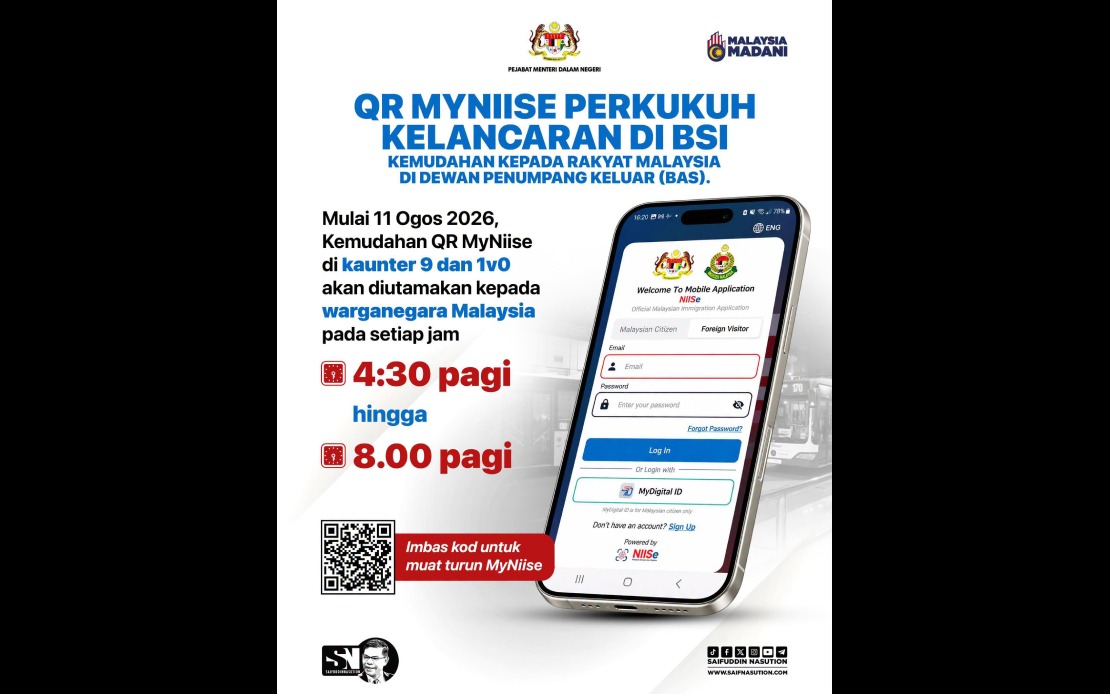
Malaysia has activated a new fast-track immigration system at its main bus terminal serving the Singapore border, offering digital-savvy travellers a significant advantage during the busiest travel period of the day. The MyNIISe QR code facility, introduced by Home Minister Datuk Seri Saifuddin Nasution Ismail, provides priority clearance at Bangunan Sultan Iskandar (BSI) from 4:30 am to 8 am, coinciding with the morning rush when thousands of cross-border commuters attempt to enter Singapore simultaneously. The initiative targets counters 9 and 10 in the Bus Departure Hall, creating dedicated lanes for users of the National Integrated Immigration System's mobile application.
The timing of this rollout reflects a specific pain point in the regional travel landscape. Hundreds of thousands of Malaysians transit through BSI daily to reach workplaces, schools, and business commitments in Singapore, with the pre-dawn hours representing the most congested period as workers rush to arrive on time. The minister acknowledged this reality in his announcement, noting that many commuters depart at first light to board buses and make their way across the causeway. By introducing a differentiated processing system, the government seeks to reward technology adoption while simultaneously reducing overall queue times, a strategy increasingly common in Southeast Asian immigration systems.
MyNIISe represents a key component of Malaysia's broader digital transformation agenda, positioning immigration clearance as a testbed for modernising citizen-facing government services. The system's availability across multiple platforms—Apple App Store, Google Play Store, and Huawei App Gallery—acknowledges the diversity of smartphone ecosystems used across Malaysia and the region. This multi-platform approach is pragmatic given Malaysia's significant Huawei user base, particularly among older demographics and those using affordable devices. The breadth of distribution channels suggests the government anticipated strong uptake and sought to minimise barriers to access.
The introduction of priority lanes at BSI carries implications beyond mere convenience. For Malaysia's working class, particularly those in lower-income brackets who depend on cross-border employment, shaving even ten minutes from immigration processing represents meaningful savings in time and associated costs. Daily commuters purchasing round-trip bus tickets are highly price-sensitive, and reducing travel time indirectly increases their earning potential by allowing more productive hours in their destination location. However, the system also introduces a digital divide consideration: those without smartphones, unreliable internet connectivity, or unfamiliarity with mobile applications remain subject to traditional queue-based processing.
The counterflow of inbound travellers presents a different scenario entirely. While the announcement focuses on outbound morning clearance, the symmetry of cross-border movement means Malaysians returning from Singapore, along with Singaporean and foreign visitors entering Malaysia, experience their own bottleneck periods. The government's implementation of priority lanes specifically during morning hours suggests careful operational planning, with the capacity to add similar facilities during evening rush periods if demand justifies the resource allocation. Future expansion of the system to accommodate evening return traffic would significantly enhance its practical utility.
From a regional competitiveness standpoint, Malaysia's deployment of digital-priority immigration processing positions it competitively against neighbouring countries modernising their own border systems. Singapore has long maintained sophisticated clearance infrastructure, but Malaysia's ability to offer app-based expedited processing demonstrates technological parity in certain dimensions. This matters for labour mobility and business travel, categories where cross-border friction costs accumulate rapidly. Singaporean employers recruiting Malaysian workers, and Malaysian entrepreneurs maintaining operations across the causeway, benefit from reduced transaction costs associated with border crossing delays.
Implementation success will depend heavily on user adoption rates and sustained system reliability. Digital immigration systems throughout Southeast Asia have experienced occasional outages, and BSI's high daily throughput leaves little margin for technical failure. The government faces an implicit commitment to maintain MyNIISe availability during the precise hours when it carries greatest value—the early morning commute window. Any downtime during these critical periods would generate immediate public frustration and undermine confidence in the broader digital government initiative.
The priority lane concept also establishes an interesting precedent for service differentiation in Malaysian immigration. Government agencies typically emphasise universal access and equality of treatment, yet this system explicitly offers faster service to those with technological capacity and digital literacy. While the differentiation is justified on efficiency grounds—the QR system reduces per-transaction processing time—it nonetheless creates a two-tier system. Policymakers must balance innovation incentives against equity concerns, particularly as digital services expand across more government functions.
Longer-term implications extend to cross-border labour market dynamics. By reducing friction costs for daily commuters, Malaysia facilitates continued reliance on cross-border employment arrangements that have characterised the region's labour market for decades. Whether this represents optimal policy depends on broader economic development objectives: encouraging reliance on transnational employment may reduce incentives for local economic development and wage growth in Malaysia, yet simultaneously provides crucial income stability for workers in less-developed regions. The Home Ministry's introduction of convenience systems does not directly address these structural considerations, but it implicitly supports the status quo of high cross-border labour mobility.
The MyNIISe system's expansion to BSI represents the immigration ministry's confidence in the platform's technical foundation and user base. Earlier deployments at other border points and international airports presumably provided operational evidence supporting this larger-scale rollout. Monitoring system performance at BSI will generate valuable data on scalability and reliability, informing decisions about similar priority systems at other major crossing points. The Kuala Lumpur International Airport, the Second Link in Johor, and air-rail crossings at other locations could potentially benefit from comparable innovations.
For Malaysian travellers accustomed to traditional immigration queues, the introduction of data-driven, technology-enabled alternatives signals a gradual shift in service delivery philosophy. As more government agencies adopt similar prioritisation systems, citizens face increasing pressure to maintain digital literacy and smartphone access to avoid relegation to slower traditional channels. This trend, evident throughout Southeast Asia, fundamentally reshapes the relationship between government and citizen, where technological adoption becomes implicitly linked to service quality. The MyNIISe priority lane thus represents more than a convenient border crossing option—it exemplifies the broader digitalisation of governance in Malaysia.

