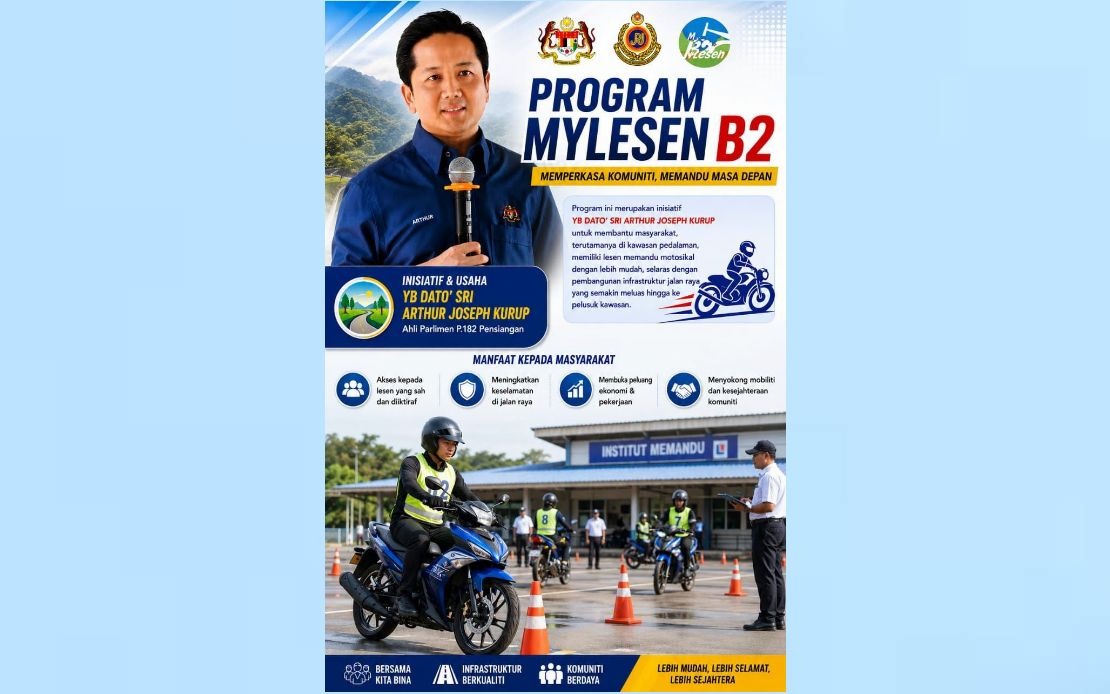
The MyLesen B2 initiative has reestablished its presence in Pensiangan, Sabah, as part of a broader effort to democratize access to motorcycle licensing across Malaysia's more remote regions. The programme addresses a persistent challenge faced by rural communities: the considerable inconvenience and expense of travelling to urban driving schools simply to obtain documentation that urban residents can access with relative ease. This disparity in administrative accessibility has historically created barriers for younger people in outlying areas seeking to formalise their riding credentials, potentially contributing to the prevalence of unlicensed riders in rural Malaysia.
Datak Seri Arthur Joseph Kurup, the Member of Parliament for Pensiangan and Minister of Natural Resources and Environmental Sustainability, framed the programme's return as a matter of equity and public safety. By bringing licensing services directly to the constituency, the initiative removes practical obstacles that have discouraged rural residents from obtaining legitimate documentation. The programme neither bypasses nor dilutes the regulatory framework; participants must still complete formal training courses and pass prescribed examinations to qualify for their certificates. This dual approach—convenience combined with maintained standards—reflects an understanding that access and accountability need not be mutually exclusive.
The licensing programme carries particular significance for rural employment and economic participation. In many Malaysian villages and small towns, motorcycles function not merely as personal transport but as essential tools for accessing employment, trade, and services. A valid licence transforms what might otherwise be an informal or legally questionable activity into legitimate economic engagement. Young people in these communities can now pursue delivery work, agricultural commerce, or travel to distant job sites with proper documentation, expanding their economic horizons in ways that urban workers often take for granted.
The initiative's eligibility criteria—targeting residents aged 16 to 63, with priority given to first-time applicants—reflects recognition that licensing barriers disproportionately affect those without prior documentation. Many rural residents may have operated motorcycles for years without ever formalising their status through official channels, not necessarily through disregard for regulations but simply due to logistical constraints. This programme provides a pathway for those individuals to regularise their position while simultaneously educating younger cohorts about proper road conduct before establishing driving habits.
Road safety constitutes another critical dimension of the MyLesen B2 initiative. Rural roads in Malaysia often present hazards distinct from urban environments: longer sightlines, higher speeds, less consistent traffic enforcement, and varying road quality. Formal licensing necessitates education in traffic laws and vehicle handling that casual or self-taught riders may lack. By coupling licence issuance with mandatory safety instruction, the programme seeks to reduce accident rates while building a culture of regulatory compliance in communities where informal norms might otherwise prevail.
The permanence of the licence—valid for lifelong use subject to compliance with prevailing regulations—represents a valuable incentive for participation. Unlike some temporary or limited credentials, MyLesen B2 recipients gain documentation that will serve them throughout their lives, subject only to standard renewal and regulatory compliance. This long-term validity transforms the programme from a temporary convenience into a genuine opportunity for sustained legal participation in economic and social life.
The logistics of the Pensiangan operation involve registration through two service centres: the Parliamentary Service Centre and the Sook State Assemblyman's Service Centre. This dual-location approach recognises that residents may be distributed across the constituency and provides multiple convenient access points. The decentralised registration system mirrors the programme's fundamental premise: that rural residents deserve administrative convenience equivalent to what urban residents encounter.
For Malaysia's broader development agenda, initiatives like MyLesen B2 illustrate a shift toward addressing rural-urban equity through targeted, practical interventions. Rather than assuming uniform national standards should mean identical implementation everywhere, the programme adapts delivery mechanisms to local realities. This pragmatism suggests growing recognition that inclusive development requires not lower standards but smarter, more context-sensitive administration.
The relaunch in Pensiangan also signals sustained government commitment to road safety as a rural development issue. Sabah's geography—with dispersed communities, long distances, and variable infrastructure—typifies challenges facing several Malaysian states. Programmes like MyLesen B2 that tackle rural-specific obstacles while maintaining national standards offer a template for addressing other administrative access disparities. As Southeast Asia increasingly focuses on sustainable development, ensuring that regulatory frameworks support rather than obstruct rural economic participation becomes increasingly important for regional progress and social cohesion.

