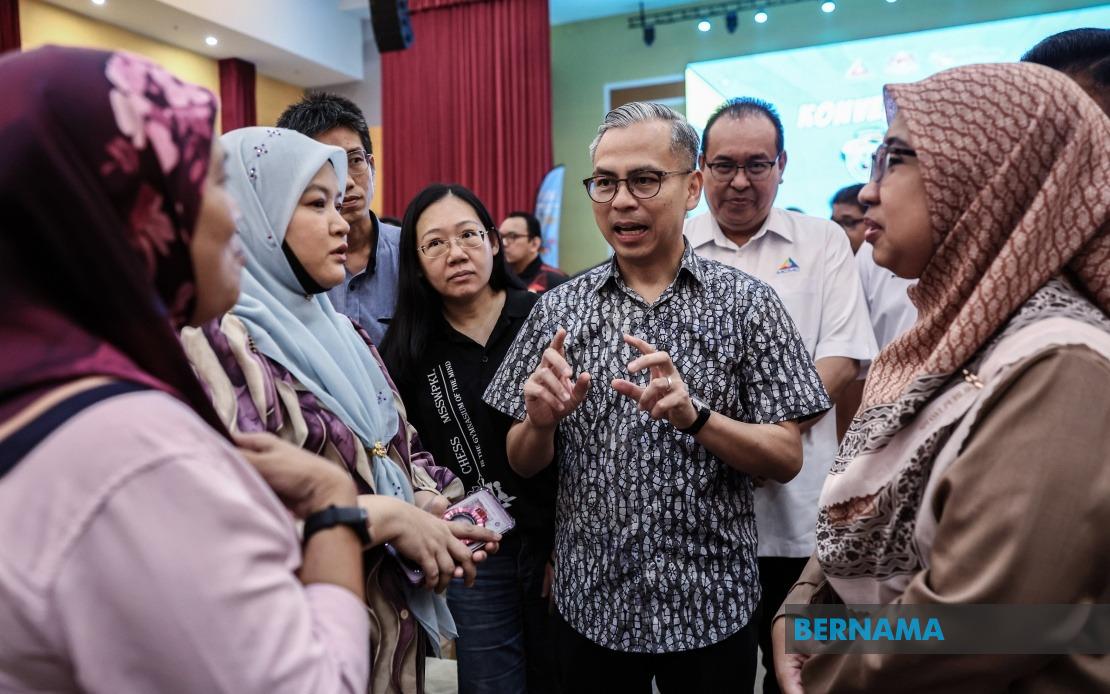
The MyKhas fund represents a constituency-level provision designed exclusively to improve the living standards and welfare of residents, not a personal benefit available to elected representatives, according to Communications Minister Datuk Seri Fahmi Fadzil. Speaking at a press conference in Kuala Lumpur, the PKR Information Chief stressed that the mechanism operates as a special allocation administered directly by the Prime Minister's office to address the specific needs of people within parliamentary constituencies. This clarification underscores the government's commitment to distinguishing between state resources meant for public benefit and any potential misuse as personal entitlements for political office-holders.
The distinction carries significant weight in Malaysia's political landscape, where questions about the allocation and distribution of government resources have long been a subject of public scrutiny. Fahmi's statement reflects Prime Minister Datuk Seri Anwar Ibrahim's broader assertion that all government allocations directed to parliamentary constituencies serve the population rather than functioning as exclusive privileges for any individual elected official. By formally anchoring this principle in Malaysia Plan and Budget documents as a special provision under the Prime Minister's authority, the government is attempting to establish transparent governance standards and prevent potential abuses of state resources.
The formalization of MyKhas in official budget documentation represents an attempt to institutionalize the principle that constituency funds belong to the people, not to politicians. Fahmi explained that the mechanism has been explicitly enshrined in Malaysia Plan and Budget documents, establishing MyKhas as a special allocation firmly within the Prime Minister's purview. This administrative structure means that disbursement decisions rest solely with the Prime Minister's office rather than with individual MPs, creating what the government presents as an additional safeguard against misappropriation. The approach essentially removes discretionary control from parliamentary representatives and centralizes it at the executive level.
What distinguishes MyKhas from conventional constituency allocations is its direct application to constituency development needs rather than channeling funds through MPs' offices. Fahmi emphasized that the fund targets specific community requirements such as school improvements, religious institution infrastructure, mosque maintenance, and essential drainage repairs. By directing resources to tangible projects that benefit residents across constituencies regardless of political affiliation, the government aims to demonstrate equitable resource distribution. This framework theoretically ensures that communities receive development benefits without partisan considerations dictating fund allocation.
The question of opposition-controlled constituencies has historically raised concerns about resource fairness in Malaysian politics. Fahmi addressed this directly by explaining that applications for assistance in opposition-held states can be submitted through the Implementation Coordination Unit operating under the Prime Minister's Department. This formal mechanism provides a pathway for constituencies outside the ruling coalition to access MyKhas funds, though critics might argue that centralizing application processes through the Prime Minister's office could still allow for discretionary filtering. Nevertheless, the existence of this formal channel attempts to create parity in fund access regardless of local political representation.
Prime Minister Anwar Ibrahim has repeatedly reinforced the message that government allocations serving parliamentary constituencies remain public resources, not personal privileges. His emphasis reflects broader governance challenges in Southeast Asia where the line between state resources and political patronage has historically been blurred. By consistently messaging that allocations are for constituency welfare rather than MP entitlement, the Prime Minister is signaling an attempt to professionalize government resource management and establish norms of accountability. Such statements, when backed by formal administrative structures, can gradually shift political culture toward stricter separation between public funds and personal benefit.
Fahmi's personal assertion that even he cannot utilize MyKhas for his own purposes adds an individual credibility dimension to the institutional message. When senior government officials publicly declare their own non-eligibility for these funds, it strengthens the credibility of the broader governance principle. This approach leverages personal integrity to reinforce systemic change, recognizing that institutional rules alone often require cultural shifts in political behavior to take root. In Malaysian politics, where personal relationships and networks traditionally influence resource distribution, such explicit renunciations by high-ranking officials can serve as important signaling mechanisms.
The MyKhas framework also reflects evolving expectations among Malaysian citizens regarding government transparency and accountability. Younger voters and civil society organizations have increasingly demanded clearer governance standards and reduced scope for patronage-based resource allocation. By formally establishing MyKhas as a constituent-focused mechanism rather than an MP perk, the government responds to these pressures while attempting to demonstrate commitment to transparent governance. The initiative signals that resource allocation increasingly requires public justification based on community benefit rather than political loyalty.
For Southeast Asian observers, Malaysia's approach to clarifying the distinction between state resources and political entitlement offers lessons in governance architecture. While the institutional framework appears sound, successful implementation ultimately depends on consistent enforcement and political will. The Myanmar situation, where military governance divorced state resources from any accountability to citizens, and the Philippines' historical struggles with corruption in disbursement mechanisms, illustrate the ongoing regional challenge. Malaysia's attempt to formalize and centralize control over constituency allocations represents one approach to addressing these persistent regional governance problems.
The long-term implications of formalizing MyKhas as a non-partisan constituency fund extend beyond immediate resource distribution. If consistently implemented, such mechanisms can gradually normalize the principle that elected officials administer public resources rather than owning them. This represents a subtle but meaningful shift in political culture, from viewing government positions as opportunities for personal enrichment to understanding them as public trusts. In the Malaysian context, where development expectations across constituencies continue rising, establishing clear resource-allocation principles becomes increasingly important for maintaining political legitimacy and public confidence in government institutions.

