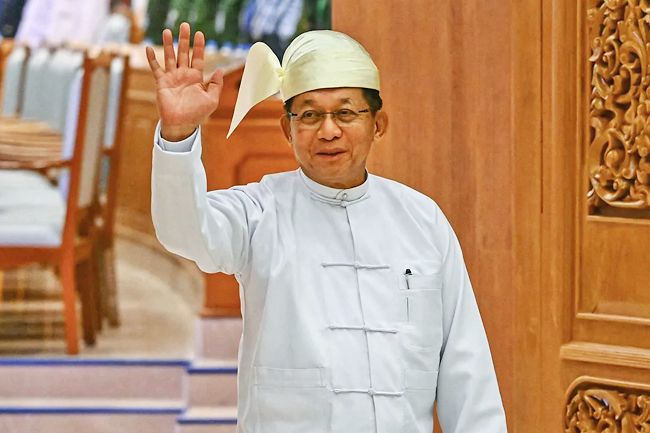
Myanmar's military leader Min Aung Hlaing is set to visit Bangkok on August 6 and 7 for talks with Thai Prime Minister Anutin Charnvirakul, Thailand's foreign minister announced on Tuesday, signalling a fresh diplomatic engagement even as the Southeast Asian bloc remains deeply fractured over how to handle the junta-ruled state.
The planned bilateral meeting represents a significant step in Thailand's broader campaign to bring Myanmar back into the fold of the Association of Southeast Asian Nations. Since the 2021 military coup that deposed civilian leader Aung San Suu Kyi, Myanmar has remained a source of acute tension within ASEAN, with member states sharply divided between those sympathetic to Thailand's engagement approach and others advocating stricter accountability measures. The visit comes after what Thai Foreign Minister Sihasak Phuangketkeow described as intense discussions among ASEAN foreign ministers in Manila, where member states grappled with fundamental questions about how to measure progress and define success in Myanmar's diplomatic rehabilitation.
Thailand's geographic and humanitarian stakes in Myanmar's turmoil are enormous. The country shares an extensive border with the war-torn nation and hosts millions of Burmese refugees, making stability in Myanmar a direct national interest rather than merely a regional concern. Bangkok's willingness to engage directly with Min Aung Hlaing reflects this urgency, though the approach has proven controversial within ASEAN itself, exposing fault lines between pragmatists and those prioritising democratic principles and human rights.
Sihasak articulated Thailand's strategy as a "dual-track approach" that balances bilateral pragmatism with ASEAN's collective diplomatic framework. He outlined concrete areas demanding immediate attention, including transnational crime, online scams targeting the region, and the narcotics trade that destabilises both Myanmar and its neighbours. These issues transcend political ideology and appeal to security-conscious governments across Southeast Asia, potentially offering common ground where normative arguments about democracy have foundered.
Yet Thailand's engagement does not signal abandonment of ASEAN's formal peace framework. The bloc established a five-point consensus in 2021 calling for dialogue cessation, humanitarian aid, and restoration of democratic processes in Myanmar. Sihasak stressed that bilateral meetings complement rather than replace this collective approach, though critics might question whether prioritising immediate concerns risks diluting pressure on the junta regarding fundamental governance questions.
Crucially, Thai officials are attempting to redefine what constitutes meaningful progress, moving away from maximalist demands toward incremental benchmarks. Sihasak suggested that allowing ASEAN's special envoy access to detained opposition leader Suu Kyi could represent progress, as could reducing violence along the Thai-Myanmar border. This pragmatic calculus acknowledges that comprehensive political transformation remains implausible in the near term, yet allows ASEAN to claim diplomatic momentum without abandoning the framework entirely.
The recent contested elections in Myanmar that installed Min Aung Hlaing as president have been widely dismissed as lacking legitimacy by democratic nations and observers. However, Thai officials view the exercise, however flawed, as potentially creating space for dialogue with armed ethnic groups and opposition elements. This interpretation strains credibility but reflects Bangkok's determination to identify pathways forward that do not require waiting for wholesale junta capitulation.
Parallel to bilateral engagement, ASEAN is reconsidering its institutional approach to Myanmar. Philippine Foreign Minister Theresa Lazaro revealed that member states are exploring appointment of a permanent, long-term special envoy to replace the current annual rotation system, which she conceded had proven ineffective. This structural reform acknowledges that Myanmar's crisis demands sustained, specialised engagement beyond what yearly rotating representatives can provide, though it also raises questions about whether institutionalising engagement signals weakening resolve to condition relations on democratic reform.
The diplomatic shuffle reflects deeper ASEAN fractures that extend beyond Myanmar policy. Indonesia and Malaysia have historically emphasised human rights concerns, while Thailand, Vietnam, and Cambodia have been more tolerant of military rule and transnational engagement. Myanmar has become a proxy battleground for competing ASEAN visions about whether the bloc prioritises absolute non-interference and state sovereignty or whether shared democratic values should constrain engagement with authoritarian regimes.
For Malaysia and other Southeast Asian economies, Myanmar's trajectory carries significant implications. The country remains crucial to regional security architecture, drug trafficking routes, and labour migration patterns. Thailand's pragmatic approach may offer the most realistic path to stabilising bilateral relations, yet without clear democratic benchmarks, there is risk that engagement merely legitimises military rule without securing tangible improvements in governance or human rights protection.
The August visit and forthcoming discussions will test whether Thailand's incremental approach can build sufficient momentum to gradually reintegrate Myanmar into ASEAN structures while preserving the bloc's stated commitment to democratic principles. Success would require careful calibration between pressure and engagement, a balance that has eluded ASEAN since 2021. Failure might entrench the current stalemate or accelerate Myanmar's drift toward greater Chinese and Russian alignment, fundamentally reshaping regional geopolitics.

