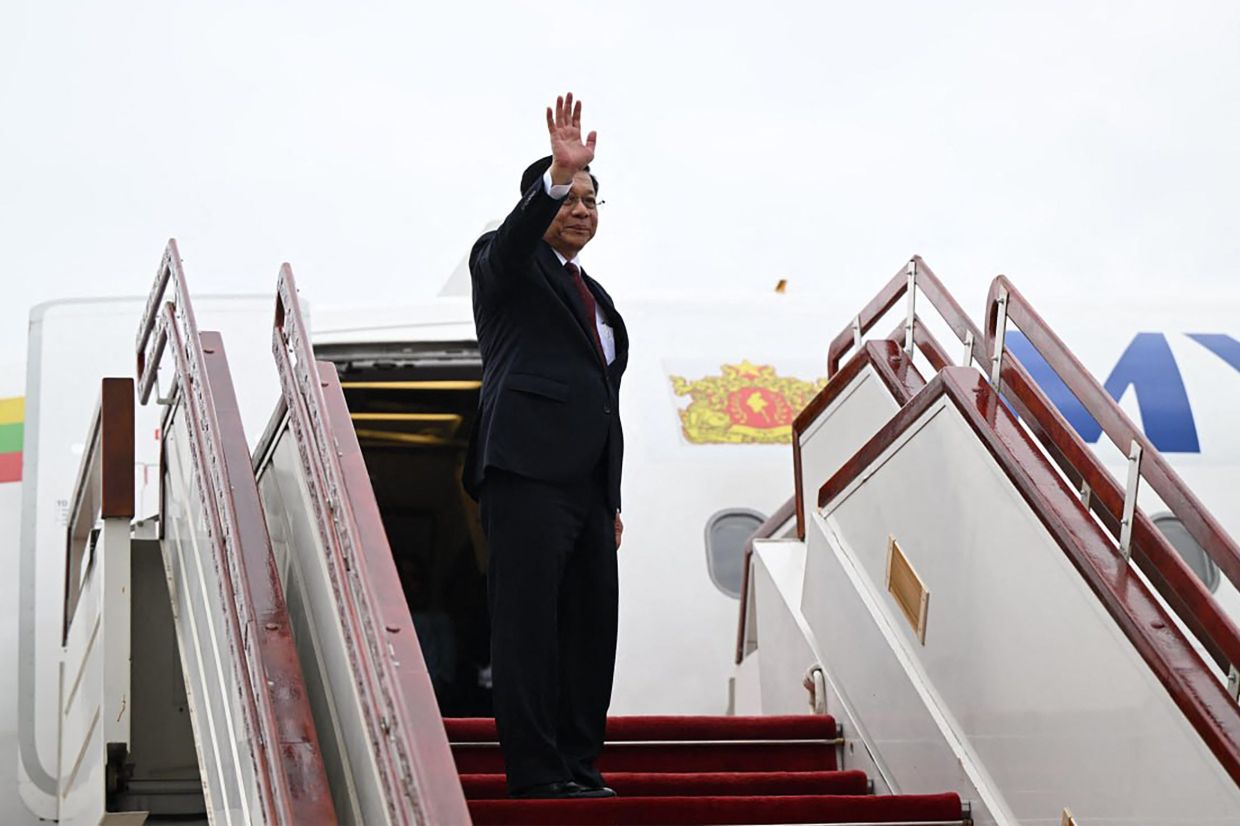
Myanmar's military leader Min Aung Hlaing departed for Russia on Monday for what his government describes as a strategic engagement with President Vladimir Putin, marking his first visit to Moscow since assuming the presidency through contested elections in April. The journey underscores the deepening alignment between Naypyidaw and Moscow at a time when Myanmar faces international isolation over the 2021 military coup that dismantled civilian democratic rule.
Russia's embrace of Myanmar's military government stands in sharp contrast to Western nations and regional democracies that have condemned the takeover and its aftermath. Among the world's major powers, Moscow emerged as one of the few willing to sustain diplomatic relations with Myanmar after the coup, which toppled the government of Aung San Suu Kyi. This strategic opening has become increasingly significant as Myanmar descends into what international observers characterize as a protracted civil conflict, with estimates suggesting over 100,000 people have been killed in the ensuing violence.
The elections that brought Min Aung Hlaing to the presidency were widely dismissed as orchestrated and illegitimate by democracy advocates and Western governments. The military, which dissolved the civilian parliament and assumed emergency powers, orchestrated a carefully controlled electoral process that consolidated its grip on power while offering the facade of democratic transition. This theatrical approach to governance underscores the military junta's attempt to navigate international criticism while maintaining absolute political control.
According to official statements from the Myanmar presidency, the Moscow visit seeks to elevate bilateral relations across multiple domains, with particular emphasis on military and economic cooperation. The scope of discussions will extend beyond formal bilateral meetings to include engagement with Russia's Prime Minister, the Speaker of the State Duma, and participation in a Myanmar-Russia economic forum. These varied platforms suggest a comprehensive effort to institutionalize the relationship across governmental and commercial channels.
The military dimension of Myanmar-Russia ties has become increasingly visible and consequential for the conflict's trajectory. The Myanmar armed forces operate aircraft of Russian manufacture against various opposition factions, and human rights organizations have documented allegations that these military operations have resulted in civilian casualties on a significant scale. Some conflict monitors contend that the pattern and nature of these attacks may constitute war crimes under international humanitarian law, though investigations remain incomplete.
Formalizing military cooperation between the two nations, Myanmar and Russia signed a five-year defence pact in February, although the Naypyidaw government has released minimal information regarding its specific provisions and operational scope. The deliberate opacity surrounding this agreement reflects the sensitive nature of military-to-military ties, particularly given international scrutiny of Myanmar's conduct in its internal conflict. Such cooperation arrangements typically encompass equipment transfers, joint training exercises, and coordination on strategic matters affecting regional security.
Min Aung Hlaing's diplomatic calendar since assuming civilian office has been notably active, with journeys to China, India, and Thailand complementing this Russian engagement. These regional and global overtures represent an attempt to rehabilitate Myanmar's international standing and forestall complete diplomatic ostracism. Each of these visits carries distinct strategic purpose: cultivating the relationship with Beijing addresses concerns about Chinese economic interests; engagement with India reflects broader Asian connectivity and balancing considerations; and visits to Thailand address immediate regional stability concerns. Collectively, these initiatives suggest a deliberate campaign to reintegrate Myanmar into international forums and bilateral relationships.
For Malaysia and broader Southeast Asia, Myanmar's trajectory presents complex implications. The civil conflict has generated regional spillover, including refugee flows and security challenges for neighbouring states. Myanmar's pivot toward Russia, coupled with its existing strategic partnership with China, raises questions about the balance of great power influence in Southeast Asia. The Association of Southeast Asian Nations, which includes both Myanmar and Malaysia, faces mounting pressure to address the crisis while maintaining the bloc's principle of non-interference in internal affairs.
The economic dimensions of the Russia-Myanmar relationship, to be explored during this visit, may offer some relief to Myanmar's deteriorating fiscal position. International sanctions and the withdrawal of foreign investment have constrained economic activity, though Russian sanctions themselves limit the extent of meaningful economic partnership. Nevertheless, trade arrangements and potential energy cooperation represent avenues through which Moscow can provide tangible support to the junta.
The visit also signals Russia's broader strategic calculus in Asia, where it seeks to maintain influence and counter Western-led regional arrangements. By sustaining engagement with Myanmar, Russia demonstrates its capacity to offer diplomatic cover and material support to regimes facing international pressure. This approach aligns with Russia's strategy of positioning itself as an alternative partner for states seeking to escape Western-dominated international architecture.
Min Aung Hlaing's diplomatic efforts reflect the military government's determination to prevent complete international isolation despite facing widespread condemnation from democracies and human rights organizations. The junta appears committed to constructing an alternative diplomatic ecosystem comprising authoritarian and non-aligned states willing to engage without moral or political conditions. Russia clearly occupies a central position within this emerging alignment.

