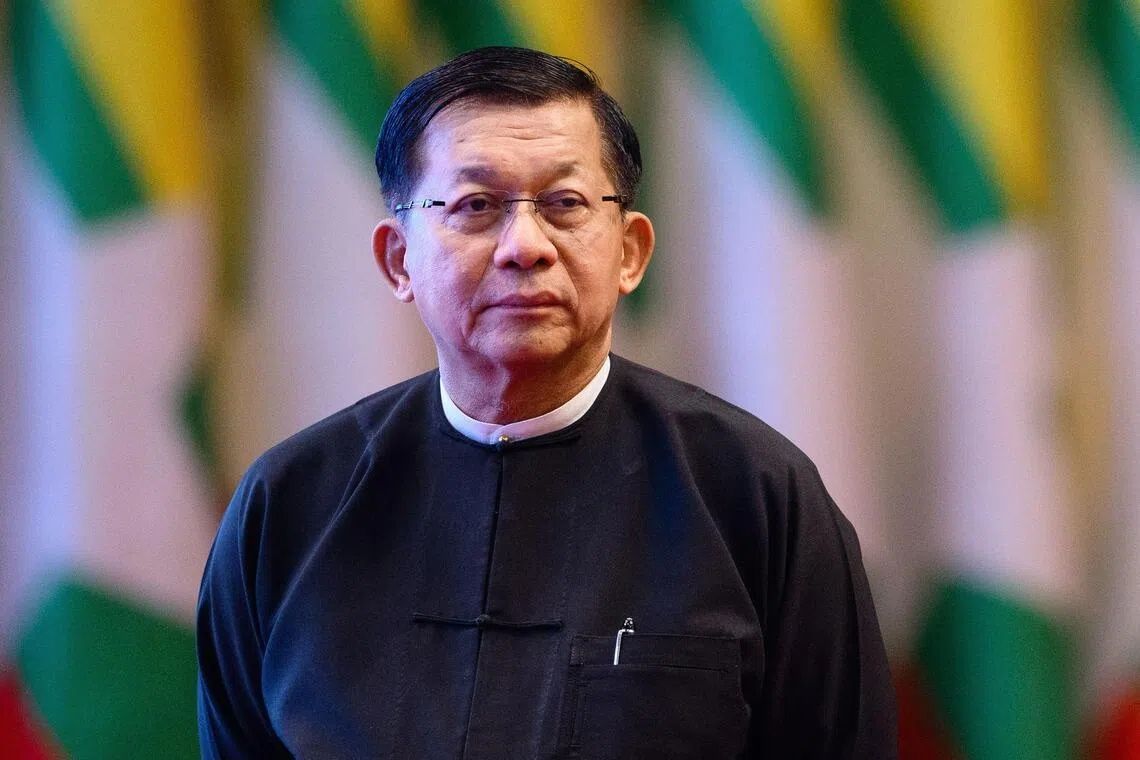
Myanmar's former military strongman Min Aung Hlaing arrived in Bangkok on Thursday for what marks a significant moment in his transformation from junta ruler to civilian president—a status he has held since April following elections widely dismissed as illegitimate by international observers and democracy advocates. The visit underscores an emerging diplomatic strategy aimed at rehabilitating Myanmar's standing within regional institutions after years of isolation stemming from his seizure of power in 2021.
The former general's path to the presidency proved deeply controversial. His military coup toppled the democratically elected government of Aung San Suu Kyi and plunged Myanmar into sustained civil unrest, with independent estimates suggesting the conflict has claimed over 100,000 lives across all combatant groups. The elections that installed him as civilian leader in April were orchestrated under military control and dismissed by credible international observers as a facade designed to give democratic legitimacy to authoritarian rule. Yet this civilian veneer has become central to his strategy for re-engaging with the Association of Southeast Asian Nations, the regional bloc that suspended Myanmar's participation in high-level forums following the coup.
Thailand has emerged as Myanmar's chief advocate within Asean, actively championing efforts to restore diplomatic normalcy both through bilateral channels and multilateral mechanisms. This Thai initiative reflects pragmatic regional calculations. The country shares a lengthy and porous border with Myanmar, experiences direct consequences from the military conflict occurring across that frontier, and hosts millions of Myanmar refugees whose presence strains Thai resources and communities. Beyond humanitarian concerns, Thai officials grapple with security challenges emanating from Myanmar's ungoverned territories, particularly the proliferation of cybercrime operations and narcotics trafficking networks that exploit the lawlessness of borderland regions.
Min Aung Hlaing's diplomatic calendar has accelerated markedly since exchanging military garb for civilian clothing. Recent journeys have taken him to India, China—a long-standing ally—and Laos, demonstrating a calculated effort to accumulate diplomatic capital and project legitimacy among neighbouring nations. Each visit reinforces the narrative of a reformed leader engaging responsibly with the international community. Thailand's willingness to host him with ceremonial honours, including an official reception at Government House and bilateral meetings with Prime Minister Anutin Charnvirakul, signals Asean's cautious willingness to acknowledge this transition.
Yet this diplomatic manoeuvre masks fundamental contradictions in Myanmar's regional positioning. Analysts have identified a striking paradox in the junta-backed government's approach: while seeking recognition as a responsible Asean member worthy of rehabilitation, Myanmar's leadership has steadfastly refused to commit to the bloc's so-called five-point consensus framework, which ostensibly provides the pathway for ending hostilities and facilitating dialogue among all warring parties. This selective engagement—embracing the prestige of Asean membership whilst rejecting its core peace mechanism—reflects what observers describe as a zero-sum calculation by Myanmar's rulers, who appear unwilling to compromise on military dominance.
Thailand's Foreign Minister Sihasak Phuangketkeow has signalled that bilateral discussions will extend beyond ceremonial courtesy to address concrete security challenges. Officials have indicated that cyber scam networks operating from Myanmar's borderlands will feature prominently in conversations, alongside efforts to combat drug trafficking and other transnational crimes. The visit agenda includes signing a memorandum of understanding on labour cooperation, reflecting economic dimensions alongside security concerns. Such practical cooperation demonstrates that normalisation serves multiple interests—security cooperation, commercial ties, and labour arrangements all benefit from stable bilateral relations.
Suu Kyi's situation adds complexity to this diplomatic narrative. The former democracy leader remains under house arrest following her ouster, yet was permitted on Monday to meet with an International Committee of the Red Cross representative—her first publicised contact with a foreign official since her removal from power. Though seemingly a modest concession, the meeting represents a minor softening in Myanmar's posture toward international scrutiny. Thailand has welcomed this development whilst diplomatically expressing hope that such gestures might presage broader commitments to reconciliation and stability.
The analytical consensus suggests Min Aung Hlaing's diplomatic offensive fundamentally concerns matters of prestige and international standing rather than substantive shifts in Myanmar's governance trajectory. Independent Myanmar observers characterise the regional outreach as motivated primarily by desire to erase the stigma of pariah status that followed the coup. Asean's pragmatic willingness to accommodate this reengagement reflects the bloc's characteristic preference for dialogue and engagement over confrontational isolation, even when dealing with leaders whose legitimacy remains deeply contested.
However, this regional realpolitik approach confronts growing international criticism. Human rights organisations and justice advocates have condemned Thailand's diplomatic overtures toward a leader facing International Criminal Court investigation for alleged crimes against humanity. Western nations maintain targeted sanctions against Min Aung Hlaing and numerous military colleagues. Campaign groups such as Justice For Myanmar have characterised Thailand's ceremonial welcome as bestowing false legitimacy upon a government responsible for systematic abuses and argue that diplomatic rehabilitation must be conditioned upon genuine accountability mechanisms rather than offered unconditionally.
The deeper tension reflects a widening gulf between Asean's consensus-based pragmatism and international norms surrounding accountability. The bloc's traditional emphasis on non-interference and engagement-over-isolation remains deeply rooted despite Myanmar's humanitarian catastrophe. Thailand's leadership of the normalisation effort suggests that security and economic interests—managing refugee flows, combating transnational crime, maintaining regional stability—take precedence over pressure for fundamental governance reform or accountability for alleged atrocities.
For Malaysian observers and policymakers, Myanmar's reintegration into regional diplomacy raises pertinent questions about Asean's evolving role. As the bloc's consensus mechanisms demonstrate limited capacity to influence member states' domestic governance, questions persist regarding whether engagement without conditionality can meaningfully shape outcomes. Myanmar's simultaneous embrace of Asean membership and rejection of its peace framework illustrates this tension acutely, suggesting that regional diplomatic standing and institutional membership do not necessarily translate into commitment to shared principles or conflict resolution mechanisms that Asean collectively endorses.

