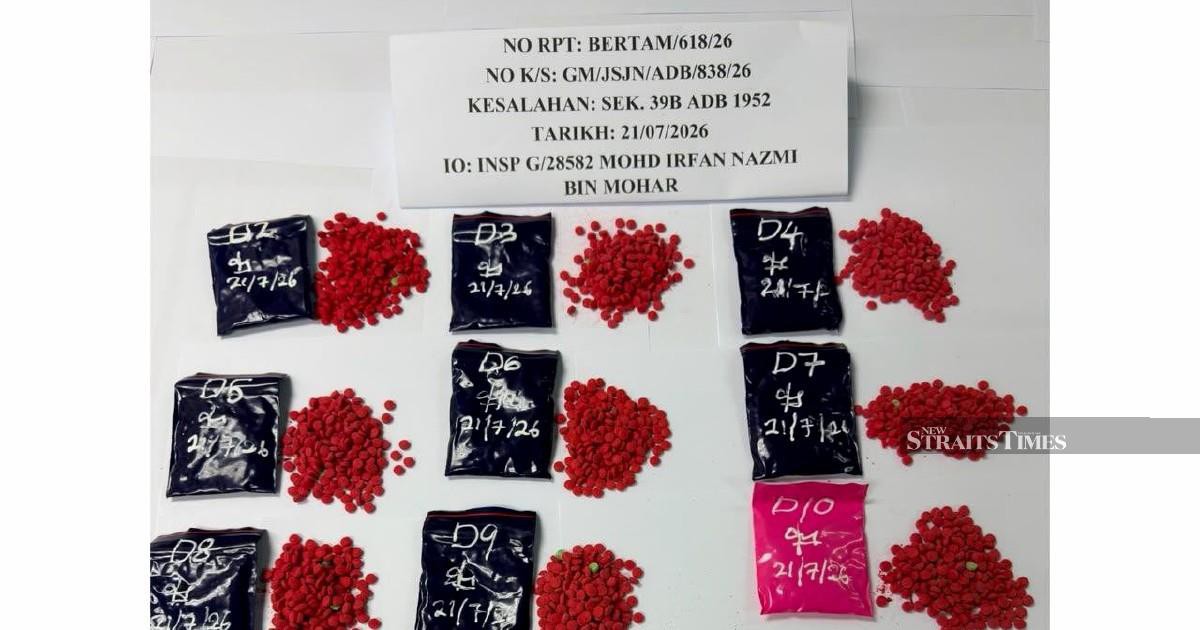
Police in Kelantan have arrested two Myanmar nationals following a short pursuit in Gua Musang, culminating in one of the state's significant recent drug seizures. The operation resulted in the confiscation of 6,000 yaba pills, with authorities valuing the contraband at approximately RM60,000. The arrests highlight the ongoing struggle Malaysian law enforcement faces in combating narcotics trafficking flowing through the country's vulnerable northern borders.
The incident underscores a persistent security challenge for Malaysia's border regions. Kelantan, situated along the Thailand-Malaysia frontier and with extended proximity to Myanmar through northern Thailand, remains a critical transit corridor for illicit substances destined for domestic consumption and regional distribution networks. The yaba trade—centring on methamphetamine tablets traditionally produced in Golden Triangle clandestine laboratories—has intensified significantly across Southeast Asia over the past decade, driven by surging demand in urbanised centres and the drug's relatively affordable price point compared to alternative stimulants.
Yaba, known colloquially as "crazy medicine" in Malay-speaking communities, carries particular social significance across Malaysia. The tablets combine methamphetamine and caffeine, producing stimulant effects that appeal to certain demographic groups including young adults, long-distance lorry drivers, and individuals in high-stress occupations. The RM60,000 valuation suggests street-level pricing that renders the drug accessible to economically disadvantaged populations, thereby expanding its market penetration within the country.
The police chase element of this apprehension reveals tactical engagement strategies employed by Kelantan's drug enforcement personnel. Such pursuit operations, while necessary to intercept mobile trafficking operations, carry inherent operational risks including potential traffic safety hazards. However, Malaysian authorities have increasingly prioritised aggressive interdiction tactics given the exponential growth in yaba seizures—national figures have demonstrated year-on-year increases in methamphetamine tablet confiscations, indicating both expanded trafficking activity and enhanced detection capabilities.
The cross-border dimension of this case reflects structural vulnerabilities within Southeast Asia's drug control architecture. Myanmar's protracted internal conflicts have fractured state capacity to regulate production within its territory, particularly in border regions controlled by non-state armed organisations. These groups have reportedly diversified revenue streams through narcotics manufacturing, creating substantial quantities of yaba for regional markets. Thailand's porous boundaries and Malaysia's vast maritime and terrestrial frontiers provide trafficking networks multiple pathways for substance movement.
Kelantan's specific vulnerability stems partly from its economic profile and geographic positioning. The state's relatively modest industrialisation compared to Selangor or Kuala Lumpur creates limited formal employment opportunities in certain districts, potentially rendering narcotics distribution economically attractive for vulnerable populations. Additionally, Gua Musang's rural character and location near forested terrain frequented by both legitimate travellers and trafficking operatives complicate enforcement surveillance and interdiction efforts.
The 6,000-pill quantity indicates this was likely an intermediate-scale trafficking operation rather than street-level retail activity. Such volumes suggest distribution arrangements reaching multiple secondary dealers across Kelantan and potentially neighbouring Terengganu and Pahang. The operation's scope implies sophisticated supply chain coordination involving multiple actors across the sourcing, transportation, and distribution pipeline. Breaking such networks requires intelligence-led operations extending beyond individual apprehensions.
For Malaysian policymakers, such arrests provide both validation of enforcement efficacy and sobering evidence of trafficking system resilience. While successful interdictions demonstrate police capability, the regularity of similar seizures indicates that enforcement alone cannot adequately address underlying demand drivers. Public health officials have noted that Malaysia's drug treatment and rehabilitation infrastructure remains insufficient to accommodate the expanding user population, particularly among younger demographics.
The detention of Myanmar nationals carries diplomatic dimensions warranting careful handling. Malaysia maintains complex bilateral relations with Myanmar's military-dominated government, alongside engagement with various ethnic armed organisations. How authorities manage these detainees—whether through local prosecution, extradition negotiations, or repatriation arrangements—reflects broader diplomatic considerations. Such cases frequently become vehicles through which regional governments test cooperation frameworks on transnational crime.
Beyond immediate enforcement outcomes, this incident signals necessity for coordinated regional responses addressing yaba manufacturing capacity. Unilateral Malaysian enforcement, while important, cannot substantially reduce supply pressures emanating from Myanmar's production bases. Meaningful intervention would require enhanced international cooperation, including intelligence sharing with Thai and Myanmar authorities, joint border patrols in designated zones, and coordinated disruption targeting trafficking organisations' logistical networks.
Looking forward, Kelantan's drug enforcement agencies face escalating operational challenges as trafficking networks adapt tactics responding to intensified law enforcement pressure. Transnational criminal organisations have demonstrated remarkable adaptive capacity, shifting routes, diversifying product portfolios, and employing more sophisticated concealment methods. Sustained success requires continuous modernisation of detection technologies, enhanced intelligence capabilities, and strategic partnerships extending across regional boundaries.

