Myanmar's tourism sector is experiencing tentative signs of life as the military-backed administration pursues an ambitious plan to transform visitor numbers into a tangible marker of economic revival following the tumultuous years since the 2021 coup. The strategy hinges on leveraging the country's extraordinary cultural heritage—its ancient temples, colonial architecture, and sacred pilgrimage sites—to lure travellers predominantly from neighbouring China and Thailand, while gradually reopening borders through streamlined visa procedures. This tourism pivot represents far more than a hospitality sector recovery; it signals broader government intent to rebuild regional relationships and project stability to international observers still wary of investing in or visiting a nation wracked by civil conflict.
The numerical targets reveal both ambition and the scale of the challenge ahead. Myanmar welcomed approximately 973,263 international visitors throughout 2025, though this baseline figure remains difficult to verify independently. By May 2024, the country had received 448,205 arrivals, translating to a modest five percent increase compared to the same period the previous year. For the government to realise its target of 1.8 million visitors annually, the second half of the year must deliver substantially stronger performance—a goal that demands both sustained regional interest and accelerating global confidence in Myanmar's stability. The mathematics underscore how far the nation has fallen from its pre-coup trajectory, when tourism had emerged as a cornerstone of economic development and international integration.
Context matters enormously for understanding Myanmar's position. In 2015, following the country's democratic opening, Myanmar attracted approximately 4.7 million international visitors—a figure that now appears almost quaint given subsequent political upheaval. Today's target of 1.8 million represents roughly 38 percent of that pre-coup peak. Meanwhile, neighbouring Thailand has consolidated its position as Southeast Asia's tourism juggernaut, attracting roughly 33 million visitors last year and maintaining similar expectations for the current year. The comparative scale underscores Thailand's entrenched advantages—established infrastructure, relative stability, and decades of tourism marketing—alongside the ongoing perception risks that plague Myanmar despite incremental improvements in security and accessibility.
Geographic sourcing patterns reveal strategic priorities and emerging trends. Chinese visitors constitute Myanmar's largest air-arrival demographic, followed closely by Thai and South Korean travellers. During the first five months of 2024, Chinese arrivals surged twelve percent year-on-year, while Thai numbers climbed seven percent. This composition reflects both geographic proximity and government targeting decisions, particularly Beijing's influence as a major regional economic player and strategic partner. Yet the official statistics encompass only legal border crossings; they deliberately exclude the disturbing phenomenon of human trafficking into online scam compounds, which has prompted coordinated regional enforcement operations and the repatriation of thousands of Chinese nationals caught in exploitative situations. This distinction matters for understanding Myanmar's genuine tourism recovery versus the shadow economy's expansion.
The visa liberalisation programme represents the government's most direct lever for stimulating visitor growth. Myanmar has expanded its visa-on-arrival scheme to include citizens from China, India, Japan, and South Korea—countries identified as priority source markets. Citizens from Russia and most Southeast Asian nations already enjoy visa-free entry, reflecting historical relationships and ASEAN membership considerations. Authorities indicate that further visa relaxations depend on demonstrable demand patterns from individual markets, suggesting a calibrated rather than wholesale approach to border opening. This measured strategy attempts to balance economic incentives with security concerns, though the precise calculus remains opaque and subject to shifting political circumstances beyond tourism ministry control.
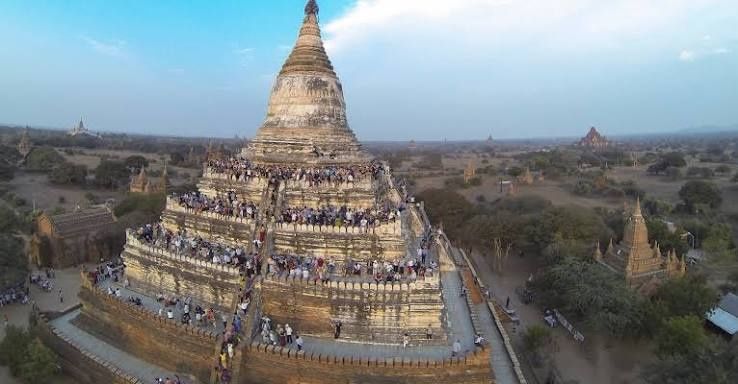
Official messaging emphasises relationship-building and trust reconstruction as foundational to tourism recovery. Aung Aye Han, director general of the Directorate of Hotels and Tourism, articulated this approach, noting that the country prioritises trust-building while identifying established attractions—Yangon, Mandalay, Bagan, Inle Lake, and the Golden Rock Pagoda—as perennial draws. These sites represent Myanmar's most famous cultural and natural assets, each with distinct appeal to different traveller demographics. Bagan's archaeological temples attract culturally curious visitors; Inle Lake appeals to eco-tourists; the Golden Rock Pagoda serves Buddhist pilgrims. The concentration on these established nodes rather than new destination development reflects resource constraints and the reality that infrastructure investments require both capital and security confidence that post-coup Myanmar has struggled to guarantee.
President Min Aung Hlaing's diplomatic agenda directly intersects with tourism promotion. Since assuming office in April, he has pursued state visits to China and India while signalling intent to normalise relations with Southeast Asian neighbours. Thailand, identified as one of Myanmar's closest economic partners, has begun reciprocal engagement; Thai Foreign Minister Sihasak Phuangketkeow visited Myanmar in April, symbolising official receptiveness. More tellingly, popular Thai travel influencers including Farose and Go Went Go's Bas have recently filmed content in Yangon for regional distribution, representing grassroots sentiment-shifting toward Myanmar destinations after years of virtual disappearance from mainstream travel discourse. This influencer engagement demonstrates how personal narratives and social media exposure operate alongside formal diplomatic channels to reshape destination perception among younger, digitally-connected traveller cohorts.
International tour operators detect genuine if cautious revived interest from Western markets, suggesting Myanmar's appeal transcends geographic proximity. Thet Lwin Toh, managing director of Myanmar Voyages International Tourism Co., reports that inquiry levels from Europe, the United States, and India have increased despite persistent constraints on international flight connectivity. This pattern intrigues because it occurs amid Western government travel warnings; the US State Department maintains a "Do Not Travel" advisory citing armed conflict and unrest, yet American visitor arrivals rose seventeen percent through May. Individual travellers like Liam Martinez, a 34-year-old from Texas, describe YouTube-sourced content inspiring visits despite negative headlines, suggesting that informal information channels shape decisions as powerfully as official warnings.
The hospitality sector itself provides tangible indicators of incipient recovery momentum. Luxury hotels in Yangon report occupancy increases of approximately ten percent since the election, a modest but symbolically significant uptick. May Myat Mon Win, general manager of Chatrium Hotel Royal Lake and adviser to the Myanmar Tourism Federation, characterises current guests as predominantly business travellers, religious pilgrimage groups, and individuals exploring investment opportunities. This composition differs fundamentally from pre-coup leisure tourism demographics, reflecting the current economy's focus on relationship-building rather than mass-market recreation. Win anticipates resurgent Japanese arrivals, though driven primarily by business and investment considerations rather than traditional tourism motivations. This trajectory suggests Myanmar's recovery may unfold differently than the leisure-focused boom of the mid-2010s, with commercial and religious travel anchoring stability before conventional tourism expands.
The political economy underpinning this tourism bet deserves scrutiny. Economic recovery generates legitimacy for military-backed governance; visible international engagement and commerce provide cover for continued centralised control. Tourism development conveniently supports this narrative while theoretically distributing economic benefits across communities that depend on hospitality employment. Yet the concentration on established urban and religious sites, coupled with emphasis on regional rather than global source markets, suggests a cautious strategy prioritising nearby, more politically aligned nations. Myanmar's tourism recovery thus operates within broader patterns of strategic realignment toward China and India rather than Western markets, reflecting geopolitical shifts that extend well beyond hospitality management. Success in reaching 1.8 million visitors this year would represent material progress but would simultaneously demonstrate the constraints and particular contours of Myanmar's current international positioning.

