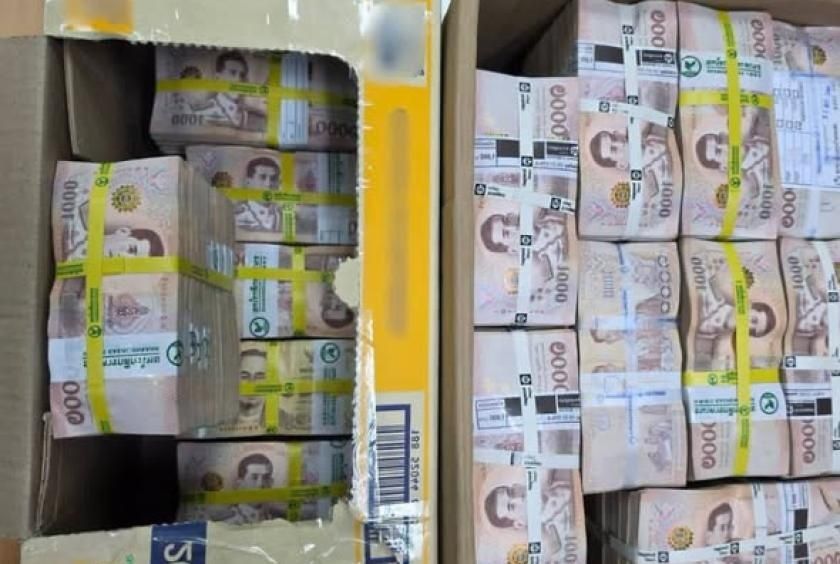
Authorities in Thailand have apprehended a Myanmar national suspected of orchestrating a significant currency smuggling operation across one of Southeast Asia's busiest land borders. The 31-year-old driver was intercepted on the Thai side of the Mae Sai crossing while transporting contraband Thai baht valued at approximately 23 million baht, equivalent to nearly US$689,000, according to reports from Thai media outlets covering the incident.
The interception took place at the customs checkpoint operated on Thai territory near the Thai-Myanmar Friendship Bridge, a critical transit point that processes thousands of vehicles daily between the two nations. Routine inspection protocols initiated by Thai customs officials proved decisive in uncovering the concealment scheme. When inspectors examined a vehicle displaying Myanmar registration plates, they discovered an elaborate attempt to disguise the currency as legitimate goods crossing the border.
The ingenuity of the smuggling method underscores the sophistication of cross-border financial trafficking networks operating in the region. Customs staff found that approximately 23 million baht in Thai 1,000-baht notes had been meticulously packaged and distributed across cartons ostensibly containing dried fish and potatoes—items that routinely cross borders in significant quantities and therefore attract less intensive scrutiny than obviously valuable merchandise. The cash was further wrapped in multiple layers of plastic bags, suggesting careful planning to minimize detection risks during the inspection process.
The seizure was detailed across two distinct containers discovered during the search. The first carton yielded approximately 17 million baht, while a second produced an additional 6.023 million baht, establishing a total contraband value of 23.023 million baht. This systematic distribution across multiple packages likely reflected an attempt to obscure the total amount being transported and potentially to suggest that the goods were routine cross-border commerce rather than a coordinated smuggling enterprise.
Thailand's legal framework governing currency movement across international borders is comprehensive and strictly enforced. The suspected offence breaches provisions of Thailand's Customs Act, which regulates the transit of goods and merchandise across national boundaries, as well as the nation's foreign exchange control regulations designed to monitor and prevent unauthorised movement of currency outside the country. These regulatory structures exist to maintain financial stability, prevent money laundering, and ensure that large-scale currency transfers remain traceable for tax and security purposes.
The implications of such smuggling operations extend beyond individual criminal cases. The Mae Sai checkpoint sits at the intersection of significant trade routes connecting Thailand with Myanmar and, by extension, with wider Southeast Asian commercial networks. Large-scale currency smuggling can distort economic data, complicate monetary policy effectiveness, and potentially facilitate other illicit activities including proceeds from drug trafficking or other organised crime. The discovery therefore represents a successful intervention in what could have been part of a broader criminal enterprise.
Investigative authorities have detained the suspect at Mae Sai Police Station while pursuing leads into the broader network potentially responsible for orchestrating the smuggling attempt. Thai police have indicated that their investigation focuses on identifying additional individuals connected to the operation, suggesting that the apprehended driver may represent merely one participant in a larger scheme. Such collaborative investigations often reveal multiple actors across different jurisdictions, including organisers, financiers, drivers, and recipients on either side of the border.
For Malaysia and other Southeast Asian nations, this incident illustrates the persistent challenge of managing porous borders and preventing financial crimes in a region characterised by dense cross-border trade and significant informal economy activity. Authorities throughout the region employ similar inspection protocols and share intelligence on smuggling routes and techniques. The case demonstrates both the capacity of frontline customs staff to detect sophisticated concealment methods and the ongoing evolution of smuggling tactics designed to circumvent such detection.
The Mae Sai checkpoint has emerged as a focal point for customs interdictions precisely because of its high volume of legitimate traffic, which creates both opportunities for smugglers to blend contraband with routine commerce and opportunities for trained inspectors to identify anomalies. The successful interception reflects investment in customs infrastructure and staff training at this critical border facility, a model that other Southeast Asian nations continue to adopt and refine.
Cross-border currency smuggling often reflects underlying economic disparities, currency exchange rate advantages, and demand for untraced cash in informal markets. The sophistication of this particular operation—the choice of food packaging, the layering of plastic wrapping, the use of high-denomination notes, and the vehicle selection—suggests familiarity with successful previous operations and adaptation to known inspection procedures. Authorities will likely examine whether similar contraband has previously transited this route undetected.
The investigation moving forward will determine whether this represents an isolated incident or whether it forms part of a pattern of systematic smuggling through the Mae Sai crossing. Authorities in both Thailand and Myanmar maintain coordinated border security operations, though the porous nature of the frontier and the volume of cross-border activity create persistent challenges. The case will likely inform future risk assessment protocols at the checkpoint and contribute to regional intelligence sharing initiatives aimed at disrupting organised cross-border financial crime networks.

