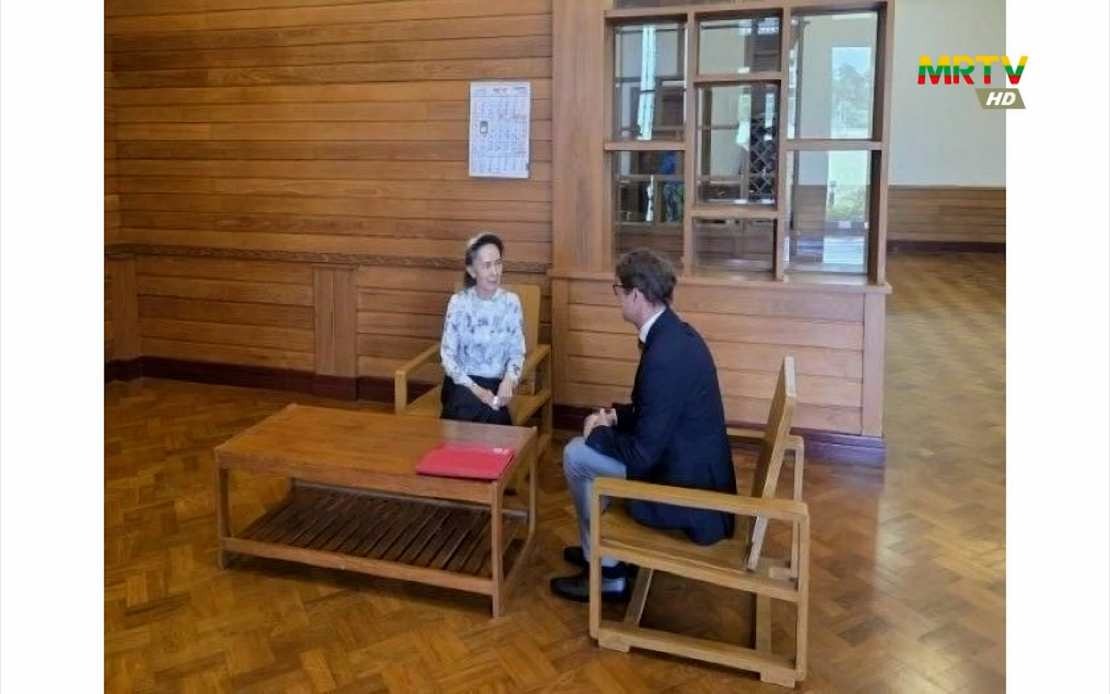
Myanmar's junta has announced that Aung San Suu Kyi, the country's ousted civilian leader, received a visit from an official representing the International Committee of the Red Cross in the capital Naypyitaw on Monday. Government spokeswoman Khine Khine Soe disclosed the meeting with Arnaud de Baecque, the ICRC's Resident Representative to Myanmar, through a Telegram message. The development represents a significant, albeit limited, breach in the information blackout surrounding one of Asia's most prominent political prisoners, though the ICRC declined to comment immediately on the encounter.
Suu Kyi, now 81 years old and a Nobel Peace Prize laureate, has languished in detention since the military abruptly seized power in a dawn coup on February 1, 2021, dismantling the elected democratic government she led. Since that tumultuous day, the country of 51 million people has descended into deepening instability, with armed conflict spreading across multiple regions and the economy contracting sharply. Her precise location and physical condition have remained shrouded in mystery throughout her nearly four-year incarceration, with no foreign dignitary or international envoy publicly confirmed to have met with her until now.
The Burmese government released four photographs purporting to document the meeting. Two images show Suu Kyi, dressed in traditional Burmese garb, seated across from Baecque in a sparsely appointed room furnished with only chairs and a desk. A third photograph offers rare insight into her living quarters, revealing her cutting what appears to be a birthday cake bearing her name, with a clothes rack and storage boxes visible in the background. The fourth image is a close-up of the cake's inscription reading "Happy Birthday Aunty Suu 19.6.2026". However, Reuters was unable to independently verify when and where these photographs were actually taken, and no evidence of their prior circulation online could be found.
The timing and context of this meeting carry particular significance for Southeast Asia's broader geopolitical landscape. ASEAN nations, Myanmar's regional neighbours, have increasingly voiced concern about Suu Kyi's welfare and demanded transparent verification of her health status. During a regional diplomatic gathering in Bangkok last month, Thailand's Foreign Minister Sihasak Phuangketkeow explicitly called for access to the detained leader to independently substantiate government assertions regarding her wellbeing. Similarly, the Philippines formally requested permission for an ASEAN special envoy to visit Suu Kyi in May, a request the military administration rebuffed.
The Myanmar junta has repeatedly claimed that Suu Kyi enjoys "good health", yet these declarations have been met with considerable scepticism from international observers and her family. Her son, Kim Aris, disclosed to Reuters last December that he possesses virtually no reliable information about his mother's condition, receiving only sporadic secondhand reports of various health complications including heart, bone, and gum problems. Most troublingly, Aris revealed he has had no direct contact with his mother in years, harbouring deep fears that she might die without his knowledge or ability to be present.
Suu Kyi's legal ordeal has been extraordinary in scope and severity. Following a series of secretive trials conducted after the coup, military courts convicted her on multiple charges spanning corruption, election fraud incitement, and breaching state secrecy legislation, initially imposing a 33-year prison sentence. This sentence was subsequently reduced to 27 years, then further shortened by one sixth in April this year, leaving her with 18 years of her original term still outstanding according to her legal representatives. Her supporters and international observers view these charges as transparently politically motivated mechanisms designed to neutralize the nation's most popular political figure and prevent her return to power.
The military's decision to place Suu Kyi under house arrest rather than prison detention, announced in late April following a carefully orchestrated election that elevated former junta commander Min Aung Hlaing to the presidency, represents a marginal improvement in conditions. Yet this modification remains entirely cosmetic and continues to constitute imprisonment. The authorities maintain strict control over who may contact her and what information reaches the outside world, as demonstrated by the carefully curated photographs released through government channels.
For Malaysian readers and broader Southeast Asian audiences, Suu Kyi's continued detention symbolizes the fragility of democratic gains across the region and the persistent danger posed by military interventionism. Myanmar's trajectory since 2021 has been cautionary, illustrating how quickly institutional democracy can collapse and how effective personality-based political systems become vulnerable to authoritarian capture. The international community's relative impotence in responding to Myanmar's coup—despite ASEAN's nominal commitment to democratic principles—raises uncomfortable questions about regional solidarity and enforcement mechanisms.
The Red Cross meeting, while appearing modest in scope, potentially opens pathways for future international oversight of Suu Kyi's detention. The ICRC's mandate includes monitoring treatment of detainees and prisoners, and any findings from this visit could eventually feed into broader international reporting on Myanmar's human rights situation. However, scepticism remains warranted given the junta's demonstrated willingness to manipulate information and the organization's historically cautious approach to public criticism of host governments.
Looking forward, regional countries including Malaysia must grapple with the question of how to constructively engage Myanmar's military leadership while simultaneously maintaining pressure for Suu Kyi's release and broader democratic restoration. ASEAN's consensus-based diplomacy has proven insufficient to influence Myanmar's trajectory, yet more confrontational approaches risk further isolating the country and potentially accelerating its drift toward destabilization. The delicate balance between maintaining engagement channels and advocating for fundamental rights and freedoms remains one of the region's most pressing diplomatic challenges.

