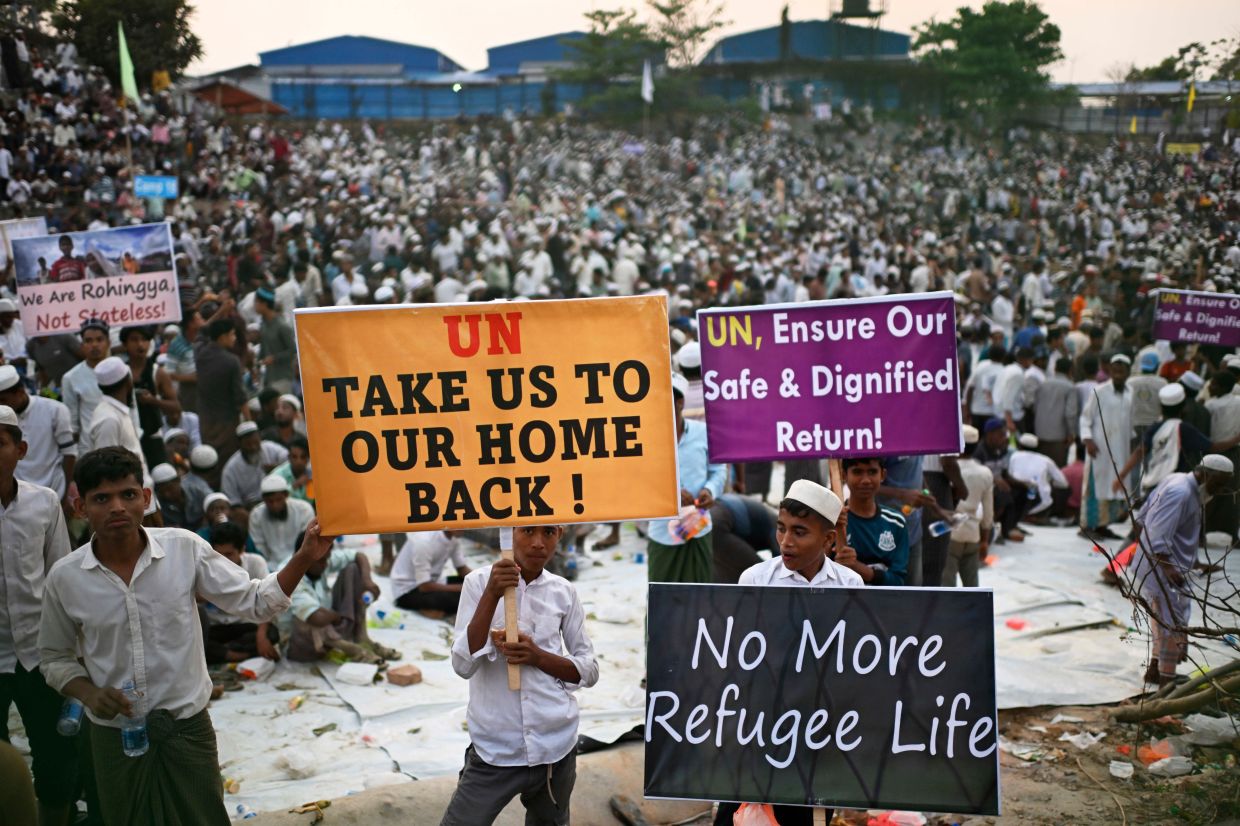
Myanmar's military-led administration announced Saturday that it has verified identification documents for over 300,000 Rohingya refugees sheltering in Bangladesh camps, declaring them eligible for eventual repatriation to Rakhine state. The statement from the Ministry of Foreign Affairs marks a symbolic step in addressing the humanitarian crisis that has consumed nearly a decade, yet offers little practical progress toward actually returning the displaced population to Myanmar soil.
The ongoing crisis represents one of the region's most intractable displacement emergencies. Approximately 700,000 Rohingya fled Myanmar in August 2017 when the military executed a large-scale operation against the community following attacks by a Rohingya insurgent group on military installations in Rakhine. The scale and brutality of that campaign prompted accusations of ethnic cleansing and genocide from international bodies including the United Nations, allegations that Myanmar's government has consistently rejected.
According to official figures released by Myanmar, authorities have completed verification procedures on 426,545 individuals from a list of 828,824 refugees provided by Bangladesh as of late July. Of those verified, Myanmar determined that 308,797 qualified as former residents of Rakhine state. The government reported that 113,507 individuals could not be verified through existing documentation, while 4,241 were flagged as having involvement in what Myanmar describes as terrorist activities—a characterization reflecting the government's perspective rather than independent assessment.
Myanmar refuses to acknowledge the Rohingya as one of the nation's 135 officially recognised ethnic minorities, instead referring to them as Bengalis to suggest they are migrants from Bangladesh rather than indigenous to Myanmar. This fundamental categorical denial underpins much of the political intransigence surrounding any resolution to the crisis. The government's stated position requires security conditions in Rakhine to stabilise before accepting returnees, a precondition that remains distant given current circumstances.
The repatriation framework that Myanmar and Bangladesh negotiated in 2018, envisioning a two-year process, has produced virtually no returns. The plan collapsed following Myanmar's 2021 military coup, which ousted Aung San Suu Kyi's democratically elected government and triggered an armed rebellion across the country. This internal conflict fundamentally transformed the security environment, making any large-scale refugee repatriation logistically impossible and politically impractical.
Conditions in Rakhine have deteriorated significantly since 2021. Fighting between the Arakan Army, an ethnic armed organisation based in the region, and Myanmar's military has intensified control disputes over territory. The Arakan Army has captured substantial portions of Rakhine from government forces during recent fighting, establishing itself as a major power broker. This factional conflict forced additional waves of Rohingya to flee across borders toward Bangladesh and beyond during 2023, deepening the humanitarian crisis rather than resolving it.
The deteriorating situation within camps has pushed increasing numbers of Rohingya toward dangerous maritime migration. Faced with inadequate humanitarian assistance, severe restrictions on movement and employment, and dim prospects for return, refugees have increasingly attempted perilous ocean journeys to reach Malaysia and Indonesia aboard overcrowded vessels. These journeys have claimed lives whilst generating secondary displacement crises that affect Southeast Asian nations directly.
Recent diplomatic activity highlights the region's complex engagement with Myanmar over this issue. Malaysian Prime Minister Anwar Ibrahim stated in late July that Myanmar had agreed to accept 5,000 Rohingya refugees currently residing in Malaysia. However, Myanmar's Foreign Ministry official Han Win Aung subsequently contradicted this characterisation, asserting that any repatriation programme would involve only verified Myanmar nationals held in Malaysian detention facilities, explicitly denying that the government would accept Rohingya refugees under any circumstances.
This diplomatic contradiction illustrates the gap between international expectations for humanitarian resolution and Myanmar's official position. The government contests claims that over one million people were displaced from Rakhine, asserting instead that around 540,000 crossed into Bangladesh during the 2017 violence whilst more than 200,000 remained in northern Rakhine. These disputed figures reflect competing narratives that complicate any negotiated solution.
For Malaysia and other Southeast Asian nations, this prolonged crisis presents ongoing challenges. Malaysia hosts significant numbers of Rohingya refugees, making it directly affected by Myanmar's failure to resolve the humanitarian crisis. The verification process Myanmar announced, whilst potentially constructive in principle, lacks mechanisms for implementation and remains conditioned on security improvements that appear unlikely given regional power dynamics.
The geopolitical dimensions have become increasingly complex. Myanmar's military government faces internal conflicts that consume resources and attention, whilst international pressure to resolve the Rohingya crisis has diminished relative to other global concerns. Bangladesh, bearing the largest humanitarian burden with nearly one million Rohingya in camps, has limited leverage to compel Myanmar action.
For Rohingya themselves, the verification process offers no immediate relief from camp conditions or timeline for return. Many have lived in camps for over a decade, with an entire generation of children born in exile. The psychological and social toll of prolonged displacement, combined with uncertain prospects, has created a population facing diminishing hope for resolution through official channels.
As the crisis enters its ninth year without meaningful progress toward repatriation, the verification announcement appears largely symbolic—a gesture toward international expectations without substantive commitment to implementation. Until Myanmar's internal stability improves and its government demonstrates genuine willingness to accept Rohingya returns, the hundreds of thousands in Bangladesh camps will likely remain in limbo, with regional nations like Malaysia continuing to absorb overflow populations seeking escape from deteriorating camp conditions.

