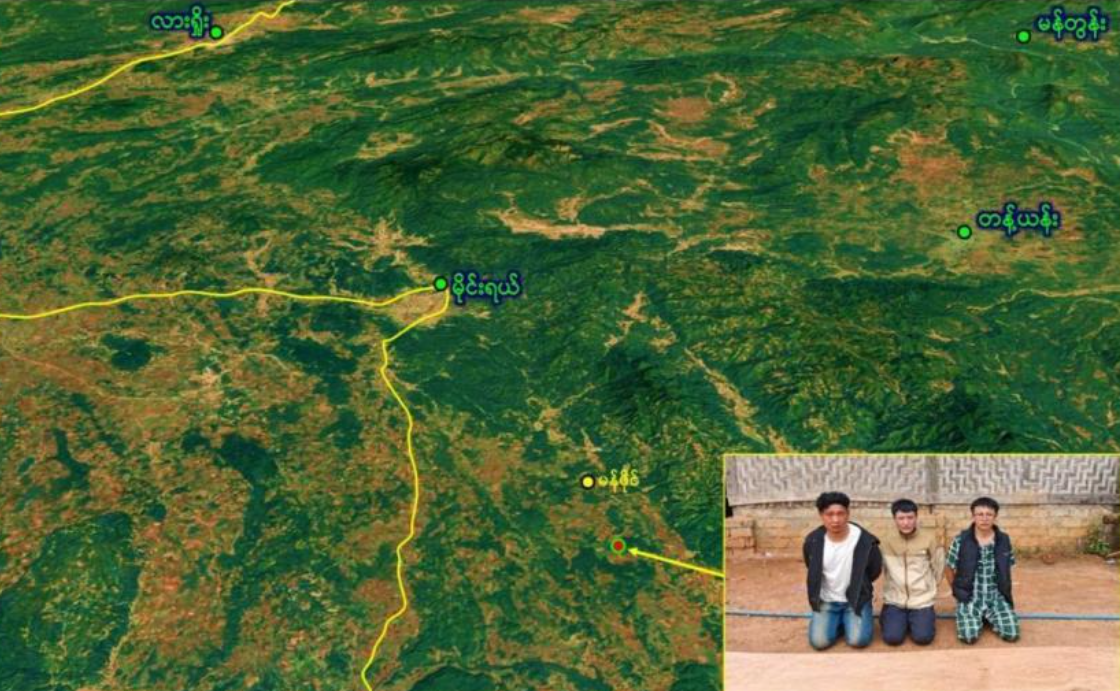
Myanmar's military has intensified crackdowns on cross-border criminal enterprises, arresting three Chinese nationals suspected of orchestrating an online gambling scam network in the remote border regions of northern Shan State. The operation, conducted in Mongyai Township on August 26, marks the latest in a sustained government campaign targeting illicit online gaming and fraud operations that have proliferated across Myanmar's porous frontier areas. The arrests signal Yangon's growing determination to dismantle sophisticated criminal networks that exploit the country's challenging terrain and limited law enforcement resources to establish bases for defrauding victims across Asia.
The three suspects had illegally crossed into Myanmar and established what authorities characterize as a temporary operational hub approximately 26 kilometres southeast of Mongyai town and five kilometres south of Manphai Village. According to local intelligence reports, individuals engaged in online scam gambling had constructed makeshift shelter complexes designed for concealment and rapid abandonment if detected by security forces. Military columns conducting routine security patrols received information from residents about suspicious activities in the area, prompting more detailed reconnaissance and the eventual security operation that led to the arrests.
The infrastructure seized during the raid reveals the sophistication of such operations and their technical requirements. Authorities confiscated one main corrugated iron structure measuring 50 by 20 feet with bamboo walls, alongside five temporary tarpaulin shelters of varying dimensions—typical construction methods in border regions where permanence could invite additional scrutiny. More tellingly, the equipment inventory demonstrates how modern communications technology enables fraud networks to operate remotely: investigators recovered 25 mobile phones, five all-in-one computers, two power stations, one Starlink satellite internet device, and ten communication radios. The Starlink equipment is particularly significant, as it indicates operators were establishing independent internet access to bypass local telecommunications infrastructure and potential monitoring.
This bust illustrates broader patterns of transnational online scam gambling that have become a regional security concern. Chinese nationals have been identified repeatedly as key players in such operations, with networks often leveraging language capabilities and existing diaspora connections to target victims throughout Southeast Asia and China itself. The sophistication of equipment—particularly satellite internet systems—demonstrates how criminal enterprises have adapted to counter law enforcement tactics, establishing operations in remote border zones where conventional telecommunications are unreliable and regulatory oversight minimal.
Myanmar's intensified campaign against online scams reflects mounting pressure from neighbouring countries and international partners concerned about the scale of financial losses incurred by victims. These operations frequently target individuals through fake investment schemes, fraudulent gambling platforms, and relationship-based scams. Victims across Malaysia, Thailand, the Philippines, and other regional nations have reported losing substantial sums to networks allegedly operating from Myanmar border areas. The country has become a de facto regional hub for such criminal activity due to weak governance in remote regions, porous borders, and the conflict-affected nature of areas where oversight capacity is minimal.
The operational methodology employed by the arrested individuals—establishing temporary shelters, using multiple communication channels, maintaining high mobility—reflects lessons learned from previous law enforcement operations. Criminal networks have become adept at establishing quick-setup, quick-shutdown operations that can relocate if pressure intensifies. The use of power stations for independent electricity supply and Starlink for unmonitored internet represents an evolution in tradecraft aimed at avoiding detection through conventional infrastructure monitoring.
Myanmar authorities have committed to systematic dismantling of illegally constructed facilities used in such operations, signalling a shift from reactive enforcement to proactive infrastructure destruction. This approach aims to increase operational costs and risks for criminal networks, making border regions less attractive as bases. However, enforcement in remote Shan State remains challenging given ongoing armed conflict, limited government presence in certain areas, and the difficulty of maintaining sustained surveillance in mountainous terrain.
The legal proceedings against the three suspects remain unclear regarding which statutes will be invoked. Myanmar's existing cybercrime and gambling regulations provide frameworks for prosecution, though border regions sometimes operate under different administrative arrangements. The seized equipment will be processed according to established procedures, likely involving documentation and either destruction or confiscation for government use.
For Malaysian readers, these arrests carry particular resonance given reports of substantial losses incurred by local victims of similar scam networks. Many Malaysian fraud victims have traced operations to Myanmar border regions, and some have faced difficulties in pursuing legal recourse across international boundaries. The crackdown suggests Myanmar authorities are responding to regional pressure, though experts note that sustained enforcement requires resources and political will that may fluctuate depending on broader security priorities.
The incident underscores how transnational crime exploits the gaps between national jurisdictions and the technical advantages offered by modern communications technology. Even as one network is dismantled, others likely adapt their methods and locations. Regional cooperation mechanisms, including information-sharing agreements and coordinated enforcement operations, remain underdeveloped compared to the sophistication of criminal networks themselves. The arrests represent progress in individual cases but highlight the broader challenge of combating organized cross-border criminal enterprises that treat Southeast Asia's borders as operational opportunities rather than barriers.

