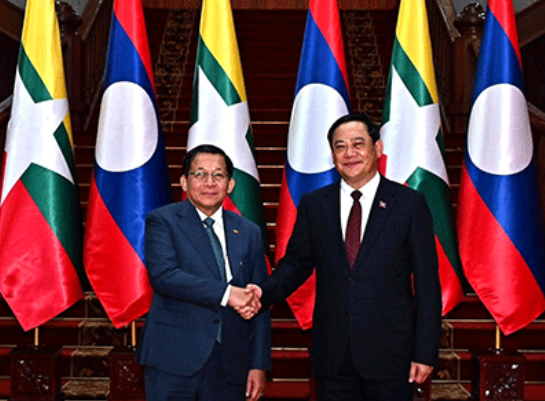
Myanmar's President Min Aung Hlaing concluded a significant three-day state visit to Laos that underscored the two nations' commitment to deepening long-established partnerships. Arriving in Vientiane on July 3 accompanied by his wife and senior delegation at the invitation of Lao President Thongloun Sisoulith, the Myanmar leader participated in full ceremonial exchanges and substantive talks that centred on broadening cooperation across political, economic and defence sectors. The visit coincided with commemorations marking seven decades of uninterrupted diplomatic relations between the two Southeast Asian neighbours, reinforcing their positioning as stable regional actors within the broader Asean framework.
President Thongloun characterised the Myanmar leader's presence as a landmark political event and fresh milestone in fostering ties that both nations have cultivated over more than seventy years. The Lao president offered his congratulations on Myanmar's recently conducted general election and the establishment of its new administration, expressing optimism that the country would advance further under Min Aung Hlaing's direction. This measured acknowledgment proved significant given the international scrutiny Myanmar has faced, suggesting that Laos—itself governed through a single-party communist system—views the Myanmar leadership's efforts within a framework of regional solidarity rather than external judgement.
During formal bilateral discussions, the two presidents reviewed the full spectrum of existing cooperation arrangements and deliberated on emerging regional and global challenges demanding coordinated responses. Both leaders expressed satisfaction with the trajectory of their political relationship, notably highlighting the consistency of high-level exchanges and the mutual confidence underpinning their interactions. The meetings encompassed defence and security collaboration, trade facilitation, investment promotion, transport linkages, energy projects, labour migration protocols and educational scholarships—indicating the comprehensive nature of the bilateral agenda and the desire to integrate cooperation across multiple dimensions of statecraft.
A notable emphasis emerged on collaborative border management and intelligence-sharing mechanisms, reflecting the practical security concerns that preoccupy both governments. The leaders further committed to strengthening their joint participation in major regional and multilateral forums, particularly within the Association of Southeast Asian Nations, United Nations bodies, and the Mekong-Lancang Cooperation framework. This multilateral dimension reveals how Myanmar and Laos position themselves within broader Southeast Asian architecture, seeking to leverage their partnership to amplify influence in increasingly important development and strategic initiatives.
Prime Minister Sonexay Siphandone separately received President Min Aung Hlaing at his office, where discussions focused on concrete mechanisms for advancing shared interests. The Lao prime minister welcomed the productive outcomes of the earlier presidential talks and formally acknowledged the signing of bilateral cooperation agreements. His remarks emphasised how such high-profile engagement consolidates longstanding friendship and strengthens the neighbour-to-neighbour relations that have historically characterised the two countries' interactions. The timing and sequence of these multiple-level engagements—presidential, prime ministerial, and parliamentary—underscored the importance Laos attaches to the visit and the desire to embed partnership commitments across all governing institutions.
Xaysomphone Phomvihane, President of Laos' National Assembly, similarly met with the Myanmar leader to discuss parliamentary cooperation pathways. The Lao National Assembly president highlighted that Myanmar's president had selected Laos as his first official Asean destination for international engagement since assuming office, itself a gesture of diplomatic priority. Discussions centred on strengthening ties between the two legislatures and ensuring that government-level agreements translate into practical legislative support and effective implementation. Both sides acknowledged the importance of parliamentary oversight in monitoring bilateral accord compliance, particularly regarding trade, investment and economic collaboration initiatives.
Two formal cooperation documents emerged from the visit, crystallising shared commitments into institutional frameworks. Myanmar's Ministry of Hotels, Tourism and Culture and Laos' Ministry of Culture and Tourism signed a Memorandum of Understanding to expand tourism cooperation, recognising the mutual benefits of promoting visitor flows and cultural exchange between the two nations. Simultaneously, Vientiane and Naypyidaw formalised their relationship as sister cities, establishing administrative and cultural linkages that typically facilitate people-to-people contact and municipal-level collaboration. These agreements reflect a pragmatic approach to deepening engagement through measurable, sector-specific initiatives rather than rhetorical commitments alone.
The Myanmar delegation also witnessed the formal transfer of snake antivenom serum to Laos' Ministry of Health, a humanitarian gesture addressing a practical public health concern affecting both nations. Though modest in scale, such medical cooperation signals the breadth of interaction and the willingness of both governments to support each other's welfare priorities. This type of low-profile but substantive collaboration often proves more durable than grand political declarations, establishing routines of exchange and mutual aid that persist across political transitions.
Ceremonial elements punctuated the official programme, reinforcing the symbolic significance both nations attach to their relationship. President Min Aung Hlaing laid wreaths at Vientiane's Unknown Soldier Monument, honouring Lao revolutionary soldiers and demonstrating respect for the historical struggles that shaped the Lao nation. The Myanmar delegation's participation in traditional Baci ceremonies—intimate rituals involving blessed cotton threads and blessings—illustrated a willingness to engage respectfully with Lao cultural practices. The state banquet hosted by President Thongloun and his wife Naly Sisoulith provided an opportunity for direct personal interaction among the highest officials, cultivating the interpersonal relationships that often underpin sustained diplomatic cooperation.
The visit extended beyond Vientiane to encompass Luang Prabang, where the Myanmar delegation explored temples, cultural monuments and other heritage sites within the Unesco World Heritage city. This cultural pilgrimage component served multiple purposes: demonstrating respect for Lao civilisation and history, allowing the Myanmar president to appreciate the nation's spiritual and artistic achievements, and providing informal settings for ongoing bilateral discussions among senior officials. Such extended visits, rather than brief capital-based engagements, signal genuine investment in relationship-building and create opportunities for candid discussions beyond formal conference settings.
For Malaysia and the broader Southeast Asian region, this visit carries implications regarding how individual nations navigate their bilateral relationships amid the complex geopolitical currents affecting Asia. Myanmar's strategic positioning within Asean remains consequential, particularly given its geography, natural resources and regional weight. Laos' positioning as a steadfast Myanmar partner—particularly during periods when the junta has faced international criticism—illustrates how ideological affinity and historical ties can supersede external pressure in determining state behaviour. The visit demonstrates that Myanmar maintains committed regional allies willing to engage constructively, a factor that will influence how effectively international efforts to shape Myanmar's trajectory might succeed.
The seven-decade relationship foundation provides Myanmar and Laos with durable institutional channels and established practices of cooperation, enabling them to sustain engagement regardless of international opinion. Their shared emphasis on sovereignty, non-interference and intra-Asean solidarity reflects values that resonate across the region. For Malaysia, which maintains diverse bilateral relationships and seeks to maintain Asean cohesion, such Myanmar-Laos cooperation exemplifies the regional partnerships that sustain the bloc's collective voice in international affairs. The emphasis on defence cooperation, border security and multilateral coordination suggests both nations view their partnership as increasingly important in managing regional security challenges, whether involving transnational crime, resource competition or great power tensions.
Looking forward, the agreements signed and commitments made during this visit establish frameworks that will structure Myanmar-Laos relations over coming years. The tourism memorandum may catalyse business and people-to-people exchanges, while the sister-city arrangement between the capitals creates institutional momentum. However, the visit's deepest significance lies in reaffirming that despite international isolation pressures, Myanmar retains engaged regional partners committed to collaborative engagement. Laos' willingness to host the Myanmar president at this scale demonstrates that intra-Asean relationships operate according to principles distinct from Western geopolitical calculations, prioritising continuity, mutual respect and gradual expansion of cooperation over confrontation or conditionality.

