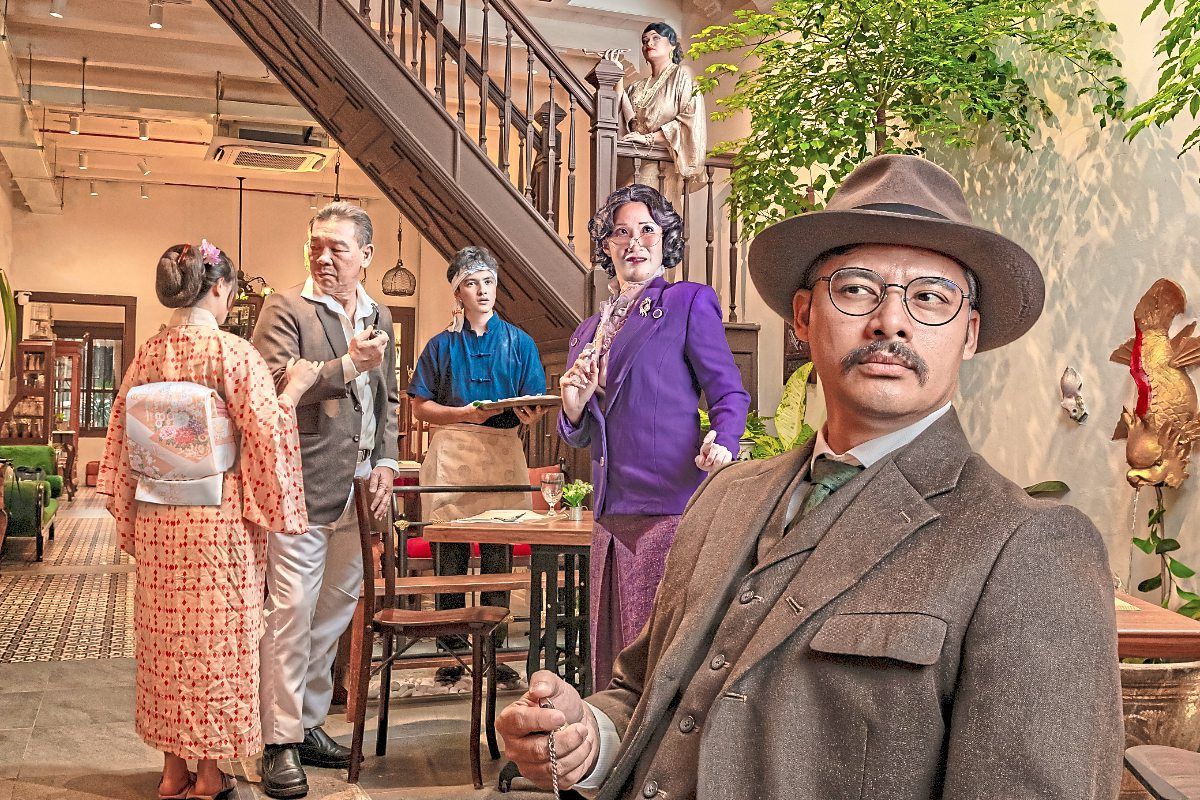
An innovative theatre collective in Melaka is merging culinary tradition with interactive narrative to create what amounts to an entirely participatory whodunit experience. Held throughout July and August at The Garden@Heeren, a carefully preserved Peranakan venue situated on Jalan Tun Tan Cheng Lock, the production represents a significant convergence of heritage preservation, cultural tourism, and experimental live performance. The experience, developed by Krate Creative Space in partnership with the heritage venue, invites audiences to don period attire and engage actively in unravelling a carefully constructed mystery while enjoying an authentic multi-course Peranakan dinner.
The production deliberately positions spectators not as passive observers seated before a stage but rather as investigative participants moving through actual rooms of the historic house. Attendees encounter costumed actors portraying characters including Detective Raymond, Miss Irene, and other figures integral to the unfolding narrative. Throughout the evening, which spans approximately two and a half hours, guests encounter clues scattered throughout the space, interview suspects, and ultimately determine their own verdict regarding the identity of the guilty party. This structural approach distinguishes the experience from traditional theatre, where audiences witness predetermined action from fixed seating.
The narrative framework establishes an elegant restaurant reopening as the setting, with invited guests arriving to sample the celebrated creations of renowned Chef Fa. However, the celebratory atmosphere deteriorates when a unexpected tragedy occurs, prompting the conveniently present Detective Raymond to launch an investigation. What follows transforms the dinner guests into reluctant participants in a crime-solving endeavour, their collective engagement shaping how the mystery develops and ultimately resolves. The production incorporates two entirely separate endings, with the first two weekends presenting one conclusion while the final two weekends reveal an alternative resolution, effectively doubling the experience for audiences willing to attend multiple performances.
The culinary component grounds the theatrical experience in authentic Peranakan tradition, moving beyond mere storytelling into sensory immersion. Diners progress through multiple courses featuring signature dishes including pie tee, pongteh chicken, and cincalok omelette, with the meal's progression deliberately synchronized with the unfolding mystery. This integration of food and narrative creates what Krate's creative director Wee describes as a transportation through all five senses, deliberately evoking the 1930s period through setting, costume, music, and interactive engagement. The approach acknowledges Melaka's profound connection to its distinctive food culture, transforming dining from consumption into active participation within a constructed historical moment.
Wee's creative vision deliberately sought to develop an experience that transcends conventional theatrical presentation. She identified finding appropriate collaborators and a venue of sufficient character as the paramount challenge, ultimately determining that the heritage house itself possessed inherent qualities conducive to mystery and suspense. The spatial authenticity of The Garden@Heeren contributes substantially to the production's immersive quality, as the actual architecture and accumulated history of the building reinforce the narrative's period setting. Rather than relying solely on design elements and technical effects, the production leverages genuine heritage space as an active participant in storytelling.
The cast comprises both returning performers from previous Krate productions and new talent, with Francis Augustine assuming the role of Detective Raymond while Sonia Lee portrays Miss Irene and other ensemble members assume supporting characters. The production is recommended for audiences aged 15 and above, suggesting that while accessible to teenagers, the narrative complexity and interactive demands may challenge younger participants. The emphasis on audience age appropriateness reflects the production's commitment to crafting experiences suited to specific demographic capabilities.
What particularly distinguishes this murder mystery from similar theatrical experiments elsewhere is the variability introduced by audience participation itself. Wee emphasizes that no two performances proceed identically, as different groups of guests ask divergent questions, prioritize separate clues, and interact distinctly with actors portraying suspects. This fundamental unpredictability means that the experience resists standardization and cannot be fully scripted in advance. The inclusion of dual endings further extends this variability, permitting returning audiences to encounter substantially different narrative resolutions and character motivations.
Krate Creative Space, established in 2016, has positioned itself as Melaka's first independent theatre collective specializing in customized, interactive, and multidisciplinary live performances. Across nearly a decade, the organization has mounted over ten original productions, cultivating both a dedicated local audience and a broader regional following. Significantly, while approximately half of Krate's attendees originate from Melaka itself, substantial numbers travel from the Klang Valley, Penang, Johor, and Singapore specifically to experience the company's productions. International tourists seeking alternatives to conventional heritage tourism have also discovered the company's work, recognizing in immersive theatre a distinctive avenue for engaging with cultural narratives.
The organization's physical home in Bukit Beruang functions as a multipurpose creative hub, incorporating rehearsal facilities, studio space, discussion areas, and a cafe. This diversified approach reflects the economic realities confronting independent theatremakers in Malaysia, where revenue from performances alone insufficient to sustain operations. By cultivating additional revenue streams including cafe operations and creative community functions, Krate has developed sustainable operational models that permit continued artistic production. Wee acknowledges the inherent difficulties in maintaining independence, emphasizing that the company's survival has demanded constant adaptation and creative problem-solving.
Wee's broader vision positions immersive theatre as a potential pillar of Malaysia's cultural tourism infrastructure, particularly within heritage-designated cities like Melaka and Georgetown. She articulates a strategic goal of establishing a permanent theatre home within Melaka capable of presenting heritage-inspired immersive experiences year-round, making original Malaysian storytelling accessible to both domestic audiences and international visitors. This aspiration reflects recognition that heritage cities currently rely predominantly on conventional museum experiences and guided tours, potentially overlooking opportunities for deeper cultural engagement through theatrical interpretation.
The company's recent expansion into Penang, where it presented the original production The Best Nyonya at Georgetown Mansion last May, suggests growing ambitions for regional reach and institutional partnerships. This outward expansion demonstrates that Melaka-based independent theatre can attract audiences and secure venue partnerships across the peninsula, supporting Wee's contention that demand exists for experiential cultural offerings beyond traditional heritage site experiences. The success of performances in multiple cities provides evidence that audiences throughout Malaysia harbor appetite for innovative approaches to heritage interpretation and cultural storytelling.
For Malaysian cultural tourism more broadly, Krate's murder mystery production represents a significant model worth examination. Rather than treating heritage sites as static repositories of historical artifacts, the production conceptualizes heritage venues as dynamic spaces capable of hosting original narratives that engage contemporary audiences while respecting historical authenticity. This approach potentially revitalizes heritage tourism by transforming passive observation into active participation, creating memorable experiences that generate word-of-mouth marketing and encourage repeat visits. The integration of authentic cuisine deepens the cultural immersion, suggesting that experiential heritage tourism might expand to encompass broader sensory and gastronomic dimensions.
The production's positioning at the intersection of theatre, dining, cultural heritage, and audience participation reflects broader global trends in experiential entertainment, yet remains distinctly grounded in Malaysian context through its emphasis on Peranakan culture, Melaka's specific heritage landscape, and original storytelling rooted in local cultural narratives. Success in this initiative could establish templates for other heritage cities seeking to deepen engagement with both domestic and international audiences, transforming heritage sites from educational destinations into experiential platforms where culture becomes lived rather than merely observed. As Krate continues developing its vision for permanent facilities and year-round programming, the organization's trajectory will likely influence how Malaysian cities conceptualize cultural tourism's future.

