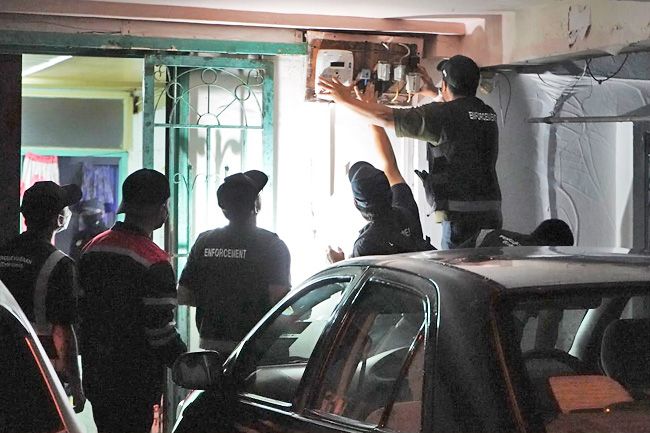
Over 200 enforcement officers from a dozen government agencies descended on two locations in Bandar Seri Begawan in a coordinated crackdown that resulted in multiple legal violations, immigration detentions, and renewed pledges of stricter law enforcement across Brunei-Muara. The operation, which involved the Royal Brunei Police Force and counterparts from immigration, labour, customs, electrical safety, and municipal authorities, underscores the region's sustained effort to tighten compliance across work sites and commercial establishments.
The Immigration and National Registration Department took into custody one male and one female foreigner during the sweep, both now under investigation for offences under the Immigration Act. The detentions signal intensified scrutiny of foreign nationals' documentation and legal status within the sultanate, a pattern consistent with Brunei's ongoing border security and population management priorities. Such operations are critical for Southeast Asian nations managing rapid demographic shifts and ensuring that foreign workforces meet registration and visa requirements.
A substantial portion of the violations centred on labour standards and worker protection. The Labour Department identified three separate breaches of Section 81 provisions, specifically relating to employers' failure to furnish workers with adequate living quarters and their inability to maintain hygienic working environments in line with statutory obligations. Additionally, two further infractions under Section 86 were logged against employers who had neglected to properly document worker accommodation within their Foreign Worker Licence applications. These findings highlight systemic gaps in workplace oversight, particularly within sectors reliant on migrant labour.
The prevalence of accommodation-related violations reflects a broader Southeast Asian challenge: employers in construction, manufacturing, and service industries often cut corners on worker housing to reduce operational costs, creating conditions that compromise worker dignity and health. For Malaysian stakeholders, the results offer a cautionary reminder of how neighbouring jurisdictions are tightening enforcement mechanisms—a trend that may influence cross-border labour practices and employer compliance standards throughout the region.
The Department of Electrical Services separately identified two offences under the Electricity Act (Chapter 71), indicating that safety hazards extended beyond labour practices to basic infrastructure standards. Electrical violations in commercial or industrial settings pose fire and electrocution risks, endangering both workers and the public. The fact that two breaches were detected during a single operation suggests that electrical compliance auditing remains sporadic or that awareness among business owners remains inadequate.
A dedicated Human Trafficking Investigation Unit interviewed 19 individuals across both enforcement sites, yet the operation yielded no human trafficking charges. While the absence of trafficking findings might appear positive, it also reflects the difficulty of detecting such hidden crimes during standard compliance sweeps. The unit's presence, however, demonstrates Brunei's commitment to identifying labour exploitation and modern slavery, aligning with regional and international anti-trafficking obligations under frameworks such as the ASEAN Convention Against Trafficking in Persons.
The operation was orchestrated by Superintendent Mohamad Noor Abd Rahman, acting commanding officer of the Brunei-Muara Police District, whose leadership in marshalling resources from disparate agencies speaks to institutional coordination challenges and successes. Coordinating dozens of officers from immigration, labour, customs, internal security, municipal, and religious enforcement divisions requires advance planning, inter-agency communication protocols, and shared intelligence—capabilities that remain unevenly distributed across Southeast Asia.
The breadth of agencies involved—spanning police, customs, narcotics control, internal security, municipal authorities, and religious enforcement—indicates that Brunei views workplace compliance as a multi-dimensional governance issue rather than the preserve of labour inspectorates alone. This holistic approach acknowledges that violations of labour standards often correlate with immigration fraud, tax evasion, and potential links to organised crime or extremist financing. For Malaysia and other ASEAN neighbours, such integrated enforcement models merit examination as they expand the detection capacity beyond traditional labour inspection remits.
The operation reflects Brunei-Muara's status as a high-priority enforcement zone, home to the capital and seat of government. Maintaining compliance standards in the nation's commercial heart carries both practical and symbolic importance, reinforcing public confidence in state capacity and rule of law. The deployment of over 200 personnel, while resource-intensive, sends a clear message that violations will be detected and prosecuted.
For foreign employers and workers throughout Southeast Asia, such operations underscore the rising compliance burden and enforcement vigilance across the region. Businesses operating in or sourcing labour from Brunei must now anticipate unannounced inspections touching on immigration, labour accommodation, electrical safety, and anti-trafficking protocols. This trend is gradually aligning workplace standards across ASEAN, though inconsistent enforcement and varying penalties across member states continue to create compliance arbitrage opportunities.
The Royal Brunei Police Force's statement that the operation reflects its "continued commitment" to law enforcement and public safety signals that such sweeps are likely to become routine rather than exceptional. Future operations may focus on particular sectors—such as construction, hospitality, or domestic work—where violation rates historically run high. Malaysian policymakers and employers should monitor Brunei's evolving enforcement patterns, as successful models and sector-specific strategies may eventually diffuse across the region, raising baseline compliance expectations.

