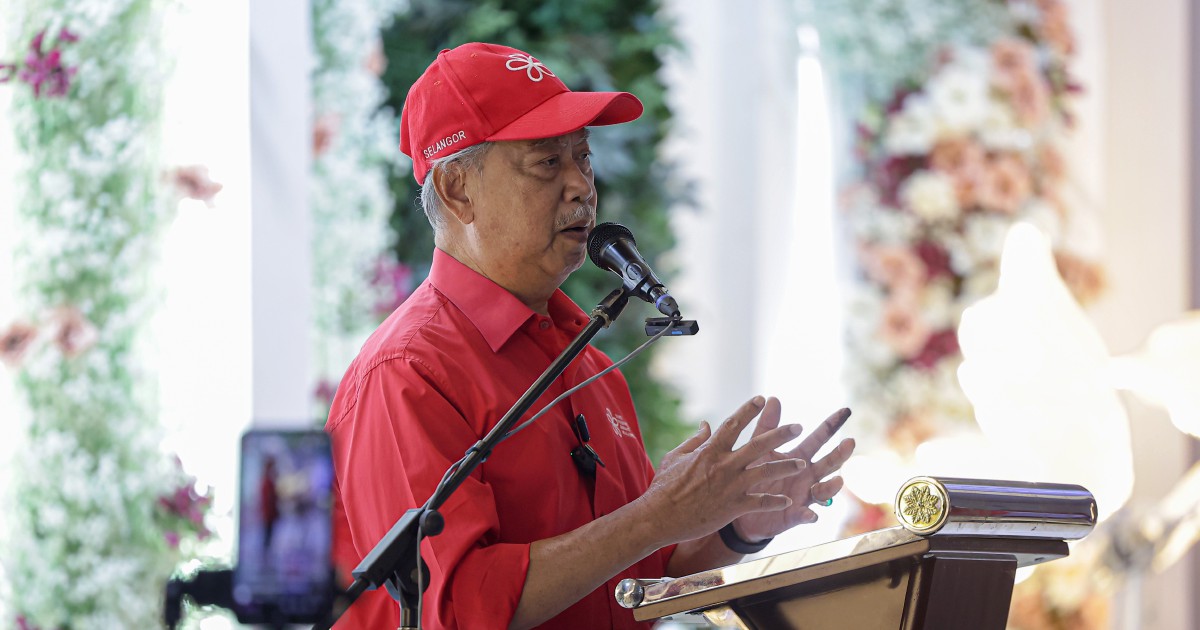
The mounting friction within Malaysia's ruling coalition intensified in Seremban this week when Bersatu's leadership publicly rebuked a senior Umno figure over remarks questioning the party's electoral strategy in Negri Sembilan. Tan Sri Muhyiddin Yassin, heading the Bersatu faction, delivered a pointed response to Datuk Seri Mohamed Khaled Nordin, the Umno vice-president, after the latter suggested that Bersatu's decision to field candidates represented a threat to Barisan Nasional's cohesion rather than a genuine bid for power.
The exchange underscores deepening tensions within the governing coalition as component parties jostle for representation and influence ahead of crucial state-level contests. Such internecine disputes have become increasingly common across Malaysia's political landscape, particularly when coalition members compete directly in the same constituencies. The accusation of acting as a spoiler, in political parlance, implies that a party's participation dilutes the combined strength of allied forces without realistic prospects of victory, thereby allowing opposition candidates to slip through a fractured vote.
Muhyiddin's rebuttal suggests that Bersatu views its participation in Negri Sembilan not as a secondary consideration but as integral to the party's broader relevance within the national political structure. For Bersatu, which has experienced fluctuating fortunes since its emergence as a separate entity from Umno in 2016, maintaining a visible presence across state-level elections remains strategically important. The party risks marginalisation if it accepts a subordinate role confined to federal-level politics, particularly given its leadership's historical roots within Umno itself.
The Negri Sembilan contest carries weight beyond the immediate state assembly races. Control of the state government carries tangible benefits in terms of patronage networks, development allocations, and positioning within the broader coalition architecture. For Umno, traditionally the dominant force in peninsular politics, allowing rivals—even ostensible allies—to gain ground represents an erosion of its traditional dominance. The tension between Umno and Bersatu reflects unresolved questions about their respective roles within Barisan Nasional, questions that successive power-sharing arrangements have failed to definitively settle.
Khaled's characterisation of Bersatu as a spoiler contains an implicit warning about the mathematics of contested elections. In constituencies where both Barisan components field separate candidates against opposition rivals, the combined Barisan vote might suffice for victory if concentrated behind a single nominee. By fragmenting Barisan's campaign efforts and messaging, the reasoning goes, internal competition creates opportunities for opposition candidates. This arithmetic carries particular weight in Negri Sembilan, where demographic and political alignments have shifted considerably over recent election cycles.
Muhyiddin's response likely reflects frustration with what Bersatu perceives as a pattern: being sidelined in negotiations whilst bearing expectations of electoral loyalty. The party leadership may view such accusations as attempts to pressure Bersatu into accepting predetermined roles rather than competing legitimately for representation. For supporters of Bersatu, such positions carry echoes of the tensions that drove the party's original split from Umno, framed then around questions of autonomy and leadership renewal.
From a broader coalition perspective, these public disagreements expose fissures that could prove problematic during election campaigns. Voters typically respond poorly to visible discord within supposedly united political fronts, particularly when senior figures engage in open criticism. The spectacle of coalition partners attacking each other's electoral participation, however diplomatically framed, undermines claims of unified purpose and coherent governance philosophy. Opposition parties monitor such tensions carefully, recognising opportunities to mobilise voters fatigued by intra-coalition bickering.
For Malaysian observers tracking coalition dynamics, the Negri Sembilan controversy illustrates persistent structural challenges in Barisan Nasional's post-2018 configuration. The coalition has struggled to establish clear protocols for managing competition between component parties, relying instead on ad hoc negotiations that frequently satisfy no one. Without explicit frameworks governing electoral participation and resource distribution, disputes like the Khaled-Muhyiddin exchange become predictable recurring features rather than aberrations.
The timing of the conflict also matters. As Negri Sembilan prepares for electoral contests, both Umno and Bersatu face pressures from their respective support bases to demonstrate strength and independence. Umno's traditional base expects the party to defend its territorial preeminence, whilst Bersatu's constituencies demand recognition as a party with genuine political weight. Neither party leadership can easily accommodate the other's demands without appearing weak to their own supporters, creating cycles of escalating rhetoric and counteraccusation.
Moving forward, whether the coalition can manage such disagreements whilst maintaining electoral competitiveness remains an open question. Previous attempts at managing intra-coalition tensions through backroom negotiations and power-sharing arrangements have produced only temporary truces. The Negri Sembilan situation suggests that deeper structural reforms—possibly including mechanisms for transparent candidate selection and resource allocation—may be necessary to prevent recurring public disputes that damage coalition credibility during elections.

