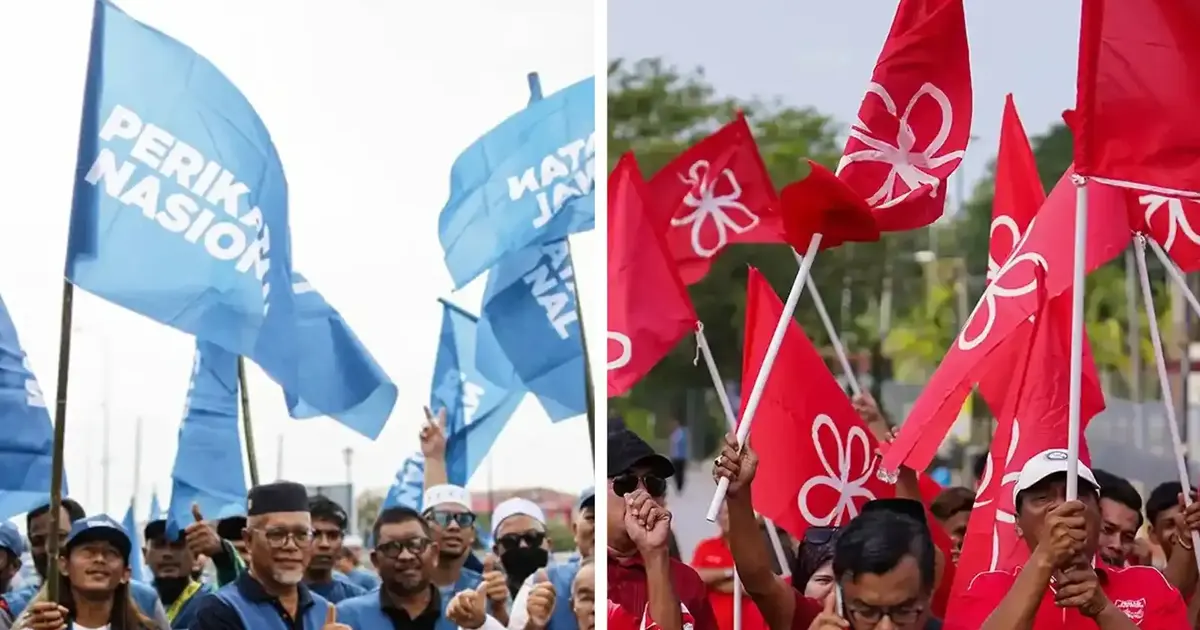
Bersatu president Muhyiddin Yassin has moved to quash speculation that any single leader within the Perikatan Nasional coalition possesses the authority to expel member parties, emphasising that such decisions demand collective agreement across all PN partners. His remarks come amid mounting tensions within Malaysia's ruling alliance, where questions about the coalition's structural integrity and decision-making protocols have surfaced repeatedly in recent months.
Muhyiddin's statement represents a significant clarification of PN's internal governance, addressing what appears to be widespread confusion about the coalition's formal mechanisms for disciplining or removing members. The Bersatu leader was responding to implications that Zahid Hamidi, as a major figure within UMNO—the largest party in PN—could engineer Bersatu's removal through unilateral action. This scenario has circulated amid broader disagreements over coalition direction and resource allocation.
The PN coalition, formed in 2020, comprises Bersatu, UMNO, PAS, and several smaller parties. Unlike some more hierarchically structured political alliances, PN operates as a partnership of ostensibly equal members, each with formal say in major decisions. This federal structure has proven both a strength and weakness: it prevents any single party from dominating, but it also complicates rapid decision-making and can lead to stalemates when fundamental disagreements emerge.
Muhyiddin's insistence on collective approval reflects the delicate balance required to maintain PN's cohesion. With Bersatu holding roughly 30 parliamentary seats and UMNO commanding around 60, the removal of Bersatu would weaken PN's numerical position in parliament, potentially threatening the coalition's commanding supermajority. This mathematical reality underpins the political logic behind Muhyiddin's assertion—no rational coalition partner would voluntarily dismantle the edifice without securing viable alternatives.
The broader context reveals simmering tensions between Bersatu and UMNO that have intensified since PN's formation. These frictions stem from competing ambitions over ministerial portfolios, policy directions, and the future leadership trajectory of Malaysian politics. Bersatu, despite its numerical disadvantage, has consistently leveraged its strategic parliamentary position to secure disproportionate influence, a dynamic that rankles some UMNO figures who view their party as the coalition's natural senior partner.
For Malaysian observers, Muhyiddin's intervention signals awareness that PN faces existential vulnerabilities. Coalition partners contemplating exit or removal require mechanisms that cannot be triggered arbitrarily; without such safeguards, the alliance becomes unstable and unreliable as a governing arrangement. By reaffirming that expulsion demands unanimity, Muhyiddin is essentially asserting that Bersatu retains veto power over its own membership status—a protective mechanism any coalition member would jealously guard.
The Southeast Asian dimension merits consideration as well. Regional analysts monitoring Malaysia's political stability view PN's cohesion as crucial to consistent governance and foreign policy continuity. Coalition fractures create uncertainty that affects international relations, investment confidence, and the region's broader geopolitical alignments. A stable Malaysian government matters not merely for domestic reasons but for maintaining predictability within ASEAN and adjacent regions.
Muhyiddin's clarification also addresses procedural ambiguities that have plagued PN since its inception. While the coalition's founding charter presumably contains provisions governing membership disputes, these rules have rarely been publicly invoked or clarified. By articulating the principle that unanimous consent is required, Muhyiddin establishes a normative framework that—while potentially constraining—provides transparency about the rules governing the political game.
The statement carries implications for Malaysian readers contemplating the durability of their country's current political arrangements. PN's survival depends partly on institutional mechanisms that prevent capricious action by powerful figures. Yet even constitutional safeguards prove fragile when fundamental disagreements emerge and incentive structures shift. The fragility of Malaysian coalition politics becomes evident whenever major parties glimpse alternative arrangements that might serve their interests better.
Looking forward, Muhyiddin's intervention may temporarily stabilise PN by clarifying that internal conflicts, however acrimonious, cannot result in sudden expulsions engineered by individual leaders. However, it does not address underlying substantive disagreements about resource distribution, policy priorities, or longer-term political trajectories. These tensions will likely resurface, potentially testing whether the coalition's commitment to collective decision-making can withstand pressures created by genuine divergence of interests.

