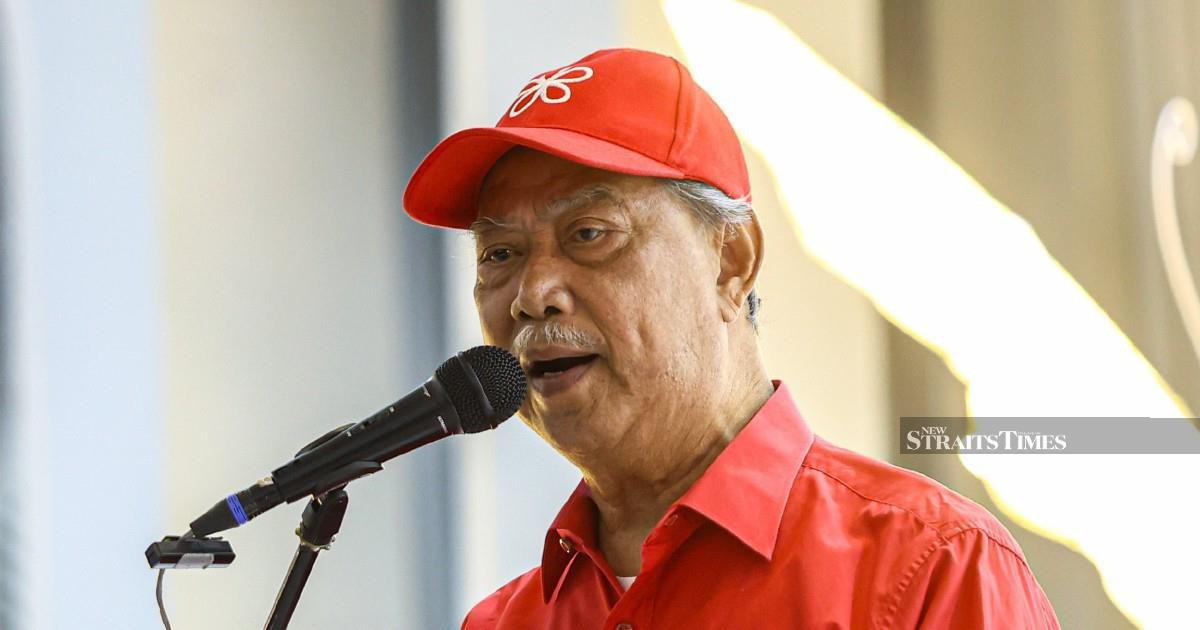
Tan Sri Muhyiddin Yassin, president of Bersatu, has finally commented publicly on the internal turmoil gripping the party, breaking weeks of silence to allege that Datuk Seri Hamzah Zainudin, who previously served as deputy president, actively pursued his removal from the top post. The allegations mark an escalation in the factional disputes that have threatened to destabilize one of Malaysia's key coalition partners in the Malay-Muslim political landscape.
The timing of Muhyiddin's statement carries significant weight given Bersatu's pivotal role within the current political framework. As a member of the ruling coalition, the party's internal stability has direct implications for parliamentary support and the continuity of government. Any leadership vacuum or factional breakdown could create ripple effects across the broader political alignment that underpins the administration in Putrajaya.
Muhyiddin's emergence from silence suggests that internal pressure within Bersatu has reached a critical juncture. Rather than allowing competing narratives to dominate, the party president has chosen to present his version of events, framing the dispute as an orchestrated challenge to his authority rather than a spontaneous expression of dissent. This narrative positioning is crucial for maintaining his standing among party grassroots and moderate faction leaders who may be evaluating their political future.
The allegations against Hamzah Zainudin, who until recently occupied the second-highest position in Bersatu's hierarchy, reveal fault lines between competing power centers within the party. Such high-level disputes often reflect deeper disagreements over party direction, policy positioning, and resource allocation. Understanding these underlying tensions requires examining how different factions within Bersatu view the party's relationship with other coalition members and its electoral strategy moving forward.
Bersatu's origins as a breakaway faction from UMNO mean that the party remains embedded in complex relationships with its parent organization and other Malay-based parties. Leadership crises within Bersatu therefore do not occur in isolation but within a broader competitive environment where rival parties seek to exploit any signs of weakness. The party's ability to manage this succession crisis while maintaining unity will significantly influence its bargaining power within coalition negotiations.
The public nature of these allegations suggests that behind-the-scenes reconciliation efforts may have failed or were deemed insufficient to contain the dispute. When party leaders resort to public statements alleging plots against them, it typically indicates that informal mechanisms for resolving internal disagreements have exhausted their utility. This escalation often precedes formal party mechanisms being invoked, including potential disciplinary procedures or extraordinary general assemblies.
For Malaysian political observers, Bersatu's internal dynamics merit close attention because the party bridges distinct constituencies. It attracts former UMNO members dissatisfied with that party's direction, newer generation politicians seeking alternative career paths, and individuals aligned with Muhyiddin personally. Keeping these diverse elements united requires careful management, and leadership disputes threaten to expose existing fractures along these lines.
Regionally, instability within Malaysian coalition partners can influence perceptions of political stability across Southeast Asia. International investors and neighboring governments monitor such developments for signals about governance continuity and policy consistency. A protracted crisis within Bersatu could prompt concerns about Malaysia's ability to maintain coherent policy implementation across key sectors.
The alleged removal plot attributed to Hamzah Zainudin implies that there exists a sufficient bloc within the party willing to challenge Muhyiddin's authority. Identifying who comprises this opposition faction and what grievances motivate them will be crucial for understanding whether the current crisis represents a temporary disagreement or a fundamental realignment within Bersatu's power structure. The scope and composition of any anti-Muhyiddin coalition will determine whether his leadership ultimately proves durable.
Historically, Malaysian political parties have survived severe internal crises, but such outcomes depend on effective conflict management and the willingness of losing factions to accept outcomes and reintegrate into party structures. Whether Bersatu proves capable of similar recovery depends partly on how comprehensively Muhyiddin addresses the grievances fueling resistance to his leadership and whether opposition figures like Hamzah can be brought back into the party fold or whether they must be politically neutralized to prevent ongoing disruption.
The next phase of this intraparty struggle will likely involve procedural battles, attempts at factional mediation, and possibly interventions from coalition allies seeking to preserve Bersatu's stability. How these developments unfold will shape not only the party's immediate future but also the broader coalition's capacity to govern effectively during a period that many analysts view as politically precarious for the administration.

