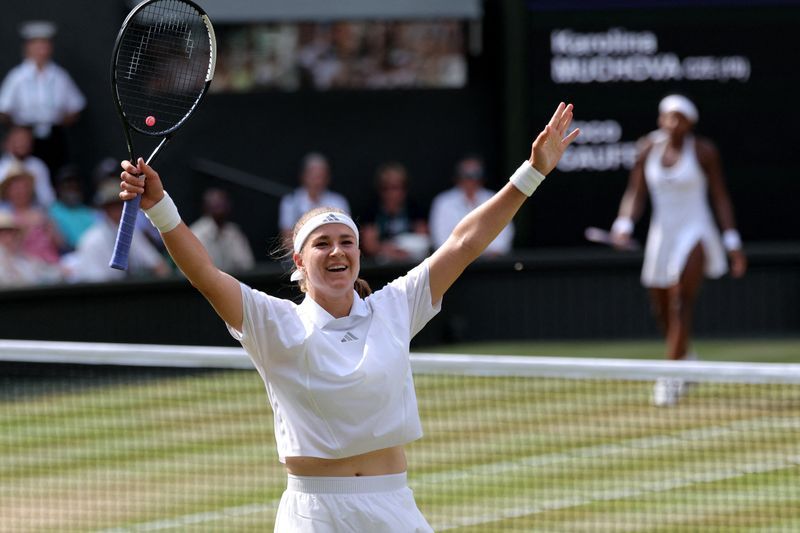
Karolina Muchova produced one of the tournament's most dramatic performances on Saturday to eliminate American seventh seed Coco Gauff from Wimbledon, securing a 6-2 1-6 7-6 (12-10) victory that propels the Czech player toward her maiden Grand Slam final. The 28-year-old's composed handling of a match point against her, combined with her shot-making brilliance in the decisive tiebreak, marks a significant breakthrough moment in a career that has long promised much but delivered unevenly at the sport's biggest stages.
Muchova's path to the final opens the tantalising prospect of an all-Czech championship match at Wimbledon for the first time in Grand Slam history, should her compatriot Linda Noskova overcome Ukrainian Marta Kostyuk in Thursday's other semi-final. Such an outcome would extend the remarkable Czech dominance of the oldest tennis championship, adding to Marketa Vondrousova's triumph in 2023 and Barbora Krejcikova's victory in 2024. The prospect underscores how thoroughly players from the Central European nation have reinvented themselves as grass-court specialists in recent years, challenging the traditional English and Australian strongholds on this surface.
What makes Muchova's advancement particularly striking is the seemingly insurmountable physical obstacle she faces on grass courts. The 10th-seeded Czech requires substantial pharmaceutical support to compete on the surface, relying on a regimen of pills, sprays, and eyedrops simply to step onto the manicured turf of the All England Club. This revelation contradicts any assumption that elite grass-court success stems from natural affinity, instead demonstrating that tactical acumen, mental resilience, and meticulous preparation can overcome biological constraints. Her triumph becomes a testament to professional determination over circumstantial disadvantage.
The opening set exposed fundamental weaknesses in Gauff's grass technique on the day. Muchova executed a masterclass in constructed play, breaking the American's serve twice in the early stages as Gauff's typically reliable forehand misfired repeatedly. A thunderous 111 mph ace underlined Muchova's command of the serve, the one weapon on grass that transcends surface-specific adjustment. By the conclusion of the first set, the scoreline of 6-2 appeared to herald a straightforward victory for the Czech, suggesting Gauff might struggle to mount a serious challenge despite her reputation for competitive intensity.
However, Gauff's competitive credentials are built upon her refusal to accept defeat when circumstances favour her opponent, a quality she has demonstrated throughout this tournament by winning successive three-set encounters to reach the semi-finals. The American responded to her first-set capitulation with a second set that flipped the match entirely, converting her ninth break point opportunity to establish a 3-1 cushion and subsequently extending it to 5-1. The sight of Gauff's mother celebrating wildly in the players' box captured the American's momentum shift, transforming what had appeared a terminal contest into a genuine two-player battle.
The decisive third set evolved into the most compelling tennis of the match, with both competitors showcasing the technical excellence that characterises elite women's grass-court play. Gauff launched ferocious forehands while Muchova countered with accomplished backhands, their aggressive ball-striking creating the kind of electric rallies that Wimbledon Centre Court crowds savour. The atmosphere inside the stadium intensified as both players elevated their games in response to the pressure, each point carrying disproportionate weight with a Grand Slam final at stake. The furnace-like conditions on court appeared to energise rather than drain both competitors.
Gauff constructed two opportunities to break Muchova's serve for a 5-4 lead, positioning herself within striking distance of forcing a match-deciding tiebreak in her favour. Yet Muchova's composure under pressure proved decisive in these critical moments. Rather than fractioning under duress, the Czech player employed her full arsenal of grass-court tricks to escape the predicament, illustrating the gap between playing well and playing under extreme duress. Her capacity to produce her finest tennis precisely when the margins for error vanished separated the two finalists.
The match tiebreak resolved the contest through exhibition tennis of the highest order, with Muchova demonstrating both technical virtuosity and tactical intelligence. A diving volley of outrageous quality exemplified her willingness to take risks at the crucial juncture, while a well-placed lob further exposed Gauff's vulnerability at the net. When Muchova earned her first match point, the American failed to convert a final opportunity, sending a forehand into the net after two hours and 35 minutes of tennis that will be remembered as one of the tournament's defining moments. Muchova's eventual triumph affirms her elevation to Grand Slam finalist status after years of knocking on the door without breaking through to these ultimate stages.
For Malaysian and Southeast Asian tennis observers, Muchova's breakthrough carries broader implications for regional players attempting to establish themselves at the highest levels. Her success despite physical disadvantage on grass courts suggests that technical excellence and strategic adaptation can compensate for surficial unfamiliarity. As the region produces increasingly accomplished players, the Czech example demonstrates that Grand Slam success need not depend upon playing background or natural facility with a particular surface type. The mental and technical dimensions of elite tennis can be developed and refined regardless of geographical starting point, offering encouragement to aspiring champions throughout Asia. Muchova's final appearance represents validation that persistence and precise preparation transcend traditional hierarchies in professional tennis.

