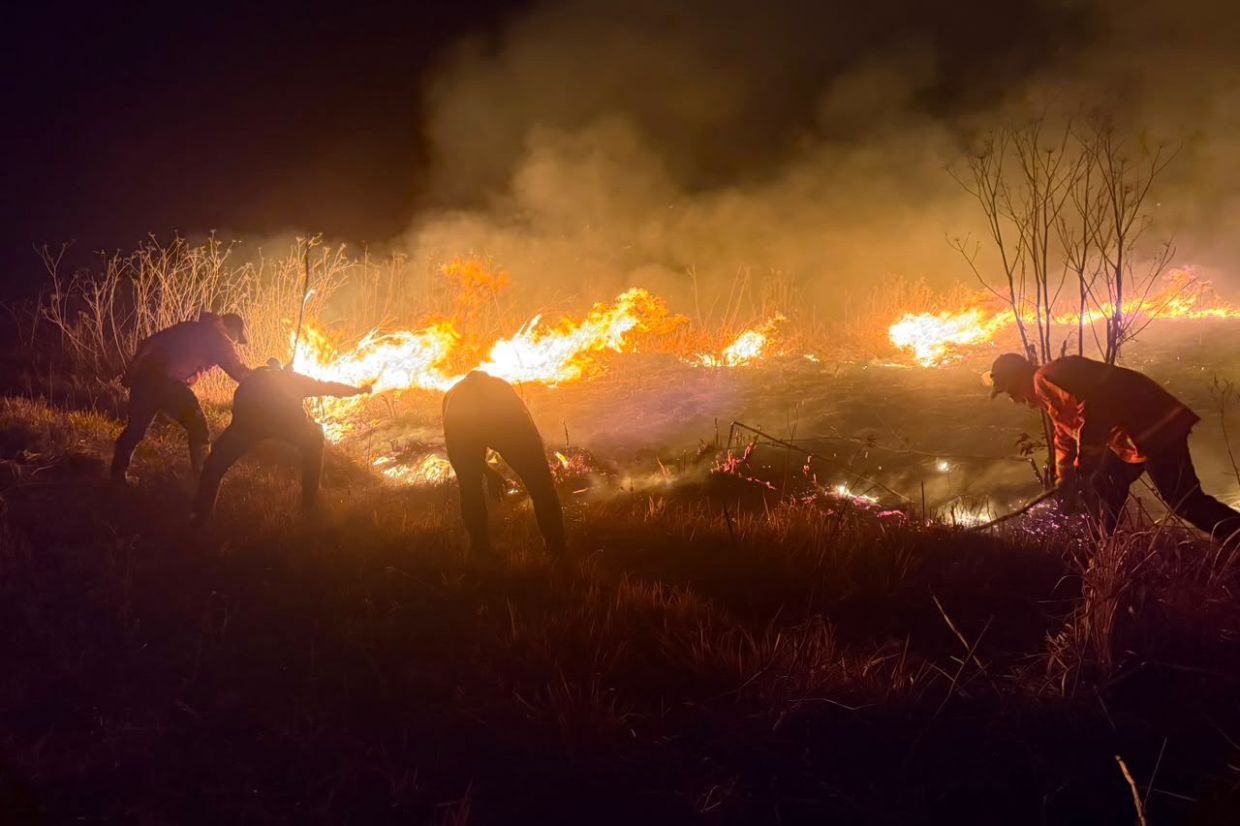
A massive wildfire engulfing Mount Bromo has expanded its destructive footprint to roughly 520 hectares across the slopes and grasslands of East Java, with authorities attributing the rapid spread to intensifying weather patterns. The Bromo Tengger Semeru National Park Authority confirmed on Sunday that the blaze, which reignited with particular ferocity on Saturday evening, has consumed swathes of the mountain's natural landscape as meteorological conditions favour the flames' advance across the terrain.
Rudijanta Tjahja Nugraha, heading the national park authority, explained that the wildfire's expansion accelerated significantly following Saturday afternoon when strong winds began pushing flames from higher elevations downslope into lower-altitude regions. The combination of powerful gusts and the mountain's exposed vegetation created ideal conditions for rapid fire propagation, transforming what might have been a contained incident into an escalating environmental disaster. The shifting wind patterns essentially created natural fire corridors along the slopes, channelling the flames across vegetated zones that had accumulated dry material throughout the preceding months.
The ecological vulnerability of Mount Bromo's landscape compounds the crisis. The park's savanna environment and surrounding grasslands, already desiccated after an extended dry season, offered minimal resistance to the advancing flames. Officials noted that the absence of adequate moisture in the vegetation meant even modest fire sources could achieve catastrophic spread, a reality that highlights the region's heightened fire risk during this period of the year. The combination of naturally arid conditions and human interference has created an especially hazardous situation in one of Indonesia's most ecologically significant mountain environments.
Authorities at Bromo Tengger Semeru National Park made the decisive move to bar all public access from 10 pm Saturday onwards, citing dual concerns for both firefighting effectiveness and visitor protection. The comprehensive closure extends across all entry points to the mountain, a significant measure given Mount Bromo's status as a major tourist destination attracting both domestic and international visitors seeking adventure and spectacular volcanic landscapes. Visitors whose trips were disrupted received practical alternatives, including rebooking options or financial refunds, though such measures offer little consolation to those unable to experience the natural wonder they had anticipated.
The administrative action reflects recognition that active firefighting operations require unobstructed access to affected zones and that civilians present during such emergencies create additional safety complications. The closure decision represents a tangible cost to Indonesia's tourism sector in this region, though temporarily unavoidable given the circumstances. Mount Bromo's prominence in regional tourism means the extended closure will reverberate through local hospitality businesses and guide services dependent on steady visitor flows throughout the calendar year.
Investigative authorities have already focused suspicion on human activity as the fire's origin, a determination that shifts responsibility beyond natural causes or accidental occurrence. Forestry Minister Raja Juli Antoni reinforced this direction by pledging that individuals responsible for forest and land burning face appropriate legal consequences under Indonesian environmental and criminal statutes. This positioning reflects governmental acknowledgement that deliberate or negligent human behaviour, rather than lightning strikes or spontaneous ignition, likely initiated the catastrophe now consuming hundreds of hectares.
The minister's emphasis on accountability signals official intent to pursue criminal or administrative proceedings against perpetrators once identified, underscoring that wildfire responsibility carries serious legal ramifications in Indonesia. This deterrent messaging attempts to discourage further incidents across the archipelago's extensive forest zones, where unauthorised burning for agricultural clearance, land development, or other purposes remains a persistent problem. However, establishing definitive causation and locating responsible parties in remote mountain terrain presents genuine investigative challenges that may complicate swift justice.
The Mount Bromo incident arrives amid broader regional vulnerability to large-scale wildfires, particularly during months when monsoon patterns recede and atmospheric moisture diminishes. Indonesia's vast forest estate faces recurring fire pressure, with previous seasons witnessing catastrophic burns across Sumatra and Kalimantan that generated transboundary haze affecting Malaysia, Singapore, and other neighbouring nations. The East Java episode demonstrates that fire risks extend beyond the traditionally vulnerable zones, affecting protected national park areas and ecologically critical mountain environments.
Climate dynamics amplify these challenges across Southeast Asia. Extended dry seasons, irregular precipitation patterns, and elevated temperatures create atmospheric conditions favouring rapid fire spread once ignition occurs. Scientists have documented connections between global climate patterns and regional fire regimes, suggesting that Mount Bromo's current crisis reflects broader environmental trends rather than isolated circumstance. These dynamics pose implications for tourism, air quality, biodiversity conservation, and agricultural productivity across Indonesia and the wider region.
The national park authority's closure and emergency response protocols reveal institutional capacity to react decisively to environmental crises, though questions persist regarding fire prevention infrastructure and monitoring systems. Investing in early detection capabilities, maintained firebreaks, controlled vegetation management, and community awareness programmes could reduce future incident severity. Mount Bromo's elevated status as a protected landscape affords it advantages in emergency resource allocation compared to unmanaged forest zones, yet the scale of current damage indicates that prevention remains preferable to remediation.
Looking forward, resolution of the Mount Bromo fire depends on sustained favourable weather developments, particularly reduced wind speeds and atmospheric moisture increases that could dampen combustion conditions. Recovery of affected ecosystems will require extended periods for vegetation regeneration and soil stabilisation, representing long-term environmental costs beyond immediate smoke and flame visibility. The incident underscores Indonesian environmental authorities' ongoing struggle to balance tourism development, conservation imperatives, and fire management across its complex landscape.

