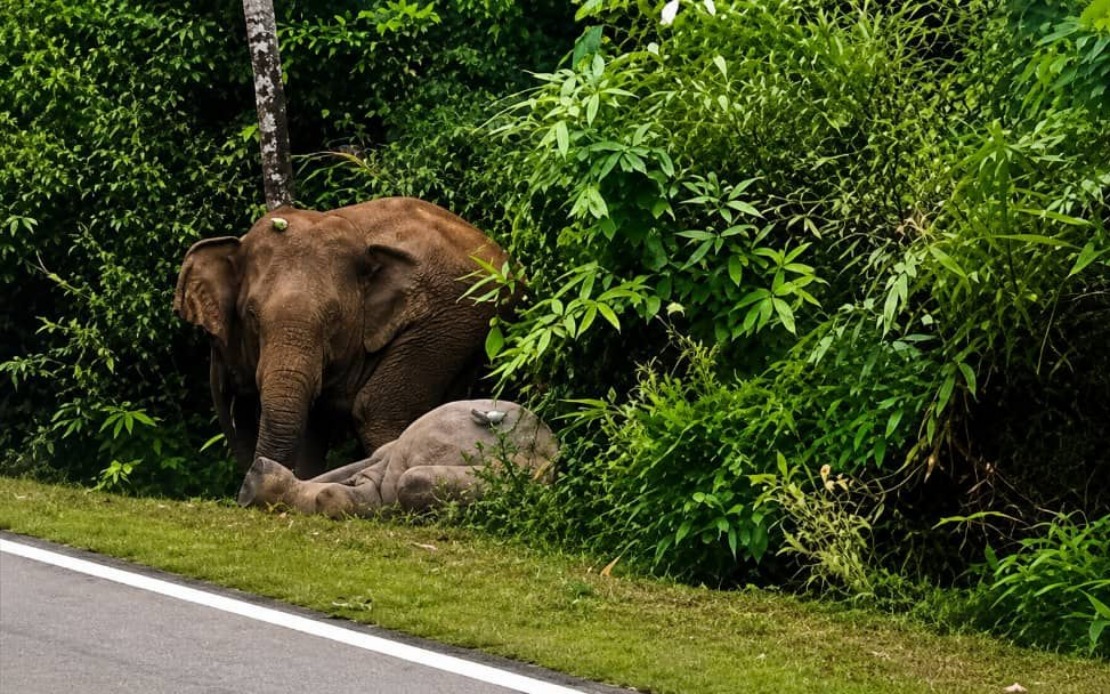
The tragedy that shocked Malaysia on Mother's Day 2023 unfolded anew in the humid dawn hours of a Johor morning when a five-year-old female elephant calf perished beneath the wheels of a passing vehicle. Along Jalan Felda Nitar near Mersing, the infant's mother stood steadfast beside the body, an image that would soon circulate across social media platforms and reignite urgent questions about the escalating toll of human-elephant conflict across the peninsula. For seven consecutive hours, she refused to abandon her dead offspring, a heartbreaking display of maternal devotion that underscores the emotional complexity of these intelligent creatures and the widening chasm between their shrinking habitats and human activity.
The collision occurred at approximately 2.28 am when a Perodua Bezza struck the young elephant along the darkened stretch of road. Johor's Department of Wildlife and National Parks, commonly known as Perhilitan, received notification roughly six hours later at 8.30 am, dispatching a four-person team to investigate the incident. Upon arrival, officers confirmed the grim reality: the calf, identified as a female measuring 150 centimetres in body length with a front footprint width of 11 inches, had succumbed to injuries sustained in the impact. The stricken mother, believed to be her parent, remained motionless at the site despite the presence of emergency personnel and gathering onlookers.
Parallels with the devastating Gerik incident on May 11 last year were immediate and unavoidable. In that earlier tragedy, a baby elephant became trapped beneath a container lorry, and its mother was documented attempting to dislodge the vehicle in what observers interpreted as a desperate rescue attempt. That incident became a watershed moment for public discourse surrounding wildlife conservation and human encroachment, generating widespread social media amplification and forcing conversations about infrastructure development in elephant corridors. Today's incident carries similar emotional weight, serving as a grim reminder that despite heightened awareness, the fundamental drivers of conflict persist unabated.
The young elephant belonged to the Jamaluang-Mersing identification group, one of several herds tracked by Perhilitan across the region. Such cataloguing systems enable wildlife officials to monitor population dynamics and migration patterns, yet such data collection offers little solace to grieving animal families. The specificity of the calf's measurements — her 150-centimetre frame, the precise dimensions of her footprints — transforms an individual death into a statistical entry within conservation databases, a clinical notation of loss. Officials noted that the calf possessed no tusks, consistent with her age and sex, and bore no visible identifying marks that might have aided in longer-term population studies.
The human toll of the collision proved equally catastrophic. The Perodua Bezza's driver, a 31-year-old man, became trapped within the vehicle as it careened off the roadway and plummeted into a five-metre ravine. Fire and Rescue personnel extracted him from the wreckage, though he sustained significant leg injuries requiring medical attention. The incident thus claimed both elephant and human casualties, illustrating how such encounters devastate both species and create cascading consequences that extend far beyond the moment of impact.
Responding to the mother elephant's refusal to depart, the Elephant Capture Unit from the Johor Elephant Sanctuary deployed specialist personnel to gradually guide her away from the accident site and encourage her return to forest sanctuary. Rather than employing forcible removal methods that might have triggered defensive aggression, handlers utilised their expertise in elephant behaviour to facilitate a measured retreat. Once the mother had been directed to safety, wildlife authorities proceeded with the respectful burial of the calf's remains in proximity to the site, acknowledging both practical necessity and the symbolic weight such burial holds for communities invested in elephant welfare.
Concern regarding the mother elephant's psychological state prompted Perhilitan to commit additional resources throughout subsequent days. Officials announced plans for intensive ground patrols during both the evening and following day to monitor her condition and discourage her from returning to the death site, where residual scent markers might trigger distress or repeated attempts to remain with her offspring. Such behaviour, while profoundly poignant to human observers, poses risks to both the animal and motorists should she return to the roadway in her grieving state.
The roadway itself had not lacked for precautionary infrastructure. Warning signage indicating elephant crossing zones had previously been installed throughout the area, yet these markers apparently failed to prevent the early-morning collision. Whether inadequate visibility in darkness, excessive vehicle speed, insufficient driver attention, or simple tragic chance precipitated the accident remains unclear, but the question points toward a broader systemic challenge: passive warnings prove insufficient when roads bisect active wildlife corridors and darkness masks the massive dimensions of creatures suddenly appearing on asphalt. For Malaysian readers familiar with rural driving conditions, the scenario is regrettably recognisable — the convergence of human urgency and animal vulnerability at precise moments when prevention becomes impossible.
The Mersing region occupies a particularly sensitive ecological position within Johor's wildlife management framework. As a corridor linking interior forest reserves to protected areas, it naturally experiences elephant transit, particularly during seasonal movements or in response to food availability fluctuations. Development pressure, agricultural expansion, and increasing vehicular traffic have progressively narrowed the margins within which peaceful coexistence remains feasible. Each incident like today's represents not merely an isolated tragedy but rather a data point within an accelerating crisis of habitat fragmentation and conflict escalation that experts across Southeast Asia increasingly regard as unsustainable.
The viral circulation of footage documenting the grieving mother elephant amplifies the psychological impact of such incidents within Malaysian public consciousness. Unlike abstract statistics about wildlife casualties, visual documentation of maternal grief creates emotional resonance that transcends typical news cycles and motivates substantive policy discussions. The parallel with last year's Gerik tragedy ensures that today's incident will register as more than mere news; it becomes part of a narrative arc suggesting systemic failure in preventing predictable disasters. Whether this renewed attention catalyses meaningful infrastructure modifications, stricter traffic enforcement in wildlife zones, or habitat restoration initiatives remains uncertain, but the mounting public pressure increasingly demands concrete response from authorities responsible for both human safety and wildlife conservation.
Mercy for the young elephant came only in extinction, yet her death paradoxically offers opportunity for the living. Should authorities and the Malaysian public channel the emotional resonance of this tragedy into substantive action—redesigned road engineering in critical elephant corridors, enhanced enforcement of speed restrictions during high-risk hours, expanded habitat connectivity reducing crossing necessity—her loss might yet prevent future equivalents. The mother elephant's seven-hour vigil, witnessed by thousands through screens across the nation, poses an unavoidable question: how long will Malaysian society wait before transforming grief into genuine change?

