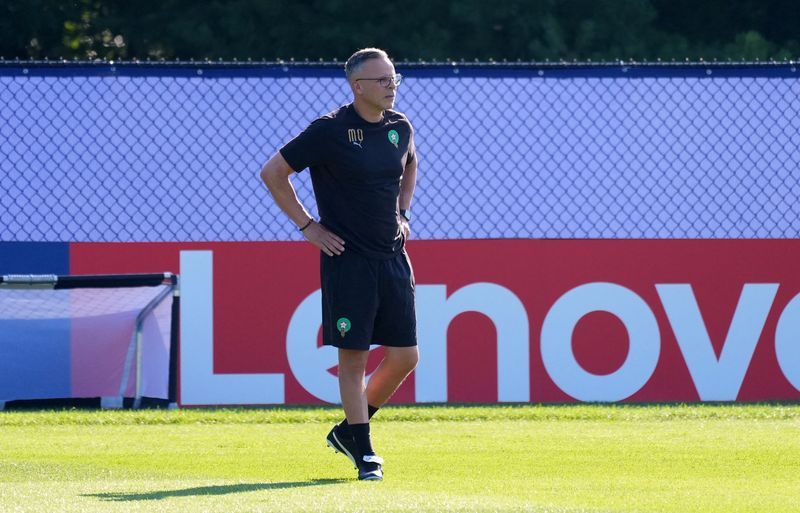
Morocco's push for World Cup glory has prompted their coaching staff to adopt an uncompromising stance on expectations and achievement. During a pre-match briefing in Foxborough, Massachusetts, coach Mohamed Ouahbi made clear that his squad will not indulge in retrospective celebration of their tournament progress, no matter how impressive the journey to the quarter-finals may appear to outside observers. The North African nation's historical advancement through the competition will only be properly assessed once the tournament concludes, he insisted, not during the continuing competition.
The forthcoming encounter with France represents a rematch of the previous World Cup's semi-final encounter in Qatar, where the European champions ended Morocco's improbable campaign. That loss still resonates, but the context has fundamentally shifted. Two years ago, Morocco arrived in Qatar as relative outsiders and underdogs, gradually earning respect through disciplined displays and collective resilience. Now, they return as a team carrying genuine championship credentials, having dismantled group-stage opponents before successively eliminating the Netherlands and co-hosts Canada. The psychological landscape has transformed entirely, moving from the narrative of honourable exit to one centred on legitimate championship ambitions.
Ouahbi's remarks reveal a philosophical stance that prioritises competitive hunger over retrospective satisfaction. When confronted with the idea that Morocco's achievements to date represent a substantial accomplishment worthy of recognition, the coach firmly rejected the framing. Such complacency, he suggested, represents precisely the mental trap that derails teams with genuine potential. The bonus prize, in his assessment, is not reaching a quarter-final or maintaining an unbeaten run—it is exclusively the World Cup trophy itself. This mentality has propelled Morocco's recent football evolution and will determine whether their quarter-final appearance proves to be a ceiling or merely a waypoint.
France enter as acknowledged favourites, carrying the credentials of defending world champions from 2018 and losing finalists from 2022. Their recent narrow passage past Paraguay in the round of 16 illustrated that even supremely talented teams face tight moments in knockout competitions. The decisive moment came via a Kylian Mbappe penalty, allowing the captain to accumulate seven goals in the tournament—a tally second only to Argentina's Lionel Messi's eight. This statistic alone underscores France's offensive capability and their reliance on Mbappe's clinical finishing.
Beyond Mbappe, France's attacking resources create an unusual concentration of contemporary talent. Ousmane Dembele's directness from the flank, Michael Olise's creative athleticism, and Bradley Barcola's pace comprise one of the most formidable forward contingents assembled at any World Cup in recent memory. For Morocco's defensive structure, containing this constellation of threats represents the primary tactical challenge. Ouahbi acknowledged France's elevated status but refused to cede psychological ground, emphasising that team evolution occurs continuously for both competitors and that match execution will ultimately determine the outcome.
Marocco's path to the quarter-finals differed markedly from France's. Their group-stage performance was comprehensive rather than merely competent, establishing dominance through technical security and defensive solidity. The subsequent eliminations of the Netherlands and Canada demonstrated their capacity to break down organised opposition and convert chances under pressure. These attributes suggest a side that has matured beyond their 2022 iteration, having integrated valuable tournament experience and refined tactical understanding.
Ouahbi's pre-match messaging emphasises total commitment rather than content acceptance. He explicitly rejected the notion that reaching the quarter-finals represents a satisfactory outcome meriting gratification. Such thinking, he argued, represents precisely the mentality that prevents genuine contenders from achieving ultimate objectives. Instead, his framing positions every remaining match as essential—not as bonus opportunities following earlier success, but as mandatory hurdles toward the singular goal of World Cup victory. This psychological positioning matters substantially in knockout football, where marginal edges in determination and focus frequently prove decisive.
The coach's insistence that Morocco must perform at maximum intensity reflects awareness that France represent the most demanding opposition they have encountered. The tactical battle will likely hinge on Morocco's ability to neutralise France's creative play while establishing territorial control. Ouahbi identified specific areas requiring improvement, suggesting tactical adjustments may materialise, though he avoided disclosing details that might inform French preparation. The emphasis on playing without regrets—essentially advocating total commitment rather than calculated caution—implies Morocco will likely adopt attacking intent rather than defensive conservatism.
For Southeast Asian observers, this quarter-final holds relevance beyond mere sporting spectacle. Morocco's emergence as a genuine World Cup force represents a broader globalisation of elite football, demonstrating that excellence extends beyond traditional European and South American powerhouses. The match also illustrates how disciplined, collectively-focused football can compete effectively against star-laden European sides, a lesson with particular resonance for developing footballing nations across the region seeking to elevate their own competitive standing.
The psychological warfare preceding Thursday's encounter already favours neither team conclusively. France's technical superiority and tournament experience create objective advantages, yet Morocco's mental fortitude and refined tactical approach suggest they possess the qualities necessary to produce a competitive contest. Ouahbi's refusal to celebrate past achievements while demanding maximum intensity from his players reflects professional football's ruthless reality: yesterday's accomplishments matter little when facing today's competition, and only tomorrow's outcomes determine whether teams achieve lasting legacies.

