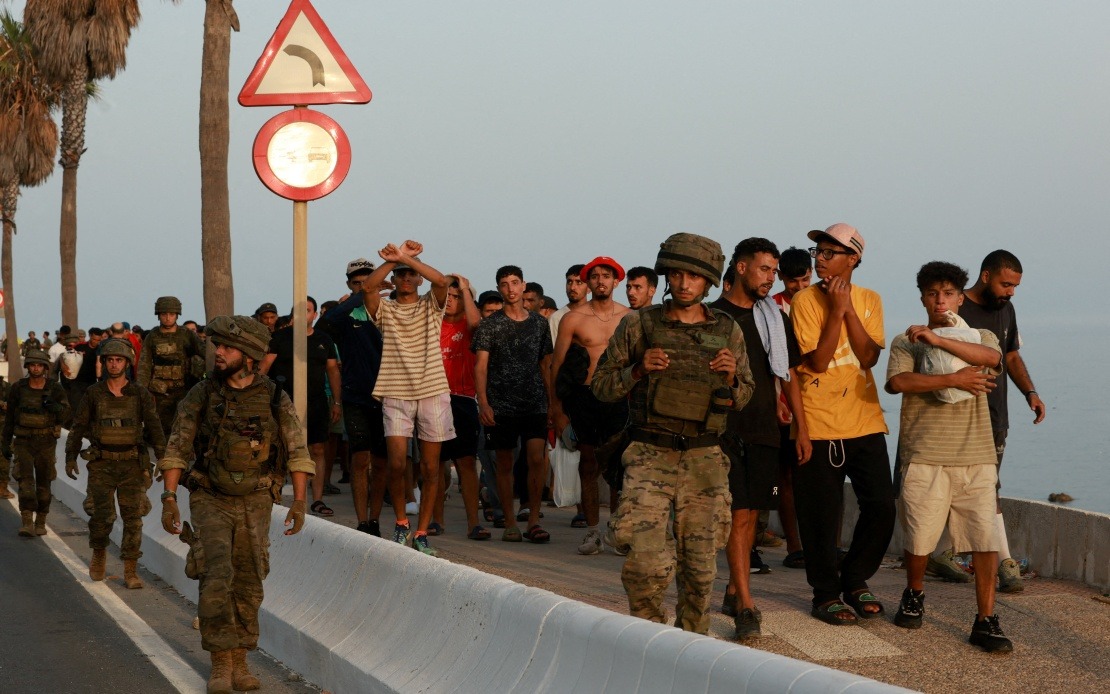
Morocco's Interior Ministry has attributed the unprecedented influx of migrants into the Spanish exclave of Ceuta to a combination of misleading social media posts and organised human trafficking operations, according to reports from the German Press Agency. The government's assessment points to how digital falsehoods and criminal networks can rapidly mobilise vulnerable populations seeking entry into Europe, creating humanitarian crises that stretch the borders of both Morocco and Spain.
The scale of the crossing has been staggering. Between 50,000 and 60,000 migrants are estimated to have entered Ceuta within just a few days, according to official Spanish figures, swamping a territory with a permanent population of approximately 85,000 residents. Morocco's own count places the number somewhat lower at around 40,000 individuals entering Ceuta, with an additional 1,135 attempting to reach Melilla, another Spanish enclave on the North African coast. The disparity in figures reflects the chaos of the situation and the difficulty in tracking individuals moving across water borders under cover of darkness.
According to Moroccan authorities, the misinformation circulating on social media platforms created false expectations among potential migrants about their ability to enter Europe without facing immediate deportation. This narrative appears to have been reinforced by what migrants interpreted as a Spanish court ruling permitting their entry, though the actual legal outcome was likely misunderstood or deliberately misrepresented by human smugglers seeking to drum up business. Such misinterpretations highlight how legal developments, when filtered through criminal networks and social media echo chambers, can be weaponised to encourage dangerous journeys across the Mediterranean and its straits.
The human cost of this migration event has been contested between the two governments, underscoring the tragedy of the situation. Morocco reported 11 deaths during the crossing attempts, while Spanish authorities documented at least 72 fatalities, a significant discrepancy that suggests either incomplete initial reporting from Moroccan sources or differing methodologies in counting deaths. The Moroccan Interior Ministry stated it was actively coordinating with Spanish counterparts to verify reports of additional deaths and to identify the nationality and identity of those who perished, a process that could take weeks or months given the scale of the movement.
For Malaysia and other Southeast Asian nations, this episode offers sobering lessons about the vulnerability of populations to human trafficking and misinformation campaigns. The mechanisms at play in the Morocco-Spain context—the exploitation of legal ambiguity, the amplification of false narratives through social media, and the targeting of desperate individuals by smuggling networks—mirror patterns seen in migrant flows within Asia, from Bangladesh to Myanmar, and across routes leading toward Thailand, Malaysia, and Indonesia. The sophistication of these operations and their ability to mobilise thousands demonstrates that trafficking is not merely a criminal enterprise but an information and communications operation.
The Ceuta crossing also reveals the fragility of border management in an age of rapid communication. When false information can reach thousands instantly, and when desperation meets opportunity, even heavily monitored borders can be overwhelmed. Spain's response to the influx, alongside Morocco's efforts to coordinate and control the situation, illustrates the challenge facing nations that sit at the intersection of major migration routes. Both countries lack unilateral solutions; the problem requires sustained cooperation, intelligence sharing, and efforts to counter misinformation at its source.
For regional policymakers in Southeast Asia, the Moroccan government's focus on attributing the crisis to external factors—misinformation and trafficking networks—rather than examining deeper causes such as economic desperation or political instability, may provide a cautionary example. While combating false narratives is important, a comprehensive response to migration requires understanding and addressing root causes in origin countries. The willingness of 40,000 to 60,000 people to risk their lives crossing water suggests conditions at home that social media posts alone cannot explain.
The immediate return of all migrants from Melilla reported by Morocco suggests that rapid response and coordination between authorities can contain the situation, though at the human cost of denying asylum access to those fleeing persecution. The ongoing coordination between Morocco and Spain to identify the dead and trace their backgrounds will become increasingly important as international scrutiny of the incident grows. Families across Africa and beyond will be seeking information about missing relatives, adding another dimension to what has become a regional crisis.
Looking forward, the Ceuta incident demonstrates that trafficking networks and misinformation operations operate as integrated systems, with false narratives serving as recruitment tools for smugglers. Countering this threat requires not only border security and law enforcement but also credible communication from authorities, media literacy initiatives, and addressing the fundamental drivers of desperation that make people willing to believe these narratives in the first place. For Malaysia and the region, investing in these preventive approaches may prove more effective than border walls alone.

