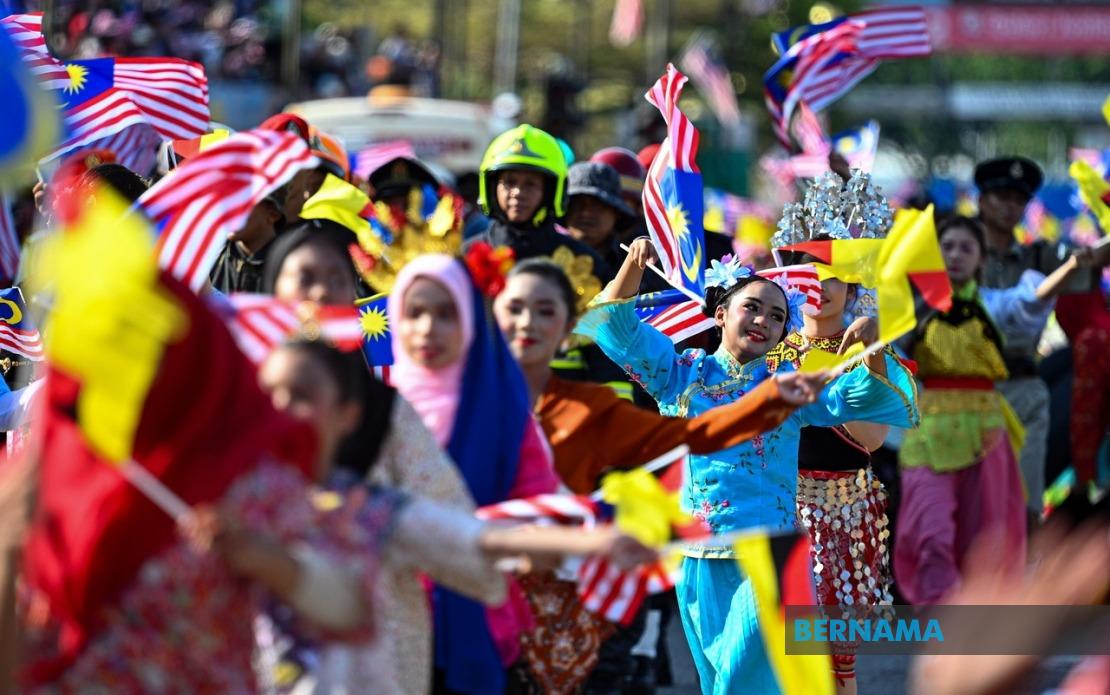
The Negeri Sembilan National Day celebration drew an impressive crowd exceeding 30,000 people across various ethnic and social backgrounds to Dataran Majlis Bandaraya Seremban, underscoring the continued resonance of Malaysia's independence message among the state's residents. The gathering demonstrated substantial public engagement with the nation's founding narrative, with attendees arriving in force from the early morning hours to secure viewing positions for the ceremonial parade and cultural performances.
Menteri Besar Datuk Ismail Lasim highlighted the crowd's composition as a meaningful indicator of grassroots patriotic sentiment, noting that many visitors had arrived before dawn to witness the proceedings. In conversations with attendees, the Menteri Besar encountered individuals who had made their way to the venue as early as 5.30 am, a testament to the personal significance residents attach to the occasion. Such willingness to commit time and effort to collective commemoration reflects broader public attitudes toward national identity and historical consciousness, particularly among families seeking to instil these values in younger generations.
Organisers opted to moderate the scale of this year's parade compared to previous iterations, a deliberate choice driven by health considerations rather than lack of public support. The decision to reduce the number of contingents and equipment on display was framed as a precautionary measure against potential haze-related discomfort, a persistent environmental challenge in Southeast Asia during certain periods of the year. Although atmospheric conditions proved favourable on the day itself, the planning decision reflected institutional awareness of climate vulnerabilities affecting outdoor public gatherings throughout the region.
The ceremonial dimension of the event received formal emphasis through the attendance of Tuanku Muhriz Tuanku Munawir, the Yang Dipertuan Besar of Negeri Sembilan, accompanied by Tunku Ampuan Besar Tuanku Aishah Rohani Tengku Besar Mahmud, who arrived shortly after 8.20 am. The royal presence lent constitutional weight and symbolic significance to the proceedings, positioning the celebration within the framework of formal state institutions and the constitutional monarchy that anchors Malaysia's political system.
Despite the moderation in scale, the parade retained substantial military and civic representation. A total of 82 distinct contingents mobilised over 4,000 active participants, encompassing federal and state government departments, regulatory authorities, district-level administrations, civil society organisations, educational institutions from primary through tertiary levels, and representatives from the private commercial sector. This breadth of institutional participation reflected the multi-stakeholder character of contemporary Malaysian civic life and the expectation that organisations across sectors contribute visibly to national commemoration.
The ceremonial guard structure drew personnel from the 15th Battalion Royal Malay Regiment stationed in Senawang, with Major Dr Muhammad Hazim Abdul Qhalib commanding a contingent comprising three commissioned officers and 103 other ranks. Supporting musical accompaniment came from a combined band drawing musicians from both the 24th Battalion Royal Malay Regiment and the Malaysian Army Basic Training Centre, performing traditional martial selections under the direction of Drum Major Warrant Officer 2 Azwan Zakaria. The musical programme featured pieces such as Sembah Tari and Seruan Tentera, compositions embedded within Malaysia's military cultural heritage.
A parade component featuring defence and security assets proved particularly engaging for spectators, with vehicles ranging from contemporary military equipment through to restored vintage automobiles and heritage bicycles. The inclusion of such diverse vehicular elements broadened appeal across age cohorts while reinforcing thematic connections between Malaysia's historical journey and contemporary security capabilities. Participation from the Malaysian Armed Forces, Royal Malaysia Police, Immigration Department, Fire and Rescue Department, Health Ministry, Malaysian Civil Defence Force, and municipal administration underscored the comprehensive institutional engagement with national commemorative occasions.
Family participation emerged as a dominant theme throughout the celebration, with parents deliberately structuring their attendance to create educational experiences for children. Siti Ruayiza Rebin, a 42-year-old homemaker, described a consistent family practice of attending National Day events across multiple years, deliberately cultivating historical awareness and appreciation for generational sacrifice among her three children aged 12 to 19. Her pedagogical approach reflected a deliberate strategy to embed national consciousness through repeated exposure and experiential engagement rather than abstract instruction.
Similarly, private sector worker Mohd Khairul Azmi brought his young children aged five and seven, specifically motivated by the opportunity to observe military assets and heritage vehicles rarely made accessible to civilian audiences. The family's decision to arrive at 6 am to secure advantageous viewing positions demonstrated the value placed on quality observation of the parade sequence. Khairul Azmi articulated the educational rationale underlying family attendance, emphasising the role such celebrations play in developing historical literacy and fostering appreciation for institutional contributions to national formation.
The celebration's significance extended beyond immediate ceremonial functions to encompass broader nation-building objectives centred on intergenerational knowledge transmission. Parents explicitly framed their attendance decisions in terms of exposing children to historical narratives and institutional structures that shaped the nation's independence, suggesting that National Day events function as informal educational venues where abstract concepts of sacrifice and nation acquire concrete, memorable form through visual and experiential engagement.
For Malaysia's broader population, particularly in Negeri Sembilan where multicultural composition is pronounced, such celebrations serve multiple simultaneous functions: they provide formal institutional recognition of national foundations, they create spaces for cross-community participation and shared civic identity, and they offer opportunities for families to cultivate patriotic consciousness through direct experience rather than mediated channels. The substantial turnout, coupled with evident enthusiasm across age groups and family structures, suggests that three decades after independence, Malaysia's National Day retains considerable cultural salience and continues to function as a meaningful occasion for public assembly and collective affirmation of national identity.

