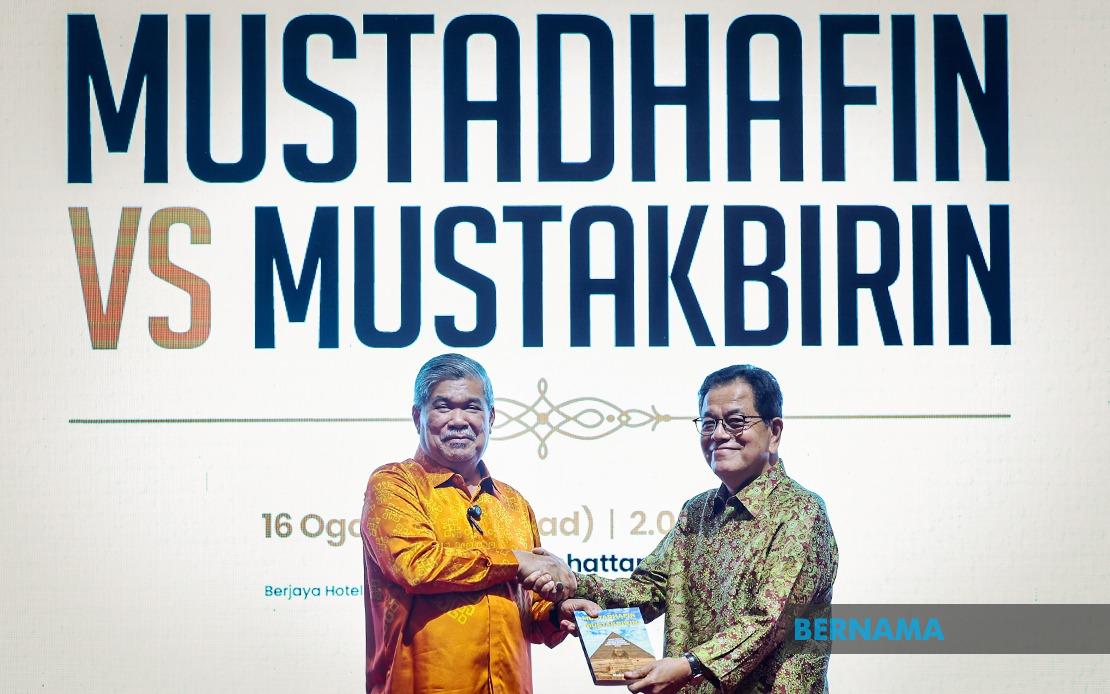
Datuk Seri Mohamad Sabu, president of Amanah and Malaysia's Agriculture and Food Security Minister, has issued a timely reminder to the public about the importance of critical thinking in an era of rapid information dissemination. Speaking at the launch of his book in Kuala Lumpur, Mohamad warned that accepting unverified claims without scrutiny could reinforce 'asabiyyah'—a psychological tendency where individuals defend their own group even when demonstrably wrong whilst simultaneously casting aspersion on the legitimate achievements of rival groups or individuals. This phenomenon, deeply rooted in human tribalism, has become increasingly pronounced in the Malaysian political landscape where partisan narratives frequently overshadow factual discourse.
The Amanah leader stressed that citizens bear a responsibility to interrogate information critically before forming opinions or endorsing political positions. Rather than passively consuming allegations circulated through conventional media channels or social platforms, Mohamad advocated for a measured approach that prioritizes verification and contextual understanding. This call for intellectual rigour extends beyond mere academic exercise; it addresses a fundamental challenge facing Malaysian democracy, where misinformation and unsubstantiated rumours can rapidly inflame communal tensions and undermine institutional credibility. The minister implicitly acknowledged the difficulty of maintaining such standards in contemporary information ecosystems, where sensational claims and emotional appeals travel far more efficiently than nuanced, evidence-based analysis.
Central to Mohamad's intervention was his direct challenge to enduring allegations regarding the Democratic Action Party's ideological orientation. Recurring claims have surfaced throughout Malaysian political discourse asserting that DAP functions as a communist organisation, and by extension, that any political coalition partner cooperating with DAP implicitly endorses communist ideology. Mohamad posed a straightforward question: whether such characterisations withstand factual scrutiny. This interrogation addresses not merely contemporary coalition politics but touches on deeper questions about how historical narratives have been weaponised within Malaysian political discourse. The communist spectre, invoked repeatedly since the party's formation in 1966, continues to influence public perception despite the absence of substantive evidence supporting such classifications in recent decades.
Mohamad observed a critical asymmetry in information dynamics that has profound implications for democratic deliberation. Accusations and suspicions, he noted, proliferate with remarkable ease—particularly through social media platforms where algorithmic amplification favours emotionally resonant content over factual accuracy. Conversely, factual information and substantive knowledge demand significantly greater cognitive investment from recipients; they require contextualisation, require audiences to confront complexity, and often demand that individuals revise previously held assumptions. This structural imbalance creates a systematic disadvantage for truth-telling in public discourse, a phenomenon Malaysian political analysts have increasingly documented as polarisation intensifies. Understanding this dynamic becomes essential for media consumers seeking to navigate the contemporary information environment responsibly.
The minister's personal intellectual trajectory, as reflected in his newly launched publication, underscores his commitment to empirical investigation over inherited assumptions. From his early years, Mohamad deliberately cultivated a practice of direct inquiry rather than accepting received wisdom or propagandistic narratives circulating within his immediate environment. This methodology has apparently informed his approach to understanding diverse stakeholders and political complications throughout his career in public service and party leadership. Such an approach—grounded in firsthand investigation and genuine dialogue rather than ideological presupposition—represents a methodology that transcends partisan affiliation and speaks to universal principles of intellectual integrity.
Mohamad's newly published work documents his accumulated experiences engaging with various political actors, community leaders, and international figures. Rather than presenting a conventional political memoir, the volume appears to synthesise his observations about Malaysian and global political dynamics whilst maintaining a commitment to understanding circumstances as they actually exist rather than through an ideological filter. The book reportedly addresses transformations in geopolitical power structures, historical questions including colonialism's legacies, contemporary religious movements, and the Israeli-Palestinian conflict—substantive topics that require precisely the kind of critical engagement and factual grounding that Mohamad advocates.
The book's launch by National Journalism Laureate Tan Sri Johan Jaaffar carries symbolic weight, positioning the publication within conversations about journalistic integrity and evidence-based discourse. As a figure whose career has embodied professional standards in Malaysian journalism, Jaaffar's involvement signals the event's seriousness as an intervention in public discourse rather than mere partisan promotion. The association with Star Media Group Berhad further anchors the event within Malaysia's mainstream media establishment, ensuring wider distribution and engagement with Mohamad's arguments about information consumption.
For Malaysian readers navigating an increasingly complex political landscape, Mohamad's intervention addresses practical concerns about how to evaluate competing claims in an election cycle anticipated within coming years. The proliferation of allegations concerning various political actors—spanning questions about funding, ideological commitments, and international allegiances—demands precisely the discriminating faculty that the Amanah president advocates. Without such critical capacity, voters risk becoming instruments through which partisan actors amplify divisive narratives, undermining the deliberative foundations upon which democratic choice depends.
The minister's emphasis on understanding global geopolitical contexts as essential to comprehending domestic politics reflects sophisticated awareness that Malaysian political developments cannot be analysed in isolation from broader international dynamics. Questions about international engagement, foreign policy orientation, and ideological alignment frequently feature in Malaysian political allegations; understanding these dimensions requires exactly the kind of systematic, evidence-based investigation that Mohamad promotes. His book apparently offers such contextualisation, attempting to equip readers with frameworks for understanding how global power shifts and historical patterns illuminate contemporary domestic complications.
Ultimately, Mohamad's message constitutes an appeal to Malaysian citizens to aspire toward higher standards of intellectual engagement with political claims and allegations. In an era when misinformation spreads instantaneously and emotional polarisation intensifies, the cultivation of critical thinking represents not merely an academic virtue but a prerequisite for preserving democratic institutions and social cohesion. By challenging citizens to verify facts, resist tribal instincts, and seek genuine understanding before taking political positions, the Amanah president advocates for a form of democratic citizenship that demands more from participants than passive consumption of partisan messaging. Whether Malaysian society proves capable of meeting such demands remains an open question with significant implications for the nation's political trajectory.

