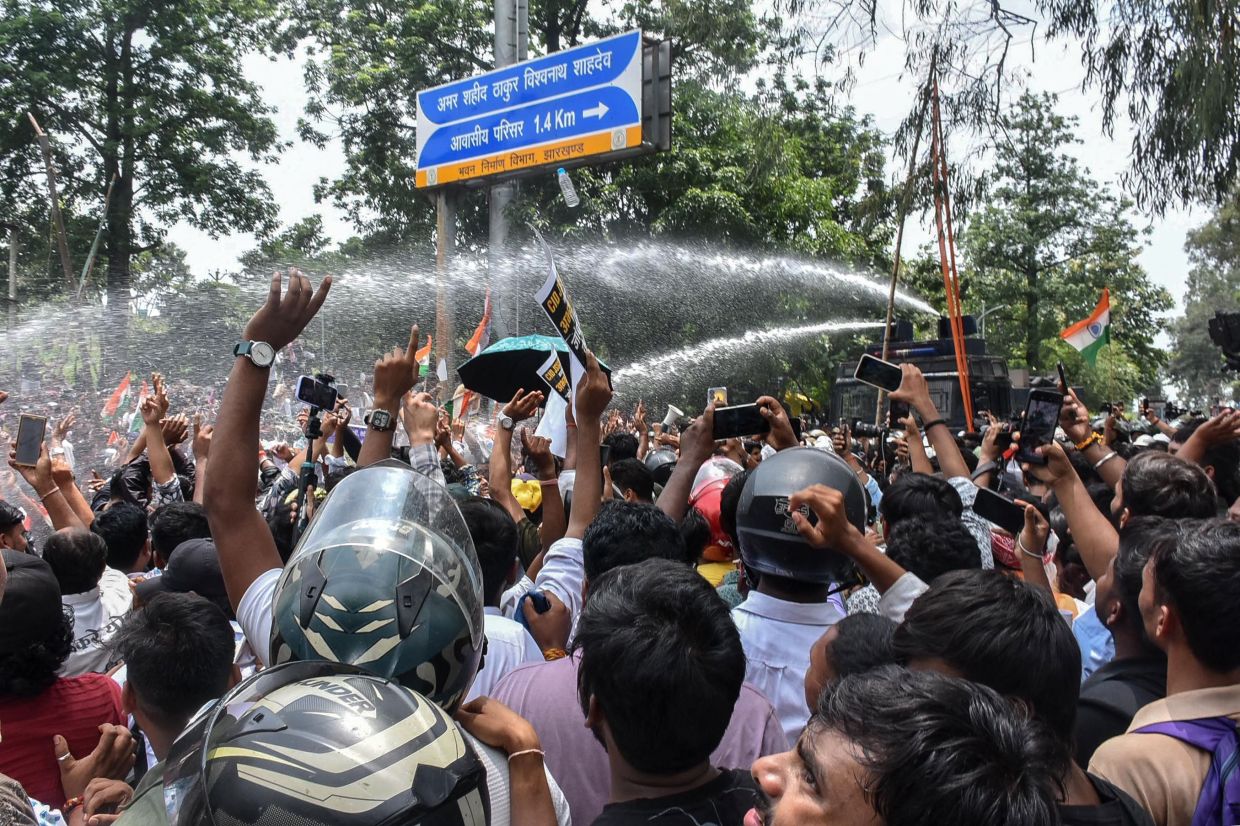
The Bharatiya Janata Party has launched a pointed attack on the activist organisation credited with orchestrating major student demonstrations in the Indian capital last month, alleging that the group's minimal engagement with parallel unrest in Jharkhand exposes contradictions in its stated mission. Spokesperson Keya Ghosh characterised the Cockroach Janta Party's posture towards the eastern state's recruitment examination protests as that of a passive observer, suggesting instead that the group's primary objective during the New Delhi agitation was to undermine Prime Minister Narendra Modi's administration rather than pursue substantive systemic change.
The Cockroach Janta Party emerged from satirical commentary before evolving into an organised pressure movement that galvanised thousands of students protesting irregularities in national competitive examinations. The group's campaign achieved a tangible political victory when Union Education Minister Dharmendra Pradhan resigned in response to mounting public pressure. However, the movement's decision to conclude demonstrations immediately following this ministerial departure has become a focal point for the BJP's criticism, particularly as unrelated but ideologically similar student agitations have gained momentum across Jharkhand's mining-dependent landscape.
Students throughout Jharkhand have mobilised independently to challenge what they characterise as systemic fraud within state-level recruitment procedures, demanding comprehensive federal investigation into the examination process. These demonstrations, which have swelled organically from local job seekers and aspirants, represent a distinct movement with origins preceding the national spotlight given to Cockroach Janta Party activism. Security forces have deployed water cannons and police batons against demonstrators, escalating physical confrontation between authorities and students—incidents that have attracted condemnation from multiple political quarters.
The Cockroach Janta Party founder Abhijeet Dipke has publicly objected to police responses in Jharkhand, characterising the deployment of force as cruel and indefensible regardless of geographic location. Through social media statements, Dipke positioned police conduct as a consistent pattern affecting students across multiple states, thereby connecting the two distinct protest movements through a common narrative of institutional violence. Some members who participated in New Delhi demonstrations have travelled to Jharkhand and integrated themselves into local protest structures, with national coordinator Akshay Shinde telling media outlets that the group remains committed to supporting student demands until tangible institutional reforms materialise.
The BJP's criticism carries particular weight given Jharkhand's complex political configuration. The state operates under coalition governance led by Jharkhand Mukti Morcha in partnership with the Indian National Congress, while the BJP functions as the primary opposition force within the state assembly. This arrangement positions the BJP as a challenger to the governing coalition rather than the authority responsible for recruitment examination administration or police operations. Ghosh's interrogation of Congress leader Rahul Gandhi's absence from protest sites operates within this framework, implying that the opposition party's restraint reflects reluctance to embarrass coalition partners governing Jharkhand.
Gandhi, who has notably avoided visiting either the New Delhi or Jharkhand protest sites despite public statements addressing both situations, has articulated a measured position emphasising students' democratic rights while advocating for dialogue-based resolution. His public messaging acknowledges police violence while eschewing personal engagement with demonstrators, a tactical approach that appears designed to navigate the political complexities of Jharkhand's coalition structure without deepening internal governmental tensions. This circumspect positioning contrasts sharply with the BJP's more aggressive framing of opposition party hypocrisy.
The broader context involves sustained anxiety within India's competitive examination ecosystem, where millions of aspirants compete for limited positions in government employment and educational advancement. Allegations of irregularities have periodically surfaced across multiple states and institutions, reflecting structural pressures within India's merit-based selection systems and public sector recruitment architecture. Jharkhand's mineral wealth and associated development expenditures create substantial job opportunities, making recruitment procedures particularly significant for regional economic mobility and youth employment prospects.
The Cockroach Janta Party's strategic evolution from satirical content creation to sustained political mobilisation represents a significant innovation in Indian protest activism, demonstrating how digital-native movements can translate online engagement into tangible policy consequences. The group's effectiveness in compelling ministerial resignation established its credibility within activist circles while simultaneously inviting scrutiny regarding its underlying motivations and organisational sustainability. The tension between the BJP's accusations and the group's stated commitment to student welfare mechanisms highlights enduring disputes about the nature of contemporary protest movements in India.
Police responses to student demonstrations, particularly involving water cannons and physical confrontation, have emerged as a recurrent point of contention across multiple political organisations and civil society actors. The use of such tactics against unarmed demonstrators generates international attention while inflaming domestic political discourse about democratic space and governmental accountability. Students' fundamental assertions regarding examination integrity and transparent recruitment procedures resonate across India's competitive examination landscape, suggesting that underlying grievances extend beyond localised administrative failures.
For Southeast Asian observers, India's protracted struggles with institutional credibility in competitive examinations and youth unemployment carry regional significance. As multiple countries across the region grapple with similar examination integrity challenges and youth employment crises, India's political responses and protest movements offer instructive case studies regarding governmental legitimacy and democratic participation mechanisms. The intersection of digital activism and institutional reform illuminates evolving patterns of political contestation that transcend national boundaries within the broader South and Southeast Asian context.

