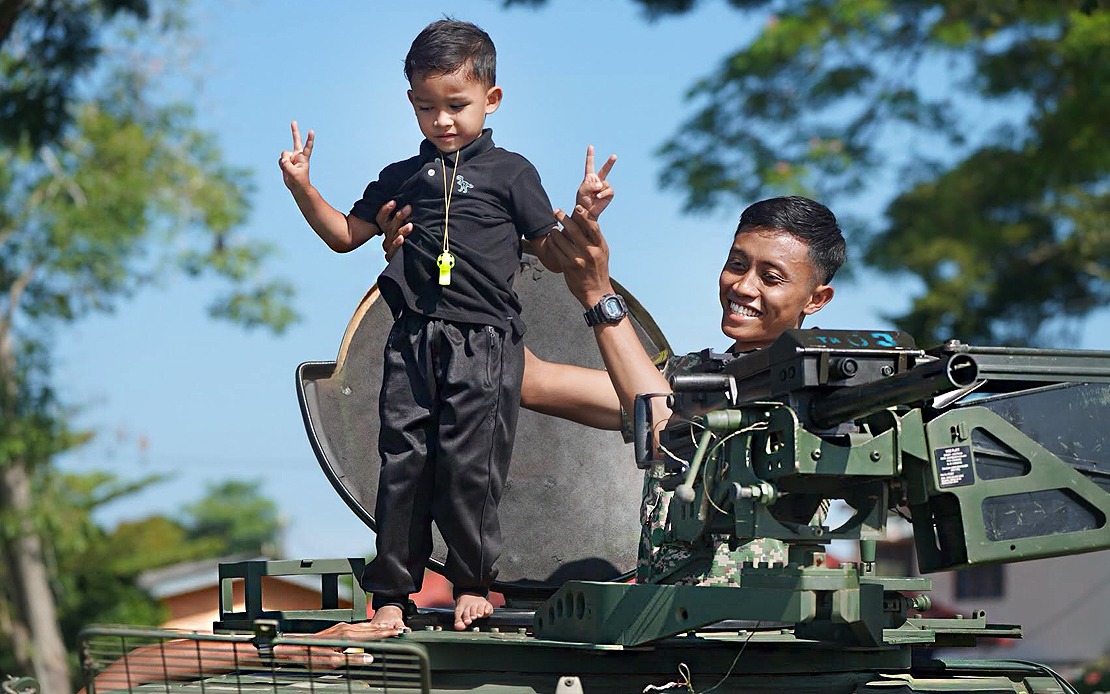
The Ministry of Defence has intensified its engagement with residents in the Alor Gajah district through a comprehensive initiative combining infrastructure development, social welfare, and direct community services. Held at Padang Awam Kampung Gadek, the 'Program Jiwa Murni MADANI' represents a systematic effort by the defence establishment to position itself as a stakeholder in local community development rather than merely a security provider. This approach signals a broader shift within Malaysia's military and defence apparatus towards embedding civil-military cooperation in everyday community interactions, a principle increasingly seen across Southeast Asian armed forces seeking legitimacy through social contribution.
The day-long event demonstrated the breadth of services the defence sector can mobilise. Free medical screenings addressed immediate health concerns facing rural communities, while career exhibitions and entrepreneurship workshops targeted economic mobility for younger residents. The inclusion of RAHMAH Sales—referring to the government's subsidised goods initiative—alongside mobile government service counters reflected an understanding that citizens often face logistical barriers in accessing basic services. For Alor Gajah residents, particularly those in outlying villages, such integrated service delivery reduces the friction typically associated with bureaucratic engagement.
The infrastructure dimension of the programme carried particular significance. The 9th Squadron of the Royal Engineers Regiment channelled RM179,200 into five distinct projects addressing community facilities across multiple neighbourhoods. Repairs to the Multi-Purpose Hall playground in Kampung Baru and the futsal court in Taman Seri Kelemak directly enhanced recreational spaces for younger residents, while restoration work on the Tamil vernacular school's perimeter fence and the madrasah roof repairs demonstrated responsiveness to needs across different ethnic and religious communities. This deliberate inclusivity suggests MINDEF's recognition that civil-military cooperation gains traction when defence investments visibly benefit diverse population segments.
Deputy Defence Minister Adly Zahari's presentation of RM133,000 in grants to eight recipients illustrated how the defence establishment channels resources through community institutions rather than imposing top-down solutions. The recipients—a mix of suraus, temples, and educational facilities—represent the organisational backbone of local civil society. By strengthening these institutions, MINDEF effectively invests in community resilience and self-governance capacity. For Malaysian observers, this model parallels successful international examples where military institutions support civil infrastructure as part of broader stabilisation strategies.
The distribution of 500 RAHMAH baskets to Malaysian Armed Forces veterans and local residents carried symbolic weight beyond the immediate material benefit. Veterans, who often face social integration challenges post-service, received recognition alongside civilian communities, suggesting an attempt to dissolve artificial boundaries between military and civilian populations. This integration becomes increasingly important as Malaysia's defence workforce evolves and veterans seek reintegration into civilian employment and social networks.
Complementing the welfare programme, the Religious Corps of the Malaysian Armed Forces organised the 'Program Ilmu dan Muafakat MADANI' at Masjid Kelemak, combining spiritual observance with community engagement. The layering of religious practice—congregational prayers followed by lectures and charitable contributions—reflected a sophisticated understanding that community trust builds through alignment with existing cultural and spiritual frameworks. For Muslim-majority Malaysia, this approach of embedding defence-led initiatives within Islamic practice structures carries particular resonance and cultural legitimacy.
The coordination between PIKAT and PJM programmes indicates institutional maturity in MINDEF's approach. Rather than fragmented, ad-hoc initiatives, the defence ministry has constructed an integrated framework linking spirituality, material welfare, and community involvement. This integration aligns with international best practices in civil-military cooperation, where sustained engagement proves more effective than episodic interventions. For Malaysian communities, such consistency signals genuine commitment rather than performative outreach.
These initiatives explicitly anchor themselves to the National Defence Strategic Plan 2026-2030, specifically Core 4 objectives. This strategic alignment suggests these are not peripheral programmes but central to how Malaysia's defence establishment conceptualises its role in an increasingly complex security environment. As traditional state-level threats evolve, defence ministries worldwide have expanded mandates to address social cohesion, economic development, and institutional strengthening. Malaysia appears to be positioning its defence sector along this trajectory.
For Alor Gajah residents, the immediate benefits include improved facilities, enhanced health services, and strengthened community institutions. But the broader implication concerns how security sector institutions relate to civilian populations. By investing in tangible community goods and engaging through trusted local organisations, MINDEF builds the social capital and trust necessary for more sensitive defence-related cooperation—whether civil protection planning, disaster response coordination, or broader national security initiatives.
The Alor Gajah programme also carries relevance for Malaysia's regional position. As Southeast Asian nations grapple with transnational challenges ranging from climate-induced displacement to non-traditional security threats, models demonstrating defence sector engagement in community resilience become increasingly valuable. Alor Gajah represents a template that neighbouring countries—facing similar pressures to bridge civil-military divides—may seek to emulate or adapt.
Looking forward, the sustainability of such programmes depends on consistent resource allocation and institutional commitment beyond leadership changes. The RM179,200 investment in Alor Gajah, while meaningful at the district level, requires multiplication across Malaysia's numerous communities to achieve transformative impact. MINDEF's challenge lies in scaling these initiatives while maintaining the authenticity and responsiveness that make localised programmes effective.
Ultimately, the Alor Gajah initiative reflects a recognition that modern defence extends beyond hardware and traditional military capabilities. By positioning Malaysia's armed forces as contributors to community welfare and institutional development, MINDEF attempts to cultivate the civilian support and social cohesion increasingly recognised as essential to national security. Whether this approach sustainably shifts perceptions of the defence establishment's role in Malaysian society will depend on programme consistency and genuine responsiveness to community needs over sustained periods.

