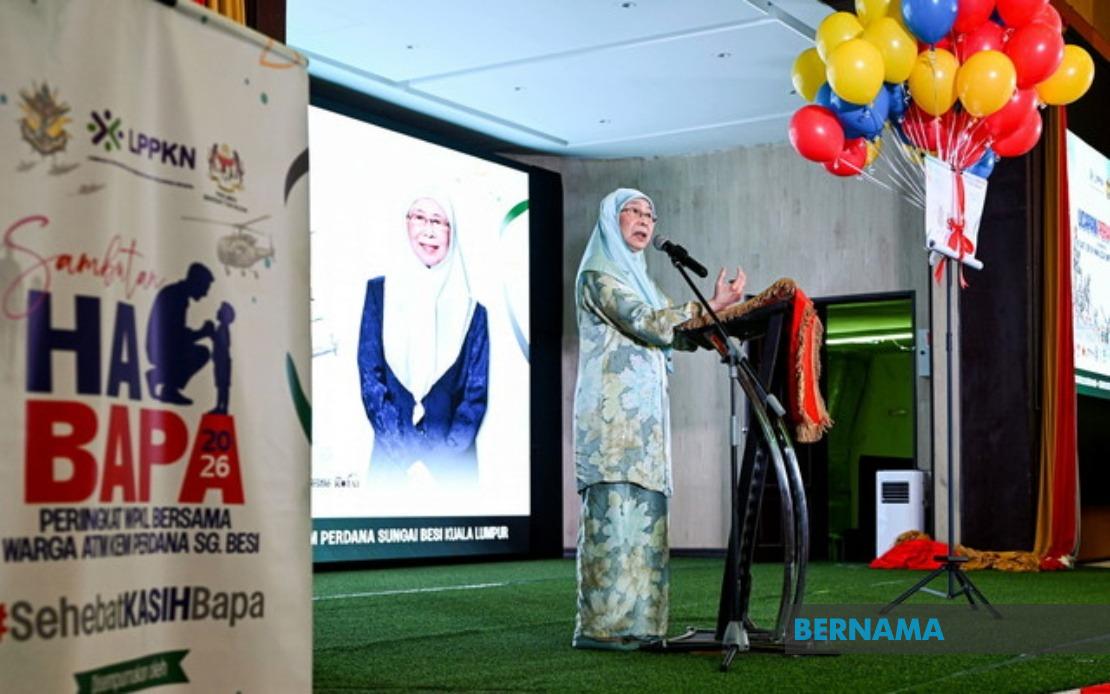
The issue of supporting fathers within Malaysia's military establishment extends beyond symbolic recognition, according to Datuk Seri Dr Wan Azizah Wan Ismail, who underscored the necessity of comprehensive empowerment measures for service personnel juggling their duty to the nation with their obligations at home. Speaking at the 2026 Federal Territory of Kuala Lumpur Father's Day Celebration, the Bandar Tun Razak Member of Parliament highlighted how the demands placed on military families—particularly the extended periods of separation inherent to defence operations—warrant deliberate policy interventions and systemic support structures.
Dr Wan Azizah's remarks signal a broader recognition within government circles of the particular vulnerabilities faced by military households. The nature of armed forces work, which frequently demands extended deployments and rotations away from civilian centres, creates compounded challenges that civilian fathers typically do not encounter. When a serving soldier, sailor, or airman is stationed remotely or deployed internationally, the responsibilities of fatherhood do not pause; rather, they shift onto spouses and extended family networks, straining household dynamics and parental involvement. This institutional reality has prompted policymakers to examine whether existing support mechanisms adequately address these distinct pressures.
Among the government's responses to this challenge is the National Family Compassion Policy (DKKN), which Dr Wan Azizah positioned as a critical instrument for enabling military fathers to manage their dual roles. The policy's design contemplates the real-world friction between military obligation and family responsibility, offering practical avenues through which servicemen can maintain meaningful engagement with their children and spouses despite operational constraints. Such measures represent a shift from purely economic support—housing allowances, medical benefits—toward more holistic family wellbeing frameworks that acknowledge the emotional and developmental dimensions of parenting.
The Bandar Tun Razak MP further connected father-focused initiatives to the health of Malaysia's family institution itself, suggesting that investing in male parental engagement serves structural purposes beyond individual household benefit. Her argument rests on the premise that fathers constitute foundational pillars within family hierarchies, and that their empowerment ripples outward to strengthen extended kinship networks and, by extension, community cohesion. This framing positions paternal support not as a welfare matter but as a social infrastructure concern with implications for national stability and social capital accumulation.
To operationalise this vision, the National Population and Family Development Board (LPPKN) has developed targeted initiatives including the Fatherhood Module, which equips military and civilian fathers alike with contemporary parenting methodologies and communication techniques. The module's curriculum reflects evolving understandings of effective parenting, moving beyond traditional hierarchical models toward engagement-based approaches that contemporary child development research suggests yield better psychological outcomes. Additionally, the Men Empowerment Network (MEN) provides peer support structures and professional guidance, acknowledging that fathers benefit from community and mentorship as much as from policy frameworks.
The 2026 Father's Day Celebration itself functioned as a demonstration project, bringing together approximately 500 participants encompassing military fathers, their spouses, children, and government representatives. The gathering, themed 'Sehebat KASIH Bapa'—roughly translating to honouring paternal love and commitment—served multiple functions simultaneously: it offered public recognition of military sacrifice, created networking opportunities for service families, and provided visibility for LPPKN's father-centred programming. Such ceremonial occasions, while symbolic, generate awareness among beneficiary populations and signal governmental priority to bureaucratic organs tasked with implementation.
For Malaysia's broader defence establishment, the emphasis on paternal empowerment reflects a modernised approach to personnel welfare that goes beyond traditional military hierarchies. The Malaysian Armed Forces, like defence organisations internationally, have begun recognising that soldier retention, mental health, and operational effectiveness correlate significantly with family stability. When service personnel lack confidence in their ability to maintain paternal bonds during deployments, or when spouses feel abandoned in managing household responsibilities, the resulting stress manifests in higher turnover, reduced morale, and potentially compromised readiness. Consequently, father-focused support becomes a force-multiplication issue, not merely a humanitarian one.
The regional context adds another layer of significance to these initiatives. Southeast Asian defence institutions, including those in neighbouring countries, have similarly grappled with military family welfare as recruitment and retention become increasingly competitive. Malaysia's emphasis on fatherhood support within the MAF potentially positions the service as an attractive employer within the region's labour market for skilled personnel. Young men considering military careers increasingly evaluate not only compensation packages but also family-friendly policies and psychological support structures. By advertising comprehensive father empowerment programmes, the MAF addresses this evolving calculus among potential recruits.
Dr Wan Azizah's intervention at the Father's Day event also reflects broader gender conversations within Malaysian society, where traditional masculine roles are being renegotiated. Her emphasis on fathers as active, engaged parents—rather than distant providers—aligns with contemporary parenting discourse that challenges outdated gender binaries. This repositioning of fatherhood within government discourse carries symbolic weight, signalling that active paternal involvement is not merely permissible within military culture but actively encouraged and institutionally supported. Such messaging can normalise deeper paternal engagement across society more broadly.
Looking forward, the sustainability of these initiatives depends on budget allocation and bureaucratic continuity. LPPKN's Fatherhood Module and Men Empowerment Network require ongoing funding, trainer development, and programme evolution to remain responsive to changing family dynamics and military operational realities. Additionally, measuring the effectiveness of father-focused interventions presents methodological challenges; outcomes such as improved family cohesion or enhanced paternal confidence resist easy quantification. Policymakers must therefore commit to rigorous programme evaluation alongside sustained resourcing to ensure these initiatives deliver genuine impact rather than remaining performative gestures toward military families.
The intersection of military service and fatherhood ultimately demands systemic attention because it involves competing loyalties that cannot be easily reconciled through individual effort alone. Dr Wan Azizah's advocacy for continued empowerment of military fathers acknowledges this structural reality and positions government support as indispensable to resolving the tension. As Malaysia's defence needs persist and the profession of arms continues demanding sacrifice, ensuring that those sacrifices do not exact unreasonable family costs becomes both a moral imperative and a practical necessity for institutional health.

